-
Use Cases
-
Resources
-
Pricing
The history of astronomy spans thousands of years, from ancient civilizations tracking celestial movements for calendars and navigation, through the revolutionary heliocentric model of Copernicus and Galileo's telescopic observations, to modern astrophysics and space-based observatories that continue to reveal the secrets of the cosmos. More Less
5000 BC
% complete
The site is one of hundreds of similar circular enclosures built in a region encompassing Austria, Germany, and the Czech Republic during a 200-year period starting shortly after 5000 BC.
Image source: Goseck Circle
3500 BC - 3000 BC
% complete
A form of writing known as cuneiform emerged among the Sumerians around 3500–3000 BC. This writing system later enabled the recording of astronomical observations in Mesopotamia.
Image source: Cuneiform
2300 BC
% complete
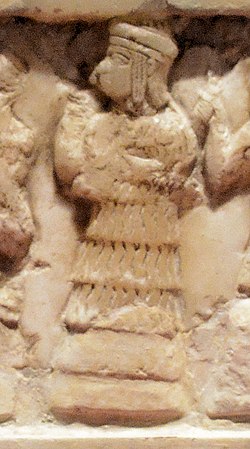
Mesopotamia is worldwide the place of the earliest known astronomer and poet by name: Enheduanna, Akkadian high priestess to the lunar deity Nanna/Sin and princess, daughter of Sargon the Great (c. 2334 – c. 2279 BCE).
Image source: Enheduanna
2000 BC - 1600 BC
% complete
The Nebra sky disc is a Bronze Age bronze disc buried on Mittenberg hill in Germany around 1600 BC. Investigations revealed that the object had been in use around 400 years before burial (2000 BC), but its use had been forgotten by the time of burial. Found by archaeological thieves in 1999 and recovered in Switzerland in 2002, it was soon recognized as one of the most important discoveries of the 20th century.
Image source: Nebra sky disc
1900 BC - 700 BC
% complete
A Bronze Age astronomical observatory was constructed at Kokino around 1900 BC and continuously served the nearby community until about 700 BC. The site, discovered in 2001, sits atop an extinct volcanic cone at an elevation of 1,013 metres in North Macedonia.
Image source: Kokino
1400 BC - 800 BC
% complete
Golden hats of Germany, France and Switzerland dating from 1400 to 800 BC are associated with the Bronze Age Urnfield culture.
Image source: Golden hat
1350 BC
% complete
The Vedanga Jyotisha is attributed to Lagadha and has an internal date of approximately 1350 BC, and describes rules for tracking the motions of the Sun and the Moon for the purposes of ritual.
1200 BC
% complete
Our knowledge of Sumerian astronomy is indirect, via the earliest Babylonian star catalogues dating from about 1200 BC.
Image source: Babylonian star catalogues
1000 BC
% complete
Early astronomical records date back to the Babylonians around 1000 BC. Centuries of Babylonian observations of celestial phenomena are recorded in the series of cuneiform tablets known as the Enūma Anu Enlil.
Image source: Babylonian astronomy
400 BC
% complete
The world's first star catalogue was made by Gan De, a Chinese astronomer, in the 4th century BC.
400 BC
% complete
The first geometrical, three-dimensional models to explain the apparent motion of the planets were developed in the 4th century BC by Eudoxus of Cnidus and Callippus of Cyzicus. This basic cosmological model prevailed, in various forms, until the 16th century.
300 BC
% complete
In the 3rd century BC Aristarchus of Samos was the first to suggest a heliocentric system, although only fragmentary descriptions of his idea survive.
Image source: Aristarchus of Samos
300 BC
% complete
In the 3rd century BC, astronomers began to use 'goal-year texts' to predict the motions of the planets.
200 BC
% complete
The first such model is attributed to Apollonius of Perga and further developments in it were carried out in the 2nd century BC by Hipparchus of Nicea.
Image source: Hipparchus
46 BC
% complete
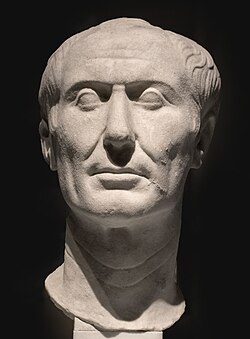
Julius Caesar instigated calendar reform in 46 BC and introduced what is now called the Julian calendar, based upon the 365+1/4 day year length originally proposed by the 4th century BC Greek astronomer Callippus.
Image source: Julian calendar
150
% complete
In his Planetary Hypotheses, Ptolemy ventured into the realm of cosmology, developing a physical model of his geometric system, in a universe many times smaller than the more realistic conception of Aristarchus of Samos four centuries earlier.
Image source: Ptolemy
2013
% complete
The Warren Field calendar in the Dee River valley of Scotland's Aberdeenshire was first excavated in 2004 but was revealed in 2013 as a find of huge significance. First discovered in 1991, its significance only became clear after results from archaeological digs became available in 2004.
Image source: Warren Field
500
% complete
In the 6th century Bishop Gregory of Tours noted that he had learned his astronomy from reading Martianus Capella, and went on to employ this rudimentary astronomy to describe a method by which monks could determine the time of prayer at night by watching the stars.
Image source: Gregory of Tours
600
% complete
By the sixth century, Indian astronomers believed that comets were celestial bodies that re-appeared periodically. This was the view expressed by the astronomers Varahamihira and Bhadrabahu. During this century, astronomy was influenced by the Greek and Byzantine astronomical traditions.
Image source: Varāhamihira
700
% complete
In the 7th century the English monk Bede of Jarrow published an influential text, On the Reckoning of Time, providing churchmen with the practical astronomical knowledge needed to compute the proper date of Easter using a procedure called the computus. It remained important to clergy education well after the rise of the Universities in the 12th century.
Image source: Bede
800
% complete
This led to the emergence of the first astronomical observatories in the Muslim world by the early 9th century. In the ninth century, Persian astrologer Albumasar was thought to be one of the greatest astrologers of that time, whose manuals profoundly influenced Muslim intellectual history and, through translations, that of western Europe and Byzantium.
Image source: Astronomy in the medieval Islamic world
900
% complete
In the late tenth century, a huge observatory was built near Tehran, Iran, by the astronomer Abu-Mahmud al-Khujandi who observed a series of meridian transits of the Sun, which allowed him to calculate the tilt of the Earth's axis relative to the Sun.
Image source: Abu-Mahmud Khujandi
1000
% complete
Building on an astronomical background circulating since the 9th century, in the 10th century European scholars such as Gerbert of Aurillac began to travel to Spain and Sicily to seek out learning which they had heard existed in the Arabic-speaking world. By the 12th century, scholars translated advanced astronomical texts into Latin from Arabic and Greek.
Image source: Pope Sylvester II
1006
% complete
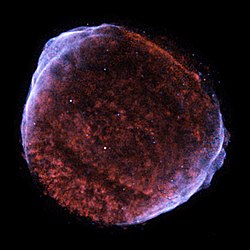
In 1006, Ali ibn Ridwan observed SN 1006, the brightest supernova in recorded history, and left a detailed description of the temporary star.
Image source: SN 1006
1054
% complete
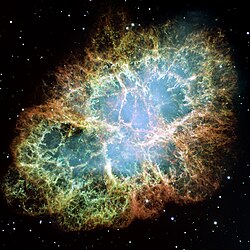
The supernova that created the Crab Nebula in 1054 is an example of a 'guest star' observed by Chinese astronomers, although it was not recorded by their European contemporaries. Detailed records of astronomical observations had been kept in China from about the 6th century BC.
Image source: Crab Nebula
1100
% complete
In 11th-century Persia, Omar Khayyám compiled many tables and performed a reformation of the calendar that was more accurate than the Julian and came close to the Gregorian.
Image source: Omar Khayyam
1100
% complete
Natural philosophy (particularly Aristotelian physics) was separated from astronomy by Ibn al-Haytham (Alhazen) in the 11th century, by Ibn al-Shatir in the 14th century, and Qushji in the 15th century.
Image source: Ibn al-Haytham
1300
% complete
In the 14th century, Nicole Oresme showed that neither scriptural texts nor physical arguments against the movement of the Earth were demonstrative, adducing the argument of simplicity for a moving Earth. However, he concluded that 'the heavens do move and not the earth.'
Image source: Nicole Oresme
1400
% complete
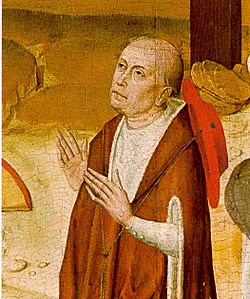
In the 15th century, Cardinal Nicholas of Cusa suggested in some of his scientific writings that the Earth revolved around the Sun, and that each star is itself a distant sun.
Image source: Nicholas of Cusa
1543
% complete
Polish astronomer Nicolaus Copernicus developed a heliocentric model depicting the planets orbiting the Sun. His De revolutionibus orbium coelestium was published in 1543, starting the Copernican Revolution.
Image source: De revolutionibus orbium coelestium
1572
% complete
Tycho Brahe came on the astronomical scene with the publication of De nova stella, disproving conventional wisdom on the supernova SN 1572 and thereby the Aristotelian doctrine of the immutability of the heavens. He also created the Tychonic system, where the Sun, Moon and stars revolve around the Earth, but the other five planets revolve around the Sun.
Image source: Tycho Brahe
1584
% complete
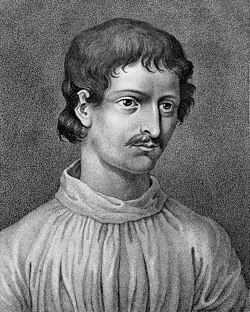
The first astronomer of the European Renaissance to suggest that the stars were distant suns was Giordano Bruno in his De l'infinito universo et mondi (1584). The idea became mainstream following Fontenelle's Conversations on the Plurality of Worlds (1686).
Image source: Giordano Bruno
1608
% complete
The invention of the telescope in 1608 revolutionized the study of astronomy and played a key part in the Copernican Revolution.
Image source: History of the telescope
1609
% complete
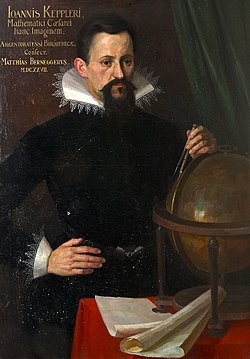
The first two of Kepler's laws of planetary motion were published in 1609. He completed the Rudolphine Tables in 1624, although they were not published for several years.
Image source: Johannes Kepler
1610
% complete
Galileo discovered the four largest moons of Jupiter in 1610, now collectively known as the Galilean moons in his honor.
Image source: Galilean moons
1633 - 1642
% complete
While Galileo was able to avoid punishment for a little while, he was eventually tried and pled guilty to heresy in 1633. His book was banned, and he was put under house arrest until he died in 1642.
Image source: Galileo affair
1659
% complete
At first, astronomical thought in America was based on Aristotelian philosophy, but interest in the new astronomy began to appear in Almanacs as early as 1659.
Image source: Great Debate (astronomy)
1667
% complete
The Italian astronomer Geminiano Montanari recorded observing variations in luminosity of the star Algol in 1667, an early observation of a variable star.
Image source: Geminiano Montanari
1738
% complete
Voltaire published a popular account in 1738, helping spread Newtonian ideas about astronomy and physics to a wider audience.
Image source: Voltaire
1748
% complete
In 1748, the French Academy of Sciences offered a reward for solving the question of the perturbations of Jupiter and Saturn, which was eventually done by Euler and Lagrange. Laplace completed the theory of the planets, publishing from 1798 to 1825.
Image source: Perturbation (astronomy)
1758
% complete
Edmond Halley succeeded John Flamsteed as Astronomer Royal in England and succeeded in predicting the return of the comet that bears his name in 1758.
Image source: Edmond Halley
1781
% complete
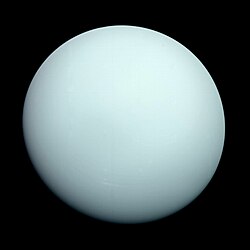
William Herschel found the first new planet, Uranus, to be observed in modern times in 1781.
Image source: Uranus
1801 - 1802
% complete
The gap between the planets Mars and Jupiter disclosed by the Titius–Bode law was filled by the discovery of the asteroids Ceres and Pallas in 1801 and 1802, with many more following.
Image source: Ceres (dwarf planet)
1827
% complete
The first solution to the problem of deriving an orbit of binary stars from telescope observations was made by Felix Savary in 1827. Observation of double stars gained increasing importance during the 19th century.
Image source: Binary star
1838
% complete
The first direct measurement of the distance to a star (61 Cygni at 11.4 light-years) was made in 1838 by Friedrich Bessel using the parallax technique. In 1834, Bessel had also observed changes in the proper motion of Sirius and inferred a hidden companion.
Image source: Friedrich Bessel
1847
% complete
In 1847, Maria Mitchell discovered a comet using a telescope, becoming a pioneering figure in American astronomy.
Image source: Maria Mitchell
1865
% complete
In 1865, Secchi began classifying stars into spectral types, laying groundwork for stellar spectroscopy. By the late 19th century thousands of photographic plates of images of planets, stars, and galaxies had been created.
Image source: Angelo Secchi
Aug 18, 1868
% complete
The first evidence of helium was observed on August 18, 1868, as a bright yellow spectral line with a wavelength of 587.49 nanometers in the spectrum of the chromosphere of the Sun.
Image source: Helium
1899
% complete
Edward Pickering discovered the first spectroscopic binary in 1899 when he observed the periodic splitting of the spectral lines of the star Mizar in a 104-day period.
Image source: Binary star
1906
% complete
In Potsdam in 1906, the Danish astronomer Ejnar Hertzsprung published the first plots of color versus luminosity for stars. In 1913, the Hertzsprung–Russell diagram was developed, propelling the astrophysical study of stars during a century of rapid advances.
Image source: Ejnar Hertzsprung
1920
% complete
The existence of the Milky Way, Earth's home galaxy, as a separate group of stars was only proven in the 20th century, as was the knowledge that other galaxies exist and that most of them are moving away from each other. The Sun was found to be part of a galaxy made up of more than 10 billion stars.
Image source: Milky Way
1925
% complete
Cecilia Payne-Gaposchkin first proposed that stars were made primarily of hydrogen and helium in her 1925 doctoral thesis, a foundational insight of stellar astrophysics.
Image source: Cecilia Payne-Gaposchkin
1943
% complete
A refined scheme for stellar classification was published in 1943 by William Wilson Morgan and Philip Childs Keenan, known as the MK classification system still used today.
Image source: Stellar classification
1965
% complete
Physical cosmology made huge advances during the 20th century, with the hot Big Bang model heavily supported by evidence such as redshifts of very distant galaxies and radio sources, the cosmic microwave background radiation, Hubble's law and cosmological abundances of elements.
Image source: Physical cosmology
Or browse the full history timeline directory, with more than 2,000 topics.
This History of Astronomy timeline was generated with the help of AI, using information found on the internet.
We work hard to keep these timelines accurate, but mistakes do get through. If you spot one, email us at [email protected] and we'll fix it for future visitors.
Generate yours with AI or build it from scratch, for free.
Export your timeline, add your own events, edit or remove AI-generated events, and much more
No credit card required.
Cancel anytime.
Cancel anytime.
You can create an unlimited number of timelines with up to 10 events on each one, customize how they look, export them to PDF, PNG, PowerPoint, CSV, and Excel, and share them with a link. Paid plans raise the event limit and add features like spreadsheet imports and collaborators.
Yes. You can cancel your subscription from your account page at any time, and you will not be charged again. Your subscription stays active for the rest of the period you already paid for.
Yes. We will email you a reminder before the annual renewal, and we will also email you a receipt.
Yes. You can email us within 15 days of any payment, and we will issue you a full refund.
Check out our pricing docs or send us an email anytime: [email protected].