-
Use Cases
-
Resources
-
Pricing
This timeline traces the history of Baghdad, the capital of Iraq, from its founding in 762 CE by the Abbasid Caliph al-Mansur. It covers Baghdad's rise as the center of the Islamic Golden Age and the House of Wisdom, its devastation by the Mongols in 1258, centuries of Ottoman control, its transformation under the British Mandate and the Iraqi monarchy, and its modern history through dictatorship, war, and reconstruction. More Less
762 - 767
% complete
According to 11th-century scholar Al-Khatib al-Baghdadi in his History of Baghdad, each course of the city wall consisted of 162,000 bricks for the first third of the wall's height.
762
% complete
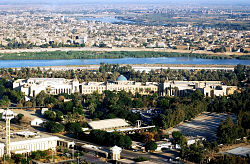
The city of Baghdad was established by the Abbasid dynasty as its capital in the 8th century, marking a new era in Islamic history after their defeat of the Umayyad Caliphate.
Image source: Baghdad
770 - 800
% complete
Baghdad replaced Seleucia-Ctesiphon, a Sasanian capital 35 km southeast of Baghdad, which was virtually abandoned by the end of the 8th century.
Image source: Seleucia
800 - 1000
% complete
Baghdad was the center of the Caliphate during the Islamic Golden Age of the 9th and 10th centuries, growing to be the largest city worldwide by the beginning of the 10th century.
Image source: Islamic Golden Age
808 - 819
% complete
Baghdad's early meteoric growth slowed due to troubles within the caliphate, including relocations of the capital to Samarra during 808–819.
Image source: Samarra
815 - 868
% complete
The ninth-century essayist, polymath, and polemicist al-Jahiz was among the celebrated literary figures who flourished in Abbasid Baghdad at the height of its cultural prominence.
Image source: Al-Jahiz
836 - 892
% complete
The Abbasid capital was again moved to Samarra from 836 to 892, depriving Baghdad of its role as the seat of the caliphate for over half a century before it was restored as the capital.
900 - 1000
% complete
By the 10th century, the city's population was between 300,000 and 500,000, making Baghdad one of the largest cities on Earth and a leading center of commerce and scholarship.
900 - 1100
% complete
It began to decline in the Iranian Intermezzo of the 9th to 11th centuries, a period marked by the fragmentation of Abbasid authority and the rise of Iranian dynasties.
Image source: Iranian Intermezzo
945 - 1055
% complete
Baghdad experienced periods of political domination by the Iranian Buwayhids from 945 to 1055, during which the Abbasid caliphs retained largely nominal authority under military governors.
Image source: Buyid dynasty
1055 - 1135
% complete
From 1055 to 1135, the Seljuk Turks dominated Baghdad politically, further diminishing the effective power of the Abbasid caliphs while the city remained an important cultural hub.
Image source: Seljuk Empire
Feb 10, 1258
% complete
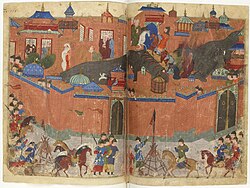
On February 10, 1258, after having remained one of the cultural and commercial hubs of the Islamic world, Baghdad was sacked by the Mongols under Hulagu Khan, destroying much of the city and ending Abbasid rule.
Image source: Siege of Baghdad (1258)
1400 - 1411
% complete
Following Timur's conquest, Baghdad became a provincial capital controlled by the Jalayirids from roughly 1400 to 1411.
Image source: Jalayirid Sultanate
1401
% complete
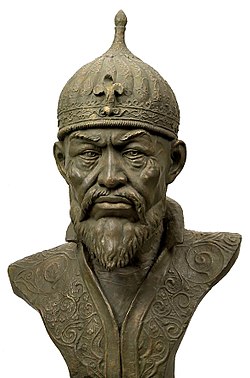
In 1401, Baghdad was again conquered, this time by Timur ('Tamerlane'), whose forces sacked the city once more, deepening its devastation; it subsequently fell under Turkic rule.
Image source: Timur
1411 - 1469
% complete
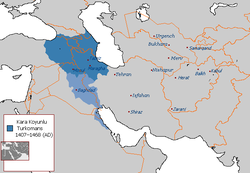
After the Jalayirids, Baghdad was controlled by the Turkoman Qara Qoyunlu confederation from 1411 to 1469, serving as a provincial capital of their realm.
Image source: Qara Qoyunlu
1430 - 1439
% complete
The Baghdad Citadel was built in the 1430s during the Qara Quyunlu period and would go on to survive until the 20th century.
1469 - 1508
% complete
From 1469 to 1508, Baghdad was governed by the Aq Quyunlu Turkoman confederation, continuing the pattern of Turkic domination over the city.
Image source: Aq Qoyunlu
1508 - 1523
% complete
Baghdad was briefly occupied by Safavid Persia in 1508, coming under the rule of Shah Ismail, marking the beginning of Persian control over the city.
Image source: Ismail I
1523 - 1529
% complete
Between 1523 and 1529, Baghdad was controlled by Dhul Fiqar Al Kurdi, a brief interlude between periods of Safavid rule.
1529 - 1534
% complete
Safavid Persia under Shah Tahmasp controlled Baghdad from 1529 until 1534, when Ottoman expansion finally reached the city.
Image source: Tahmasp I
1534
% complete
In 1534, Baghdad was conquered by the Ottoman Turks under the leadership of Suleiman the Magnificent, bringing the city into the Ottoman Empire.
Image source: Ottoman Iraq
1550 - 1600
% complete
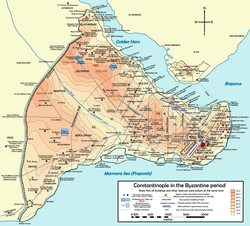
For a time, Baghdad had been the largest city in the Middle East before being overtaken by Constantinople in the 16th century.
Image source: Constantinople
1624 - 1638
% complete
Baghdad was captured by Shah Abbas I of the Safavids in 1624, restoring Persian control; the city had also been held by the Safavids under Shah Abbas earlier in the century (1624–1638).
Image source: Abbas the Great
1638
% complete
Baghdad was retaken by the Ottomans under Murad IV's command in 1638, during the Ottoman-Safavid War of 1623-1639, returning it permanently to Ottoman hands.
Image source: Murad IV
1750 - 1831
% complete
The city saw a relative revival in the latter part of the 18th century under the Mamluk dynasty, which governed Baghdad with considerable autonomy within the Ottoman Empire.
Image source: Mamluk dynasty of Iraq
1900
% complete
Around 1900, Baghdad's population stood at an estimated 145,000, a fraction of its medieval size but growing steadily as the modern era approached.
1907
% complete
The Nuttall Encyclopedia reports the 1907 population of Baghdad as 185,000, reflecting continued urban growth under late Ottoman rule.
Mar 11, 1917
% complete
Baghdad remained under Ottoman control until World War I, when on March 11, 1917 it was captured by British forces.
1920 - 1932
% complete
With the dissolution of the Ottoman Empire, Baghdad fell under the British Mandate in 1920, becoming the administrative center of Mandatory Iraq.
Image source: Mandatory Iraq
1932 - 1958
% complete
Iraq was given formal independence by the British in 1932, and Baghdad became the capital of the independent Kingdom of Iraq, gaining increased autonomy in 1946.
1950
% complete
The city's population grew from an estimated 145,000 in 1900 to 580,000 in 1950, reflecting rapid twentieth-century urbanization.
Jul 14, 1958
% complete
On July 14, 1958, the Iraqi king Faisal II was executed and the monarchy was dissolved after a revolution, forming a republic with Baghdad as its capital.
Image source: 14 July Revolution
1991
% complete
In 1991, the first Gulf War caused extensive damage to Baghdad's transportation, power, and sanitary infrastructure, degrading living conditions across the city.
Image source: Gulf War
Mar 2003 - Apr 2003
% complete
Baghdad was bombed heavily in March and April 2003 in the 2003 invasion of Iraq, and fell under US control by April 7–9.
Image source: 2003 invasion of Iraq
Sep 23, 2003
% complete
On September 23, 2003, a Gallup poll indicated that about two-thirds of Baghdad residents said that the removal of the Iraqi leader was worth the hardships they encountered and that they expected a better life in five years' time.
Image source: Gallup, Inc.
Dec 2003 - Feb 2004
% complete
The curfew imposed immediately after the invasion had been lifted in the winter of 2003, but the city that had once had a vibrant night life was still considered too dangerous after dark for many citizens.
Image source: Iraq War
Apr 2004
% complete
In April 2004, USA Today reported that a follow-up Gallup poll in Baghdad indicated that 'only 13 percent of the people now say the invasion of Iraq was morally justifiable.'
Jun 2004 - Sep 2004
% complete
In the summer of 2004, electricity was only available intermittently in most areas of the city, compounding hardships for residents after the invasion.
Jun 28, 2004
% complete
The Coalition Provisional Authority ceded power to the interim government at the end of June 2004 and dissolved itself, formally transferring sovereignty back to Iraqis.
Image source: Coalition Provisional Authority
Apr 10, 2007
% complete
On April 10, 2007, the United States military began construction of a 3-mile-long (4.8 km), 3.5-metre-tall (11 ft) wall around the Sunni district of Baghdad.
Jan 2021 - Jul 2021
% complete
In 2021, Islamic State of Iraq and the Levant suicide bombers killed 32 people in January and 35 people in July, underscoring ongoing security challenges for the Iraqi capital.
Image source: Islamic State
Or browse the full history timeline directory, with more than 2,000 topics.
This History of Baghdad timeline was generated with the help of AI, using information found on the internet.
We work hard to keep these timelines accurate, but mistakes do get through. If you spot one, email us at [email protected] and we'll fix it for future visitors.
Generate yours with AI or build it from scratch, for free.
Export your timeline, add your own events, edit or remove AI-generated events, and much more
No credit card required.
Cancel anytime.
Cancel anytime.
You can create an unlimited number of timelines with up to 10 events on each one, customize how they look, export them to PDF, PNG, PowerPoint, CSV, and Excel, and share them with a link. Paid plans raise the event limit and add features like spreadsheet imports and collaborators.
Yes. You can cancel your subscription from your account page at any time, and you will not be charged again. Your subscription stays active for the rest of the period you already paid for.
Yes. We will email you a reminder before the annual renewal, and we will also email you a receipt.
Yes. You can email us within 15 days of any payment, and we will issue you a full refund.
Check out our pricing docs or send us an email anytime: [email protected].