-
Use Cases
-
Resources
-
Pricing
Philadelphia, founded in 1682 by William Penn, played a central role in American history as the birthplace of the Declaration of Independence and the U.S. Constitution. It served as the nation's capital during the Revolutionary era and grew into a major industrial, cultural, and economic hub before evolving into the vibrant modern city it is today. More Less
1638
% complete
Swedish colonists established New Sweden along the Delaware River, building Fort Christina near present-day Wilmington. Their settlements in the region that would become Philadelphia represented some of the earliest European presence in the area.
Image source: New Sweden

Mar 4, 1681
% complete
King Charles II granted William Penn a charter for the Province of Pennsylvania as repayment for a debt owed to Penn's father. Penn envisioned the colony as a haven for Quakers and a place founded on religious tolerance and peaceful relations with Native Americans.
Image source: Pennsylvania
1682
% complete
William Penn famously entered into a treaty of friendship with the Lenape people under a great elm at Shackamaxon. Though no written record survives, Voltaire later celebrated it as 'the only treaty never sworn to and never broken.'
Image source: Treaty of Shackamaxon
Oct 27, 1682
% complete
William Penn founded Philadelphia between the Delaware and Schuylkill rivers, naming it from Greek words meaning 'brotherly love.' He designed it as a grid-planned city promoting religious tolerance, making it one of America's first planned cities.
Image source: Philadelphia
Nov 8, 1731
% complete
Benjamin Franklin and fellow members of his Junto club founded the Library Company, America's first successful subscription library. This self-improvement initiative allowed ordinary citizens access to books and became a model for libraries nationwide.
Image source: Library Company of Philadelphia
1736
% complete
Benjamin Franklin organized the Union Fire Company, one of the first volunteer firefighting organizations in colonial America. It inspired the creation of numerous volunteer fire companies that shaped Philadelphia's civic culture for generations.
Image source: Union Fire Company
1751
% complete
Franklin helped establish an academy that grew into the University of Pennsylvania, reflecting his belief in practical education. It became one of America's earliest institutions of higher learning and a cornerstone of Philadelphia's intellectual life.
Image source: University of Pennsylvania
May 11, 1751
% complete
Dr. Thomas Bond and Benjamin Franklin co-founded Pennsylvania Hospital, the first hospital in what would become the United States. It pioneered medical care for the mentally ill and served as a teaching center for American medicine.
Image source: Pennsylvania Hospital
1763
% complete
By the mid-eighteenth century, Philadelphia had grown into the largest city in British North America, surpassing Boston and New York. Its thriving port, diverse economy, and cultural institutions made it the leading urban center on the continent.
Image source: History of Philadelphia
Feb 25, 1791
% complete
Congress chartered the First Bank of the United States in Philadelphia following Alexander Hamilton's plan to stabilize the young nation's finances. The bank helped establish Philadelphia as the financial center of early America.
Image source: First Bank of the United States
Aug 1, 1793 - Nov 30, 1793
% complete
A catastrophic yellow fever outbreak killed roughly 5,000 people, about ten percent of the city's population, and drove thousands more to flee, including much of the federal government. Doctors Benjamin Rush and others struggled to treat victims while free Black residents played crucial roles in nursing the sick.
Image source: 1793 Philadelphia yellow fever epidemic
1795
% complete
The Philadelphia and Lancaster Turnpike opened as the first major paved road in the United States, connecting Philadelphia to the rich farmlands of Lancaster County. It set a precedent for private toll road companies across the country.
Image source: Philadelphia and Lancaster Turnpike
Aug 31, 1798
% complete
A daring theft of over $160,000 from the Bank of Pennsylvania at Carpenter's Hall shocked the young nation. Isaac Davis was eventually convicted for the crime, which remains one of the earliest documented bank robberies in American history.
Image source: Bank of Pennsylvania
1815
% complete
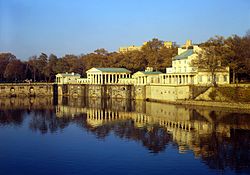
The Fairmount Water Works began pumping water from the Schuylkill River to city residents using innovative steam and water power. It became an engineering marvel admired worldwide and helped establish Philadelphia's reputation for public works innovation.
Image source: Fairmount Water Works
Feb 2, 1854
% complete
Pennsylvania passed the Act of Consolidation, merging the city of Philadelphia with surrounding districts and townships in Philadelphia County. This dramatically expanded the city's boundaries and population, creating the modern municipal structure.
Image source: Act of Consolidation, 1854
May 10, 1876 - Nov 10, 1876
% complete
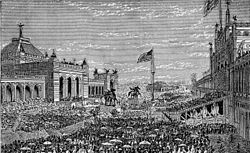
Philadelphia hosted the first official World's Fair in the United States, celebrating the nation's centennial. Nearly ten million visitors attended exhibits including the Corliss steam engine, Alexander Graham Bell's telephone, and Remington typographic machines, showcasing American industrial progress.
Image source: Centennial Exposition
1880
% complete
By the late nineteenth century, Philadelphia earned the nickname 'Workshop of the World,' with thousands of factories producing textiles, garments, machinery, and locomotives. Diverse small-scale manufacturing distinguished it from other industrial centers dominated by single industries.
Image source: Economy of Philadelphia
1900
% complete
The Baldwin Locomotive Works, headquartered in Philadelphia, became the world's largest manufacturer of steam locomotives. At its peak in the early twentieth century, it produced hundreds of locomotives annually and employed tens of thousands of workers.
Image source: Baldwin Locomotive Works
Sep 5, 1774 - Oct 26, 1774
% complete
Delegates from twelve colonies met in Philadelphia to coordinate a response to British punitive measures after the Boston Tea Party. The Congress organized a boycott of British goods and set the stage for unified colonial resistance.
Image source: First Continental Congress
Jul 4, 1776
% complete
Meeting at Independence Hall, the Second Continental Congress adopted the Declaration of Independence, primarily drafted by Thomas Jefferson. The document proclaimed the thirteen colonies independent from Britain and made Philadelphia the birthplace of the United States.
Image source: United States Declaration of Independence
Sep 26, 1777 - Jun 18, 1778
% complete
British forces under General Howe captured Philadelphia, then the American capital, after victories at Brandywine and Germantown. Washington's army encamped at nearby Valley Forge during the harsh winter before the British abandoned the city to concentrate forces around New York.
Image source: Philadelphia campaign
May 25, 1787 - Sep 17, 1787
% complete
Delegates from twelve states convened at Independence Hall to revise the Articles of Confederation but instead drafted an entirely new Constitution. George Washington presided over the convention, which produced the framework of the American federal government still in use today.
Image source: Constitutional Convention (United States)
Dec 6, 1790 - May 14, 1800
% complete
Philadelphia served as the temporary national capital for a decade while Washington, D.C., was being built. During this period, Congress met at Congress Hall and President Washington occupied a house on Market Street, overseeing the early operations of the federal government.
Image source: List of capitals in the United States
Oct 24, 1979
% complete
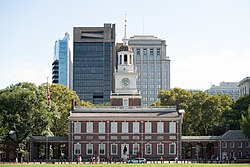
Independence Hall was inscribed as a UNESCO World Heritage Site, recognizing its extraordinary significance as the birthplace of both the Declaration of Independence and the U.S. Constitution. It joined an elite group of globally treasured historic landmarks.
Image source: Independence Hall
Apr 26, 1901
% complete
Connie Mack founded the Philadelphia Athletics as a founding franchise of the new American League. The team won multiple World Series championships and became a beloved institution until its controversial relocation to Kansas City in 1955.
Image source: Philadelphia Athletics
Sep 28, 1918 - 1919
% complete
After hosting a Liberty Loan parade attended by 200,000 people, Philadelphia became the American city hardest hit by the influenza pandemic. Over 12,000 Philadelphians died within weeks, with bodies piling up faster than they could be buried, making it the worst-hit city in the nation.
Image source: Spanish flu
Jul 1, 1926
% complete
The Benjamin Franklin Bridge opened to connect Philadelphia with Camden, New Jersey, across the Delaware River. At the time of its completion, it was the longest suspension bridge in the world and transformed regional transportation patterns.
Image source: Benjamin Franklin Bridge
1928
% complete
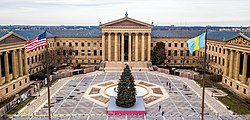
The neoclassical main building of the Philadelphia Museum of Art opened atop Fairmount, crowned by its famous 'Rocky Steps.' The museum houses one of the most significant art collections in the United States and became an iconic symbol of the city.
Image source: Philadelphia Museum of Art
Jul 8, 1933
% complete
Bert Bell and Lud Wray purchased the bankrupt Frankford Yellow Jackets franchise rights and founded the Philadelphia Eagles as part of the NFL. The team has since become deeply woven into the city's identity, winning multiple Super Bowl championships.
Jun 27, 1936
% complete
President Franklin D. Roosevelt accepted renomination at Franklin Field during the Democratic National Convention in Philadelphia, delivering his famous 'economic royalists' speech defending the New Deal to a massive crowd.
Image source: 1936 Democratic National Convention
Or browse the full history timeline directory, with more than 2,000 topics.
This History of Philadelphia timeline was generated with the help of AI, using information found on the internet.
We work hard to keep these timelines accurate, but mistakes do get through. If you spot one, email us at [email protected] and we'll fix it for future visitors.
Generate yours with AI or build it from scratch, for free.
Export your timeline, add your own events, edit or remove AI-generated events, and much more
No credit card required.
Cancel anytime.
Cancel anytime.
You can create an unlimited number of timelines with up to 10 events on each one, customize how they look, export them to PDF, PNG, PowerPoint, CSV, and Excel, and share them with a link. Paid plans raise the event limit and add features like spreadsheet imports and collaborators.
Yes. You can cancel your subscription from your account page at any time, and you will not be charged again. Your subscription stays active for the rest of the period you already paid for.
Yes. We will email you a reminder before the annual renewal, and we will also email you a receipt.
Yes. You can email us within 15 days of any payment, and we will issue you a full refund.
Check out our pricing docs or send us an email anytime: [email protected].