-
Use Cases
-
Resources
-
Pricing
Beijing, one of the world's oldest cities, has served as China's political and cultural center for centuries. From its origins as the ancient city of Ji over 3,000 years ago, through its rise as the capital of the Yuan, Ming, and Qing dynasties, to its role as the capital of the People's Republic of China, Beijing's history reflects the grandeur and transformation of Chinese civilization itself. More Less
1045 BC
% complete
The ancient city of Ji, located near present-day Beijing, was established as the capital of the state of Yan during the Zhou dynasty. It became one of the earliest urban settlements in the region and laid the foundation for the later development of Beijing.
700 BC - 222 BC
% complete
Ji served as the capital of the powerful state of Yan throughout the Spring and Autumn and Warring States periods, growing into a major political and commercial center in northern China before Yan's conquest by Qin.
Image source: Yan (state)
221 BC
% complete
Following the unification of China under the Qin dynasty, the area around Ji was incorporated into the empire as a commandery. The city declined in importance but remained a regional administrative center under successive dynasties.
Image source: Qin (state)
581 - 907
% complete
During the Sui and Tang dynasties, the city, known as Youzhou, served as a key military garrison guarding China's northeastern frontier. It was a staging ground for campaigns against Korea and a hub of trade with nomadic peoples.
Image source: Youzhou (ancient China)
Dec 16, 755 - Feb 17, 763
% complete
An Lushan, the military governor based at Youzhou (present-day Beijing), launched a massive rebellion against the Tang dynasty. The devastating revolt severely weakened the Tang empire and marked a turning point in Chinese history.
Image source: An Lushan rebellion
938
% complete
The Khitan-led Liao dynasty captured the city and made it one of its secondary capitals, known as Nanjing or 'Southern Capital'. This marked the beginning of the city's role as an imperial capital.
Image source: Liao dynasty
1153 - 1215
% complete
The Jurchen Jin dynasty destroyed the Liao city and built a new capital nearby called Zhongdu, or 'Central Capital'. It grew into a large, prosperous metropolis with palaces, gardens, and a population approaching a million.
Image source: Zhongdu
1215
% complete
Genghis Khan's Mongol forces besieged and captured Zhongdu, burning much of the city. The destruction paved the way for the construction of a new Mongol capital on the site.
Image source: Sieges of Zhongdu
1267 - 1276
% complete
Kublai Khan commissioned the construction of a new capital, Dadu (also known as Khanbaliq), just northeast of the old Jin city. Designed with a grid plan, it became the grand capital of the Yuan dynasty and impressed visitors like Marco Polo.
Image source: Khanbaliq
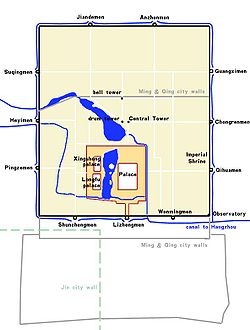
1272 - 1368
% complete
Dadu served as the political center of the Mongol Yuan dynasty for nearly a century. It was the terminus of the Grand Canal and flourished as one of the largest and most cosmopolitan cities in the world.
Image source: Yuan dynasty
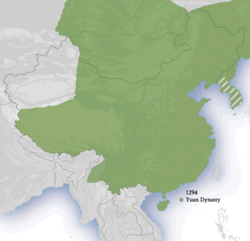
1368
% complete
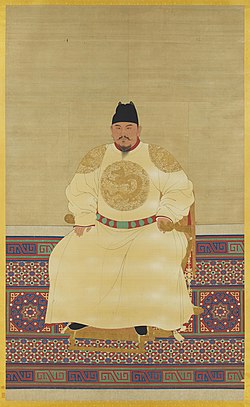
Ming armies under Zhu Yuanzhang drove the Mongols out of China and captured Dadu, renaming it Beiping ('Northern Peace'). The Yuan court fled north, ending Mongol rule over the city.
Image source: Hongwu Emperor
1420
% complete
After years of construction employing hundreds of thousands of workers, the Forbidden City was completed. It served as the imperial palace for Ming and Qing emperors for nearly five centuries and remains the world's largest palace complex.
Image source: Forbidden City
1420
% complete
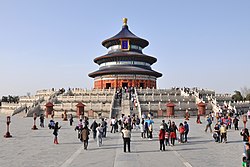
Built concurrently with the Forbidden City, the Temple of Heaven was where emperors performed annual rites to pray for good harvests. Its distinctive circular architecture made it one of Beijing's most iconic landmarks.
Image source: Temple of Heaven
1421
% complete
The Yongle Emperor relocated the Ming capital from Nanjing to Beijing, transforming it into a magnificent imperial city. He rebuilt the palace complex and expanded the city, establishing its enduring layout.
Image source: Yongle Emperor
1550
% complete
Mongol forces under Altan Khan breached the Great Wall and raided the outskirts of Beijing, demonstrating the vulnerability of the Ming capital and prompting renewed fortification efforts.
Image source: Altan Khan
Apr 25, 1644
% complete
Rebel leader Li Zicheng stormed Beijing, and the last Ming emperor, Chongzhen, hanged himself on Coal Hill. Li occupied the city briefly before being driven out by Manchu forces allied with Ming general Wu Sangui.
Image source: Li Zicheng
Jun 5, 1644
% complete
The Manchu armies entered Beijing and proclaimed the young Shunzhi Emperor ruler of China, beginning nearly three centuries of Qing rule with Beijing as the imperial capital.
Image source: Shunzhi Emperor
1750 - 1764
% complete
The Qianlong Emperor expanded Kunming Lake and built the vast Summer Palace northwest of Beijing. With its pavilions, temples, and gardens, it became the favored retreat of the imperial court.
Image source: Summer Palace
1793
% complete
British envoy Lord Macartney traveled to Beijing seeking trade concessions. The mission famously failed after disputes over ritual kowtow etiquette, symbolizing the widening gap between Qing China and expanding European powers.
Image source: Macartney Embassy
Oct 1860 - Nov 1860
% complete
Anglo-French forces captured Beijing during the Second Opium War, looting and burning the Old Summer Palace (Yuanmingyuan) in retaliation. The humiliation forced the Qing to sign the Convention of Peking.
Image source: Second Opium War
Jun 20, 1900 - Aug 14, 1900
% complete
Boxer fighters and Qing troops besieged foreign legations in Beijing for 55 days. An Eight-Nation Alliance eventually relieved the siege and occupied the city, imposing harsh penalties on China through the Boxer Protocol.
Image source: Siege of the International Legations
Feb 12, 1912
% complete
The abdication of the child emperor Puyi ended over two millennia of imperial rule. Beijing remained the capital of the new Republic of China, now governed by warlords and republican politicians.
Image source: 1911 Revolution
May 4, 1919
% complete
Thousands of students marched in Beijing protesting the Treaty of Versailles' transfer of German concessions in Shandong to Japan. The movement sparked a cultural and intellectual awakening that shaped modern Chinese politics.
Image source: May Fourth Movement
1928
% complete
After the Northern Expedition unified much of China, the Kuomintang government designated Nanjing as the national capital, and Beijing was renamed Beiping, reducing its political status.
Image source: Nanjing decade
Jul 7, 1937
% complete
Clashes between Japanese and Chinese troops near Beijing's Marco Polo Bridge escalated into full-scale war. Japanese forces quickly occupied Beiping, which remained under occupation until 1945.
Image source: Marco Polo Bridge Incident
Jan 31, 1949
% complete
Following the Pingjin Campaign, Nationalist general Fu Zuoyi surrendered the city without a battle, allowing Communist forces to enter intact. The city was renamed Beijing shortly afterward.
Image source: Pingjin campaign
Oct 1, 1949
% complete
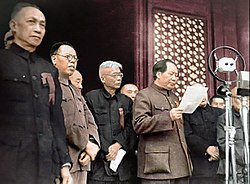
Mao Zedong stood atop Tiananmen Gate and proclaimed the founding of the People's Republic of China, restoring Beijing's status as the national capital after decades of upheaval.
Image source: Proclamation of the People's Republic of China
1958 - 1962
% complete
Mao's ambitious economic campaign caused nationwide famine. Even in Beijing, food shortages led to rationing, while backyard steel furnaces dotted the cityscape during the ill-fated industrial drive.
Image source: Great Leap Forward
Aug 18, 1966 - 1976
% complete
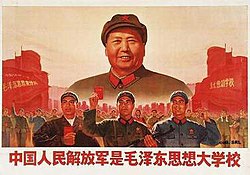
Massive Red Guard rallies in Tiananmen Square marked the start of the Cultural Revolution. Beijing became the epicenter of political turmoil as historic sites were vandalized and intellectuals persecuted.
Image source: Cultural Revolution
Apr 15, 1989 - Jun 4, 1989
% complete
Students and workers occupied Tiananmen Square for weeks calling for democratic reform. On June 4, the government declared martial law and sent troops to clear the square, resulting in numerous deaths and international condemnation.
Image source: 1989 Tiananmen Square protests and massacre
Aug 8, 2008 - Aug 24, 2008
% complete
Beijing hosted the Summer Olympics, showcasing iconic venues like the Bird's Nest stadium and Water Cube. The games marked China's emergence as a global power and transformed the city's infrastructure and skyline.
Image source: 2008 Summer Olympics
Feb 4, 2022 - Feb 20, 2022
% complete
Beijing became the first city ever to host both the Summer and Winter Olympic Games. Held amid strict COVID-19 protocols, the games featured venues across Beijing and neighboring Hebei province.
Image source: 2022 Winter Olympics
Or browse the full history timeline directory, with more than 2,000 topics.
This History of Beijing timeline was generated with the help of AI, using information found on the internet.
We work hard to keep these timelines accurate, but mistakes do get through. If you spot one, email us at [email protected] and we'll fix it for future visitors.
Generate yours with AI or build it from scratch, for free.
Export your timeline, add your own events, edit or remove AI-generated events, and much more
No credit card required.
Cancel anytime.
Cancel anytime.
You can create an unlimited number of timelines with up to 10 events on each one, customize how they look, export them to PDF, PNG, PowerPoint, CSV, and Excel, and share them with a link. Paid plans raise the event limit and add features like spreadsheet imports and collaborators.
Yes. You can cancel your subscription from your account page at any time, and you will not be charged again. Your subscription stays active for the rest of the period you already paid for.
Yes. We will email you a reminder before the annual renewal, and we will also email you a receipt.
Yes. You can email us within 15 days of any payment, and we will issue you a full refund.
Check out our pricing docs or send us an email anytime: [email protected].