-
Use Cases
-
Resources
-
Pricing
Shanghai's history traces its evolution from a small fishing village in the Song Dynasty to one of the world's most influential cities. Opened as a treaty port in 1842 after the First Opium War, it became an international center of trade, finance, and culture. After decades of transformation under communist rule and economic reform, Shanghai emerged as China's commercial capital and a leading global financial powerhouse. More Less
1553
% complete
In response to repeated raids by Japanese pirates known as wokou during the Ming dynasty, the residents of Shanghai built a defensive city wall around the old city, transforming the town and spurring its growth as a commercial center.
Image source: History of Shanghai
Nov 17, 1843
% complete
Following China's defeat in the First Opium War, the Treaty of Nanking required the opening of Shanghai to foreign trade. The port officially opened on November 17, 1843, beginning its transformation into an international metropolis.
Image source: Treaty ports
1845
% complete
The first Land Regulations between British consul George Balfour and local authorities created the British Concession along the Huangpu River's west bank, establishing extraterritorial rights for foreigners and laying groundwork for foreign settlements.
Image source: Shanghai International Settlement
Apr 1849
% complete
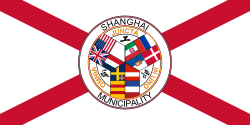
France secured its own concession in Shanghai, which would expand over the decades into one of the most elegant districts in Asia, famed for its plane tree-lined avenues, villas, and cafes.
Image source: French concession of Shanghai
1850 - 1864
% complete
The massive Taiping Rebellion devastated much of the Yangtze Delta, sending waves of wealthy refugees fleeing into Shanghai's foreign concessions. This influx of capital and population fueled the city's explosive economic growth.
Image source: Taiping Rebellion
Sep 7, 1853 - Feb 17, 1855
% complete
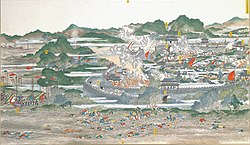
The Small Swords Society, a secret society with ties to the Triads, captured the walled Chinese city of Shanghai and held it for seventeen months before Qing forces recaptured it, causing significant destruction and driving refugees into foreign areas.
Image source: Small Swords Society
1854
% complete
The merger of the British and American concessions into the Shanghai International Settlement was accompanied by the creation of the Shanghai Municipal Council, a self-governing body dominated by foreigners that administered the settlement until 1943.
Image source: Shanghai International Settlement
Apr 1854
% complete
British and American forces engaged Qing troops who were encroaching on the foreign settlements, demonstrating Western military power in Shanghai and reinforcing the extraterritorial privileges of the treaty port.
Image source: Battle of Muddy Flat
Mar 5, 1908
% complete
Electric trams began running through Shanghai's streets in March 1908, modernizing urban transport and symbolizing the city's emergence as the most cosmopolitan and technologically advanced city in East Asia.
Jul 23, 1921 - Jul 31, 1921
% complete
Thirteen delegates, including Mao Zedong, gathered secretly at a girls' school in Shanghai's French Concession and later on a boat on Nanhu Lake to found the Chinese Communist Party, launching a movement that would transform China.
Image source: 100th Anniversary of the Chinese Communist Party
May 30, 1925
% complete
After British police shot and killed protesting Chinese workers at a silk mill, massive anti-imperialist demonstrations swept Shanghai, triggering nationwide strikes and boycotts that galvanized Chinese nationalism.
Image source: May Thirtieth Movement
Mar 21, 1927
% complete
Chiang Kai-shek's Nationalist army entered Shanghai after an armed uprising by communist-led workers had seized control of the Chinese sections of the city, setting the stage for the coming split between the KMT and CCP.
Image source: Northern Expedition
Apr 12, 1927
% complete
Chiang Kai-shek launched a violent purge of Communist Party members and labor unionists in Shanghai, killing thousands and beginning the Chinese Civil War between the Nationalists and Communists.
Image source: Shanghai massacre
Jan 28, 1932 - Mar 3, 1932
% complete
Japanese forces attacked the Chapei (Zhabei) district of Shanghai following anti-Japanese boycotts. The five-week battle destroyed much of the district but ended without Japanese territorial gains thanks to League of Nations pressure.
Image source: January 28 incident
1934
% complete
The Art Deco Park Hotel, designed by László Hudec, rose above Shanghai at 24 stories, remaining the tallest building in Asia for decades and exemplifying the city's golden age of architecture and finance.
Image source: Park Hotel Shanghai
Aug 13, 1937 - Nov 26, 1937
% complete
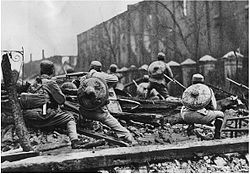
One of the largest and bloodiest battles of the entire Second Sino-Japanese War raged for three months in and around Shanghai. The city ultimately fell to Japan, and the fighting presaged the horrors of the Nanjing Massacre.
Image source: Battle of Shanghai
Nov 26, 1937 - Dec 8, 1941
% complete
While Japanese forces occupied the surrounding regions, the foreign concessions remained nominally neutral, creating the so-called 'Solitary Island' period during which refugees flooded in and espionage, commerce, and resistance activity thrived.
Image source: History of Shanghai
Dec 8, 1941
% complete
Hours after attacking Pearl Harbor, Japanese forces seized the International Settlement, ending decades of Western privilege in Shanghai and subjecting Allied nationals to internment while Jewish refugees faced increasing restrictions.
Image source: Shanghai Ghetto
1943 - 1946
% complete
Through treaties signed with wartime governments and confirmed after Japan's defeat, the International Settlement and French Concession were returned to Chinese sovereignty, formally ending nearly a century of foreign-controlled enclaves in Shanghai.
Feb 18, 1943 - Aug 1945
% complete
Under Japanese pressure, approximately 20,000 stateless Jewish refugees who had fled Nazi Europe were forced into a designated area of Hongkou district, where they endured severe hardship until the war's end.
May 12, 1949 - May 27, 1949
% complete
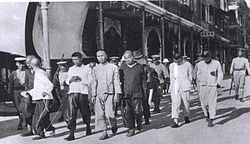
People's Liberation Army troops took Shanghai after a two-week campaign, entering the city with notable discipline. The Communist victory transformed China's largest and most capitalist city overnight.
Image source: Shanghai Campaign
1951 - 1952
% complete
The new Communist government launched campaigns against corruption, waste, and 'bourgeois' practices, targeting Shanghai's industrialists and merchants. Many prominent businessmen committed suicide or fled as private enterprise was dismantled.
Image source: Three-anti and Five-anti Campaigns
1958
% complete
As part of national restructuring, Shanghai absorbed surrounding counties from Jiangsu province and was consolidated as a provincial-level municipality reporting directly to Beijing, expanding its territory dramatically.
Image source: Direct-administered municipality
1966 - 1976
% complete
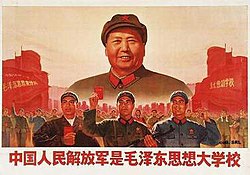
Shanghai became a hotbed of radicalism during the Cultural Revolution, with Red Guards and the Gang of Four, whose leading members including Jiang Qing and Zhang Chunqiao were based in Shanghai, wielding enormous influence over national politics.
Image source: Cultural Revolution
Oct 6, 1976
% complete
The arrest of Mao Zedong's widow Jiang Qing and three other Shanghai-based radicals marked the end of the Cultural Revolution and removed the political faction that had dominated Chinese politics from its Shanghai power base.
Image source: Gang of Four
Apr 18, 1990
% complete
Premier Li Peng announced the opening of Pudong, the farmland east of the Huangpu River, for development. The decision transformed swamps and rice paddies into a financial district that would rival Manhattan.
Image source: Pudong
Dec 19, 1990
% complete
China reopened its principal stock exchange in Shanghai after four decades, signaling the nation's embrace of market economics and helping restore the city's historic role as China's financial capital.
Image source: Shanghai Stock Exchange
1994
% complete
The futuristic Oriental Pearl Tower became the iconic symbol of Pudong's transformation, briefly the tallest tower in Asia and announcing Shanghai's return to global prominence.
Image source: Oriental Pearl Tower
Dec 31, 2002
% complete
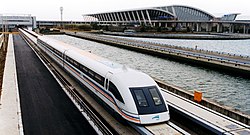
Shanghai inaugurated the world's first commercially operated high-speed magnetic levitation train, reaching speeds over 430 km/h and showcasing the city's embrace of cutting-edge technology.
Image source: Shanghai maglev train
May 1, 2010 - Oct 31, 2010
% complete
Under the theme 'Better City, Better Life,' Shanghai hosted the largest World Expo in history, attracting a record 73 million visitors and cementing the city's status as a world-class global metropolis.
Image source: Expo 2010
2015
% complete
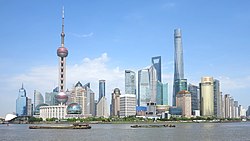
The spiraling 632-meter Shanghai Tower was completed, becoming the tallest building in China and the second tallest in the world, crowning Lujiazui's skyline of supertall skyscrapers.
Image source: Shanghai Tower
Or browse the full history timeline directory, with more than 2,000 topics.
This History of Shanghai timeline was generated with the help of AI, using information found on the internet.
We work hard to keep these timelines accurate, but mistakes do get through. If you spot one, email us at [email protected] and we'll fix it for future visitors.
Generate yours with AI or build it from scratch, for free.
Export your timeline, add your own events, edit or remove AI-generated events, and much more
No credit card required.
Cancel anytime.
Cancel anytime.
You can create an unlimited number of timelines with up to 10 events on each one, customize how they look, export them to PDF, PNG, PowerPoint, CSV, and Excel, and share them with a link. Paid plans raise the event limit and add features like spreadsheet imports and collaborators.
Yes. You can cancel your subscription from your account page at any time, and you will not be charged again. Your subscription stays active for the rest of the period you already paid for.
Yes. We will email you a reminder before the annual renewal, and we will also email you a receipt.
Yes. You can email us within 15 days of any payment, and we will issue you a full refund.
Check out our pricing docs or send us an email anytime: [email protected].