-
Use Cases
-
Resources
-
Pricing
5000 BC - 2900 BC
Hongshan culture developed north of Bohai Bay in Inner Mongolia and Hebei Province between about 4700 and 2900 BC, while the contemporaneous Yangshao culture flourished in Henan Province from about 5000 to 3000 BC. Together, they represent important early traditions in the development of Chinese settlement and building practices.
Image source: Hongshan culture
4000 BC - 2000 BC
Rather than emerging from a single center, early Chinese civilization underwent gradual multinuclear development between 4000 and 2000 BC. Village communities developed into cultures and eventually into states, creating diverse regional traditions of settlement and construction.
Image source: List of Neolithic cultures of China
3500 BC
One early architectural development described in the historical record is dated to around 3500 BC or possibly earlier, placing it among the earliest known stages of Chinese building history.
Image source: Chinese architecture
3000 BC - 2000 BC
Longshan culture developed in the central and lower Yellow River valley between about 3000 and 2000 BC. Its settlements and increasingly complex social organization formed part of the foundation for later Chinese architectural traditions.
Image source: Longshan culture
3000 BC
By about 3000 BC, the combined cultural regions of early China had given rise to thousands of small or proto-states. This political fragmentation encouraged the development of varied local architectural forms.
200 BC - 600 AD
Because many ancient wooden buildings no longer survive, clay models of buildings created as funerary items provide important evidence about ancient Chinese architecture. These models complement the surviving ruins of brick and rammed-earth walls and towers, especially for periods before the sixth century AD.
200 AD - 600 AD
Royal and nonroyal tombs found from the third through sixth centuries traced back to Han construction traditions. Their layouts and masonry demonstrate the continued importance of funerary architecture in Chinese building history.
700 AD - 800 AD
The tombs and mausoleums of imperial family members form part of China's imperial architectural tradition. The eighth-century Tang dynasty tombs at the Qianling Mausoleum are a prominent example of this funerary monumentalism.
857 AD
The East Hall of Foguang Temple demonstrates the complexity of Chinese timber framing through its use of seven types of bracket arms. The surviving structure is a key source for understanding mature Tang-period architectural techniques.
984 AD
The Guanyin Pavilion at Dule Monastery, dated to 984 during the Song dynasty, became the oldest known fully wood-constructed Tang-style building discovered in the early twentieth century. Its identification in 1931 provided crucial evidence for studying traditional timber architecture.
1271 AD
After the Mongol invasion of the thirteenth century, Beijing became the capital of China. This completed the eastward migration of the Chinese capital that had begun during the Jin dynasty and established Beijing as the center of later imperial architecture.
Image source: Beijing
1368 AD - 1644 AD
The Ming uprising of 1368 reasserted Chinese authority and fixed Beijing as the seat of imperial power for the next five centuries. The decision profoundly shaped the city's palaces, walls, ceremonial axes, and administrative architecture.
Image source: Ming dynasty
1368 AD - 1644 AD
Beijing continued to thrive through the Liao and Jin dynasties and later regained prominence as a major strategic center during the Ming dynasty. Its political importance drove extensive imperial and urban construction.
1900 AD - 1930 AD
Korman claimed that the average commoner's home changed little even centuries after the establishment of a universal architectural style. Early twentieth-century homes remained similar to mid- and late-imperial homes, illustrating the persistence of vernacular building traditions.
1931 AD
In the early twentieth century, no known fully wood-constructed Tang dynasty buildings still existed. The 1931 discovery of the Guanyin Pavilion at Dule Monastery, dated to 984 during the Song dynasty, became the oldest such building then known and transformed research into historic timber architecture.
2001 AD
By the twenty-first century, six Tang-era wooden buildings had been found. These discoveries significantly expanded the surviving material evidence for early Chinese timber construction.
300 AD - 700 AD
Dome ceilings in architecture from the fourth through seventh centuries represented the heavens. This symbolic treatment connected structural form with cosmological ideas in religious and cave-temple spaces.
300 AD - 700 AD
Many caves dating from the fourth through seventh centuries were probably carved throughout the Han and Tang periods. These cave complexes became major repositories of religious art, spatial experimentation, and architectural ornament.
400 AD - 600 AD
Timber framing dating from the fifth and sixth centuries is evident in cave-temples such as Mogao, Yungang, Maijishan, and Tianlongshan. These examples reveal the influence of wooden construction even where the surrounding structures were carved from rock.
400 AD - 600 AD
Patterns, decoration, elaboration, and ornament were established signatures of Chinese architecture by the fifth and sixth centuries. These features shaped both religious monuments and later secular building traditions.
523 AD
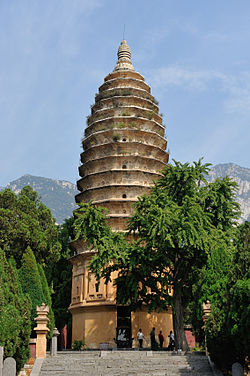
Built in 523, the Songyue Pagoda is China's oldest extant pagoda. Its use of brick rather than wood helped it survive across the centuries and made it an important milestone in the history of Chinese pagoda construction.
Image source: Songyue Pagoda
600 AD - 700 AD
During the Sui period in the seventh century, structures were carved in the mountains of Hebei. The work continued the long tradition of integrating religious architecture with dramatic natural settings.
800 AD - 900 AD
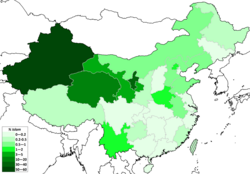
The first Muslims came to Xinjiang in the eighth or ninth centuries CE. Although Islam became a significant presence only during the Yuan dynasty, this early arrival began the development of Islamic architectural traditions in the region.
Image source: Islam in China
907 AD - 1125 AD
Buddhists built important religious structures during the Liao dynasty, which supported Buddhism. The period is especially associated with enduring pagodas and temple architecture.
Image source: Liao dynasty
1055 AD
The Liaodi Pagoda, completed in 1055, stands 84 meters high. It crowned the Kaiyuan monastery in Dingzhou, Hebei, and also served as a military watchtower from which Song soldiers could observe possible Liao troop movements.
1056 AD
The eleventh-century Pagoda of Fogong Temple features fifty-four types of bracket arms. Its elaborate timber construction illustrates the technical sophistication of Chinese architectural systems during the Liao period.
1271 AD - 1368 AD
Although Muslims had reached Xinjiang centuries earlier, Islam became a significant presence during the Yuan dynasty. This period strengthened the foundations for Islamic communities and mosque architecture in China.
1490 AD
Islam came to Hami in eastern Xinjiang at the end of the fourteenth century, and the province's first mosque was built in 1490. The complex later became associated with ten generations of Muslim kings of Hami.
1690 AD - 1932 AD
Ten generations of Muslim kings of Hami were buried in the Hami complex from the 1690s to 1932. The burials extended the architectural and dynastic significance of the site over more than two centuries.
1700 AD - 1800 AD
Some of the greatest examples of later imperial religious architecture came from the eighteenth-century Puning Temple and Putuo Zongcheng Temple. These buildings demonstrate the scale and stylistic richness of Qing-period monumental construction.
1777 AD - 1778 AD
The minaret associated with the Hami complex was begun in 1777 during the reign of the Qianlong Emperor and completed one year later. It represents the integration of Islamic architectural forms into Qing-era Xinjiang.
1840 AD
The Hami mausoleum complex was built in 1840. Its most prominent feature is the tomb of King Boxi'er, constructed after the Muslim rebellion of 1867.
1900 AD - 2000 AD
Throughout the twentieth century, Chinese architects attempted to bring traditional Chinese designs into modern architecture. Their work negotiated between inherited forms, modern materials, new planning needs, and changing political and cultural expectations.
1952 AD - 1954 AD
From 1952 to 1954, socialist realism from the Soviet Union influenced Chinese architecture. The influence affected architectural expression and planning during the early period of the People's Republic.
1964 AD
Starting in 1964, Mao Zedong advocated a “mass design revolution movement.” The campaign promoted broad participation in design and sought to align architecture with revolutionary social and political goals.
1973 AD - 1976 AD
Following the Wall Reform Movement of 1973–1976, reinforced concrete, brick infill, and prefabricated materials were used increasingly in Chinese construction. These methods were promoted in publications such as Architectural Journal.
2014 AD
In 2014, Datong began rebuilding its ancient city wall and buildings in traditional architectural styles. The effort initially received skepticism and opposition from citizens, although many later praised the mayor for reviving traditional Chinese aesthetics.
Image source: Datong
Or browse the full history timeline directory, with more than 2,500 topics.
This History of Chinese Architecture timeline was generated with the help of AI, using information found on the internet.
We work hard to keep these timelines accurate, but mistakes do get through. If you spot one, email us at [email protected] and we'll fix it for future visitors.
Generate yours with AI or build it from scratch, for free.
Export your timeline, add your own events, edit or remove AI-generated events, and much more
No credit card required.
Cancel anytime.
Cancel anytime.
You can create an unlimited number of timelines with up to 10 events on each one, customize how they look, export them to PDF, PNG, PowerPoint, CSV, and Excel, and share them with a link. Paid plans raise the event limit and add features like spreadsheet imports and collaborators.
Yes. You can cancel your subscription from your account page at any time, and you will not be charged again. Your subscription stays active for the rest of the period you already paid for.
Yes. We will email you a reminder before the annual renewal, and we will also email you a receipt.
Yes. You can email us within 15 days of any payment, and we will issue you a full refund.
Check out our pricing docs or send us an email anytime: [email protected].