-
Use Cases
-
Resources
-
Pricing
700 - 1000
The term Pre-Romanesque is applied to Carolingian and Ottonian architecture in Germany and to Visigothic, Mozarab, and Asturian constructions in the Iberian Peninsula between the 8th and 10th centuries.
1000 - 1200
Romanesque architecture was the architectural style of medieval Europe predominant during the 11th and 12th centuries.
Image source: Romanesque architecture
1400
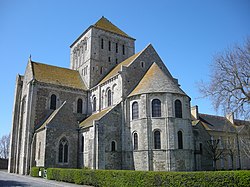
The distinction between Romanesque and Gothic architecture was recognized as early as the 15th century, as demonstrated by artworks from that period.
1600 - 1800
Until the 19th century, architecture preceding Gothic was not recognized as a unified style. Writers such as Giorgio Vasari and Christopher Wren instead described Tuscan, Saxon, Norman, and other regional architectures.
1666
The word Romanesque, meaning 'in the manner of Romans,' appeared in English by 1666. It was initially used to designate what are now called the Romance languages.
1800 - 1950
Over the 19th century and the first half of the 20th century, the definition of Romanesque narrowed from a broad pre-Gothic category to a period typically beginning in the late 10th or 11th century and ending in the 12th.
1813
In 1813, William Gunn used Romanesque to describe pre-Gothic architecture in Western Europe, extending from the 4th through the 12th century.
Dec 18, 1818
Archaeologist Charles de Gerville first used the French term romane in an architectural sense in a letter dated 18 December 1818 to Auguste Le Prévost. Gerville used it to describe what he regarded as debased Roman architecture.
1819
William Gunn's work An Inquiry into the Origin and Influence of Gothic Architecture was published in London in 1819, following his broad use of Romanesque terminology.
1900 - 1950
Scholars including Robert de Lasteyrie and Henri Focillon helped change Romanesque from a label for sub-Roman or Roman-like architecture into a stylistic designation emphasizing arrangements of mass and space accepted around the beginning of the 11th century.
2000 - 2001
Eric Fernie wrote that by the beginning of the 21st century there was 'something like agreement' among scholars about the characteristics of the Romanesque style.
800 - 899
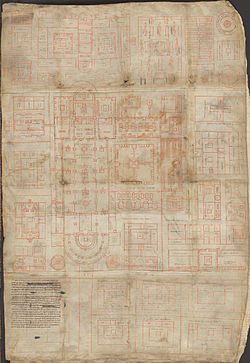
Dating shortly after the Palatine Chapel, the 9th-century Plan of Saint Gall is a detailed Swiss manuscript showing a monastic complex, including its buildings and their functions.
Image source: Plan of Saint Gall
800
Built around AD 800 in Aachen, Germany, Charlemagne's Palatine Chapel was inspired by the 6th-century octagonal Byzantine Basilica of San Vitale in Ravenna and became a major Early Medieval European building.
Image source: Palatine Chapel, Aachen
900 - 1000
Romanesque-style architecture developed simultaneously in northern Italy, parts of France, and the Iberian Peninsula during the 10th century, before the later influence of the Abbey of Cluny.
900 - 1050
First Romanesque describes buildings in northern Italy, Spain, and parts of France that possess Romanesque features but predate the later influence of the Abbey of Cluny.
1000 - 1200
The movement of people and armies encouraged bridge building. Surviving examples include the 11th-century Puente de la Reina in Navarre, the 12th-century bridge at Besalú in Catalonia, and the Pont-Saint-Bénézet at Avignon.
1000 - 1300
The style flourished across Europe from the 11th to the 13th century. It was distinguished from the Gothic style that followed by its semicircular arches and more massive forms.
1050 - 1200
Across Europe, the late 11th and 12th centuries saw unprecedented growth in the number of churches. Many large and small Romanesque buildings survive, although some were heavily altered in later centuries.
1050 - 1100
A dazzling Romanesque style developed in Pisa during the mid-11th century and became known as Pisan Romanesque.
1066
William, Duke of Normandy, invaded England in 1066. The resulting Norman presence encouraged the construction of castles and churches in the Romanesque tradition.
Image source: Norman architecture
1095 - 1270
The Crusades brought a large movement of people, ideas, and trade skills across Europe. Skills involved in fortification and metalworking for arms were also applied to the fitting and decoration of buildings.
Image source: Crusades
1000 - 1050
The Imperial Palace of Goslar was built in the early 11th century by Otto III and Henry III. The complex was heavily restored in the 19th century.
1000 - 1300
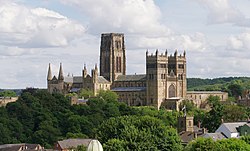
The slow process of construction often left the upper parts of Romanesque towers incomplete for centuries, as happened at Durham and Lincoln.
1000 - 1200
The structure of large Romanesque churches differed by region and developed over time. Some 11th-century churches used huge circular columns and had no clerestory or only a small one, as at St. Philibert in Tournus.
1000 - 1200
Romanesque interiors used varied roofing systems, including open timber roofs, wooden ceilings, barrel vaults, groin vaults, and increasingly ribbed vaults in larger abbey churches and cathedrals.
1001 - 1030
St. Michael's Church in Hildesheim, built from 1001 to 1030, displays Proto-Romanesque features including the characteristic treatment of architectural mass and space.
Image source: St. Michael's Church, Hildesheim
1050 - 1100
Octagonal cloister vaults appeared in connection with basilicas across much of Europe between 1050 and 1100.
1050 - 1200
Some churches, including Saint-Étienne at Caen and Pisa Cathedral, had three western portals modeled on the arrangement of Early Christian basilicas.
1060
Groin vaults occur in early Romanesque buildings. The high vault of about 1060 at Speyer Cathedral is identified as the first Romanesque use of this type of vault over a wide nave.
Image source: Speyer Cathedral
1062 - 1095
The circular chapter house at Worcester Cathedral was built under Bishop Wulfstan between 1062 and 1095. It was the first circular chapter house in Europe and became a model for others in England.
Image source: Worcester Cathedral
1075 - 1125
Depressed diagonal ribs were used in the sexpartite vaults of Saint-Étienne and Sainte-Trinité at Caen, France, during the late 11th and early 12th centuries.
1080 - 1120
The church of St. Sernin at Toulouse, built from 1080 to 1120, remains substantially intact. Its modular form, massive appearance, and repeated simple arched windows demonstrate the regularity of Romanesque design.
Image source: Basilica of Saint-Sernin, Toulouse
1088 - 1130
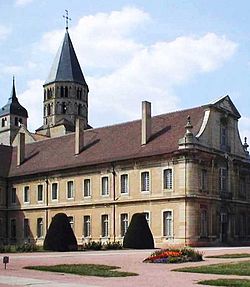
The rebuilding known as Cluny III was constructed from 1088 to 1130. Although little of the abbey church remains, its design is known to have made it the largest building in Europe until the Renaissance.
Image source: Cluny Abbey
1100 - 1200
By the early 12th century, composite piers had evolved. Their attached shafts rose toward ribbed vaults or continued into the arcade mouldings at places including Vézelay Abbey, Saint-Étienne at Caen, and Peterborough Cathedral.
1100 - 1200
Ribbed vaults came into general use during the 12th century and became increasingly important in large abbey churches and cathedrals.
1128
The transverse ribs of the vaults at Durham Cathedral in northern England, dating from 1128, represent one of the first appearances of pointed ribs.
Image source: Durham Cathedral
1130
The chapter house at Durham Cathedral is a wide space with a ribbed vault. Its restoration returned it to the form in which it was originally constructed around 1130.
1130
The narthex of La Madeleine at Vézelay contains the earliest pointed vault in France, dating from 1130.
1140 - 1144
Abbot Suger's innovative choir at the Abbey of Saint-Denis, built from 1140 to 1144, helped establish the Gothic style in Paris and the surrounding region.
Image source: Basilica of Saint-Denis
1170
The ruined palace at Gelnhausen was received by Frederick Barbarossa before 1170, representing the secular and imperial side of Romanesque construction.
1400 - 1499
Norwich Cathedral's huge ornate 12th-century crossing tower later received a 15th-century masonry spire. The spire rose to 320 feet and remains standing.
1000 - 1100
Stained glass came into increasing use from the 11th century, adding colored pictorial and decorative windows to Romanesque churches.
Image source: Stained glass
1000 - 1200
Chevrons and other geometric ornaments, called 'barbaric ornament' by 19th-century writers, were frequently used on the mouldings of Romanesque central doorways.
1050 - 1200
During the 11th and 12th centuries, figurative sculpture flourished in a recognizable Romanesque style across Europe. The most spectacular projects were concentrated in southwestern France, northern Spain, and Italy.
Image source: Romanesque art
1075 - 1100
The five prophet windows at Augsburg, dating from the late 11th century, are the earliest intact figures known in medieval pictorial stained glass.
1100 - 1200
Panels from the 12th century survive at Canterbury and Chartres Cathedrals. Canterbury includes images of Adam digging and his son Seth from a series depicting the Ancestors of Christ.
1100 - 1300
Notable Romanesque baptisteries include Parma Cathedral's building with a galleried exterior and Florence's polychrome Baptistery of San Giovanni, whose vault mosaics date from the 13th century.
1100 - 1125
The vault of Saint-Savin-sur-Gartempe in France preserves an important example of early 12th-century medieval painting.
1130
A figure of the Prophet Jeremiah on a portal pillar at the Abbey of Saint-Pierre in Moissac, France, dates from about 1130 and is considered one of the finest examples of Romanesque sculpture.
1800 - 1900
Major 19th-century reconstructions in Germany sought to return Romanesque buildings to their presumed original forms.
Image source: Romanesque Revival architecture
1830 - 1900
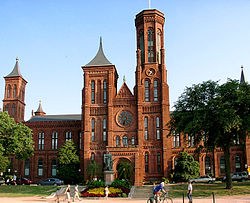
Romanesque Revival churches appeared from as early as the 1830s and continued into the 20th century. The style valued the massive and sometimes brutal qualities of Romanesque architecture, often using brick.
1879
Designed by Alfred Waterhouse and completed in 1879, London's Natural History Museum is a Romanesque Revival building that makes extensive use of Romanesque arcading and architectural sculpture.
Image source: Natural History Museum, London
1885
Marshall Field's Wholesale Store in Chicago, designed by H. H. Richardson in 1885, is a notable American example of Romanesque Revival architecture.
1887
The Chadwick Lead Works in Boston, designed by William Preston in 1887, is another notable example of the Romanesque Revival style in the United States.
Or browse the full history timeline directory, with more than 2,500 topics.
This Romanesque Architecture timeline was generated with the help of AI, using information found on the internet.
We work hard to keep these timelines accurate, but mistakes do get through. If you spot one, email us at [email protected] and we'll fix it for future visitors.
Generate yours with AI or build it from scratch, for free.
Export your timeline, add your own events, edit or remove AI-generated events, and much more
No credit card required.
Cancel anytime.
Cancel anytime.
You can create an unlimited number of timelines with up to 10 events on each one, customize how they look, export them to PDF, PNG, PowerPoint, CSV, and Excel, and share them with a link. Paid plans raise the event limit and add features like spreadsheet imports and collaborators.
Yes. You can cancel your subscription from your account page at any time, and you will not be charged again. Your subscription stays active for the rest of the period you already paid for.
Yes. We will email you a reminder before the annual renewal, and we will also email you a receipt.
Yes. You can email us within 15 days of any payment, and we will issue you a full refund.
Check out our pricing docs or send us an email anytime: [email protected].