-
Use Cases
-
Resources
-
Pricing
Gothic Architecture is a style of European architecture that flourished from the mid-12th century until the 16th century, characterized by pointed arches, ribbed vaults, flying buttresses, and expansive stained-glass windows. Originating in France with the rebuilding of the Basilica of Saint-Denis, it spread throughout Europe, producing iconic cathedrals such as Notre-Dame de Paris, Chartres Cathedral, and Cologne Cathedral. The style was later revived in the 18th and 19th centuries during the Gothic Revival movement. More Less
1140
% complete
Sens Cathedral, begun around 1140, was one of the first Gothic cathedrals and served as a prototype for later structures. Its use of ribbed vaulting over a three-story elevation influenced major works such as Notre-Dame de Paris and Canterbury Cathedral.
Image source: Sens Cathedral
Jul 14, 1144
% complete
Abbot Suger's rebuilding of the choir of the Basilica of Saint-Denis near Paris is widely regarded as the birth of Gothic architecture. By combining pointed arches, rib vaults, and expansive stained glass windows, Suger created a luminous interior that embodied his theology of light and inspired builders across Europe.
Image source: Basilica of Saint-Denis
1163 - 1345
% complete
Bishop Maurice de Sully initiated construction of Notre-Dame de Paris in 1163. The cathedral pioneered early Gothic innovations on a monumental scale, including flying buttresses in its later phases, and became one of the most celebrated examples of French Gothic architecture.
Image source: Notre-Dame de Paris
1420 - 1520
% complete
From Brunelleschi's dome onward, Renaissance architects rejected Gothic forms in favor of classical orders and symmetry. Gothic gradually fell from favor across Europe, surviving longest in England, Spain, and Central Europe before fading by the mid-16th century.
Image source: Renaissance architecture
1174 - 1184
% complete
After a devastating fire in 1174, William of Sens was commissioned to rebuild the choir of Canterbury Cathedral, introducing French Gothic style to England. His work marked the beginning of English Gothic architecture, later developed through Early English, Decorated, and Perpendicular styles.
Image source: Canterbury Cathedral
1245 - 1517
% complete
Henry III began rebuilding Westminster Abbey in 1245 in the French-influenced Gothic style. The abbey became the coronation and burial church of English monarchs and a showcase of evolving English Gothic design.
Image source: Westminster Abbey
1248 - 1880
% complete
Inspired by Amiens Cathedral, Cologne Cathedral was begun in 1248 but left unfinished for centuries. Completed in the 19th century according to medieval plans, it became Germany's most celebrated Gothic monument and a UNESCO World Heritage Site.
Image source: Cologne Cathedral
1284 - 1317
% complete
Giovanni Pisano designed the striking polychrome marble lower facade of Siena Cathedral between 1284 and 1317, blending French Gothic forms with Italian decorative traditions and helping establish Gothic style in Italy.
Image source: Siena Cathedral
1296 - 1436
% complete
Arnolfo di Cambio began Florence Cathedral (Santa Maria del Fiore) in 1296. Its Gothic body, later crowned by Brunelleschi's Renaissance dome, reflects the transition from medieval to early modern architecture in Italy.
Image source: Florence Cathedral
1340 - 1442
% complete
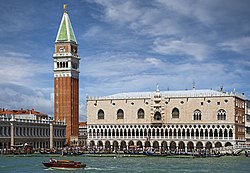
Venice's Doge's Palace received its great Gothic additions between 1340 and 1442, blending Byzantine and Moorish influences with pointed arcades. Venetian Gothic became a distinctive regional variant celebrated for its ornamental elegance.
Image source: Doge's Palace
1350 - 1550
% complete
Perpendicular Gothic, England's distinctive final Gothic phase, emphasized strong vertical lines, large windows with panel tracery, and fan vaults. King's College Chapel and Henry VII's Chapel at Westminster are supreme examples.
Image source: Perpendicular Gothic
1377 - 1890
% complete
Ulm Minster, begun in 1377, was finally completed in 1890 with a spire reaching 161.5 meters, making it the tallest church in the world. Its hall church design reflects German Late Gothic traditions.
Image source: Ulm Minster
1386 - 1965
% complete
Milan Cathedral, begun in 1386, is Italy's largest church and one of the largest Gothic cathedrals in the world. Its forest of spires and pinnacles, built over centuries, represents the late Gothic style adapted to Italian taste.
Image source: Milan Cathedral
1388 - 1905
% complete
St. Barbara's Church in Bohemia, begun in 1388, is famed for its tent-like roof and net vaults associated with the Parler workshop. It exemplifies Central European Late Gothic creativity, though completion took over five centuries.
Image source: St. Barbara's Church, Kutná Hora
1401 - 1507
% complete
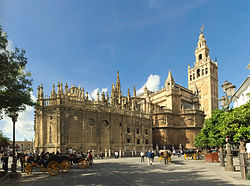
Built on the site of a former mosque, Seville Cathedral became the largest Gothic cathedral in the world. Its immense scale, Giralda bell tower, and richly decorated interiors showcase Spanish late Gothic ambition.
Image source: Seville Cathedral
1421 - 1440
% complete
The Ca' d'Oro ('House of Gold'), completed around 1440, is the finest example of Venetian Gothic palatial architecture. Its ornate loggias and marble facade along the Grand Canal epitomize the city's unique fusion of Gothic and Eastern motifs.
Image source: Palazzo Santa Sofia
1446 - 1515
% complete
Founded by Henry VI and completed under Henry VII and Henry VIII, King's College Chapel features the world's largest fan vault. It stands as a masterpiece of Perpendicular Gothic and late medieval craftsmanship.
Image source: King's College Chapel, Cambridge
1194 - 1220
% complete
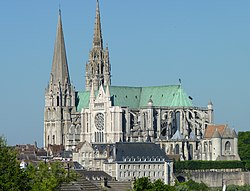
Rebuilt after a fire destroyed much of the earlier structure, Chartres Cathedral became the quintessential High Gothic building. Its harmonious proportions, flying buttresses, sculptural portals, and magnificent stained glass set the standard for cathedrals throughout Europe.
Image source: Chartres Cathedral
1195 - 1230
% complete
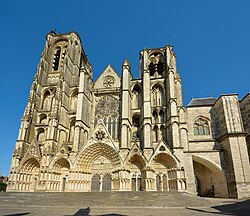
Bourges Cathedral, begun in 1195, featured an innovative five-aisled plan without transepts and a continuous elevation. Its design drew on both Notre-Dame de Paris and Chartres, demonstrating the growing confidence of High Gothic architects.
Image source: Bourges Cathedral
1211 - 1275
% complete
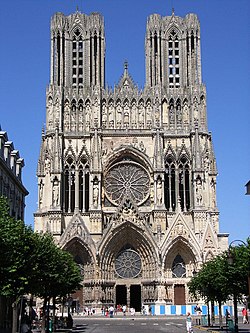
Reims Cathedral, the coronation church of French kings, was begun in 1211. Its soaring nave, elaborate west facade with famous statues including the Smiling Angel, and refined tracery exemplify the maturity of High Gothic architecture.
Image source: Reims Cathedral
1220 - 1269
% complete
Amiens Cathedral, begun in 1220 under architect Robert de Luzarches, achieved the tallest complete Gothic nave at roughly 42 meters. Its vast interior and unified design made it a masterpiece of High Gothic engineering and artistry.
Image source: Amiens Cathedral
1225 - 1272
% complete
The choir of Beauvais Cathedral reached an unprecedented vault height of about 48 meters in 1272, the tallest Gothic vault ever built. The ambitious structure collapsed in 1284, illustrating the structural limits of Gothic experimentation.
Image source: Beauvais Cathedral
Apr 26, 1248
% complete
King Louis IX consecrated the Sainte-Chapelle to house relics of the Crown of Thorns. Its walls of stained glass supported by slender structure represent the Rayonnant ideal of dissolving walls into light, making it a jewel of Gothic architecture.
Image source: Sainte-Chapelle
1230 - 1350
% complete
The Rayonnant period of French Gothic, spanning roughly 1230 to 1350, emphasized radiating tracery, enlarged windows, and reduced wall mass. Landmarks include the Sainte-Chapelle and the nave of Notre-Dame de Paris, prioritizing light and geometric refinement.
Image source: Rayonnant
1400 - 1520
% complete
Flamboyant Gothic, dominant in France from about 1400 to 1520, featured flame-like curvilinear tracery, intricate rib patterns, and exuberant decoration. Notable examples include Rouen's Saint-Maclou and the facade of Senlis Cathedral.
Image source: Flamboyant
1749 - 1776
% complete
Horace Walpole transformed his villa at Twickenham into a 'little Gothic castle,' sparking the Gothic Revival movement. His playful medievalism inspired a fashion for Gothic cottages, castles, and interiors throughout Britain.
Image source: Strawberry Hill House
1764
% complete
Walpole's novel The Castle of Otranto founded the Gothic literary genre, intertwining medieval settings with romance and terror. The book reinforced cultural fascination with the Gothic past that fueled architectural revival.
Image source: The Castle of Otranto
1836
% complete
Augustus Welby Pugin's Contrasts argued that Gothic architecture embodied moral and spiritual superiority over modern classical styles. His passionate advocacy shaped Victorian taste and drove the ecclesiological Gothic revival.
Image source: Augustus Pugin
1840 - 1876
% complete
Charles Barry and Augustus Pugin rebuilt the Palace of Westminster after the 1834 fire in Perpendicular Gothic Revival style. The project established Gothic as the national architectural identity of Britain and showcased revived medieval craftsmanship.
Image source: Palace of Westminster
1842 - 1880
% complete
Resumed in 1842 using original medieval plans, the completion of Cologne Cathedral in 1880 symbolized German national unity and demonstrated the enduring power of Gothic design, becoming the world's tallest structure until 1884.
1844 - 1864
% complete
Eugène Viollet-le-Duc undertook extensive restoration of Notre-Dame de Paris, adding the iconic flèche and grotesque gargoyles. His theories on restoration and rational Gothic structure profoundly influenced 19th-century architecture and preservation.
Image source: Eugène Viollet-le-Duc
1882
% complete
Antoni Gaudí took over the Sagrada Família project in 1883, reinterpreting Gothic principles through catenary arches, hyperboloid structures, and organic forms. Still unfinished, it represents a radical continuation of the Gothic tradition into modernity.
Image source: Sagrada Família
Or browse the full history timeline directory, with more than 2,000 topics.
This Gothic Architecture timeline was generated with the help of AI, using information found on the internet.
We work hard to keep these timelines accurate, but mistakes do get through. If you spot one, email us at [email protected] and we'll fix it for future visitors.
Generate yours with AI or build it from scratch, for free.
Export your timeline, add your own events, edit or remove AI-generated events, and much more
No credit card required.
Cancel anytime.
Cancel anytime.
You can create an unlimited number of timelines with up to 10 events on each one, customize how they look, export them to PDF, PNG, PowerPoint, CSV, and Excel, and share them with a link. Paid plans raise the event limit and add features like spreadsheet imports and collaborators.
Yes. You can cancel your subscription from your account page at any time, and you will not be charged again. Your subscription stays active for the rest of the period you already paid for.
Yes. We will email you a reminder before the annual renewal, and we will also email you a receipt.
Yes. You can email us within 15 days of any payment, and we will issue you a full refund.
Check out our pricing docs or send us an email anytime: [email protected].