-
Use Cases
-
Resources
-
Pricing
Constantinople, founded by Roman Emperor Constantine the Great in 330 AD on the site of ancient Byzantium, served as the capital of the Byzantine Empire for over a thousand years. Strategically located between Europe and Asia, it became a major center of trade, culture, and Christianity before being conquered by the Ottoman Empire in 1453. More Less
657 BC
% complete
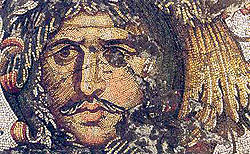
Greek settlers from Megara, led by Byzas according to legend, established the colony of Byzantium on the European side of the Bosphorus. Its strategic position between Europe and Asia made it a vital trading hub for centuries before it rose to imperial fame.
Image source: Byzantium
340 BC - 339 BC
% complete
Philip II of Macedon besieged Byzantium in an effort to expand his influence over the Greek city-states. The siege failed thanks to Byzantine resistance and aid from allied forces, preserving the city's independence for a time.
Image source: Byzantium
196
% complete
After backing his rival Pescennius Niger in Rome's civil war, Byzantium was besieged for nearly three years and destroyed by Septimius Severus. He later rebuilt the city, restoring its prosperity within the Roman Empire.
330 - 370
% complete
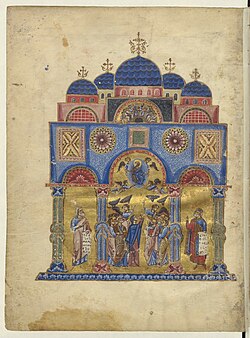
Constantine commissioned the Church of the Holy Apostles as a grand mausoleum complex intended to house relics of the apostles and tombs of emperors. It became one of the most important churches in early Christian Constantinople until its replacement under Justinian I.
Image source: Church of the Holy Apostles
May 11, 330
% complete
Emperor Constantine the Great dedicated Nova Roma, later called Constantinople, on the site of ancient Byzantium as the new capital of the Roman Empire. Its location gave it control of key trade routes between Europe and Asia, launching over a millennium of imperial history.
Image source: Constantinople
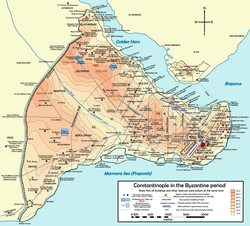
381
% complete
Emperor Theodosius I summoned bishops to Constantinople to reaffirm and expand the Nicene Creed, addressing Arian controversies. The council affirmed the divinity of the Holy Spirit and elevated the bishop of Constantinople to second rank in Christendom after Rome.
Image source: First Council of Constantinople
408 - 413
% complete
Under Emperor Theodosius II, massive land walls were built west of the city, later augmented by a triple line of fortifications and moat. These defenses protected Constantinople from countless sieges for over a thousand years.
532 - 537
% complete
Following the Nika riots, Justinian I commissioned architects Anthemius of Tralles and Isidore of Miletus to build Hagia Sophia. Completed in just five years, its colossal dome made it the largest church in the world and an enduring symbol of Byzantine architecture.
Image source: Hagia Sophia
Jan 13, 532 - Jan 18, 532
% complete
Factional violence between chariot-racing fans erupted into a citywide revolt against Emperor Justinian I. Tens of thousands died as imperial forces crushed the uprising, and much of the city center, including the original Hagia Sophia, was burned down.
Image source: Nika riots
541 - 542
% complete
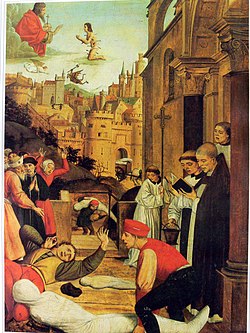
Bubonic plague swept through Constantinople at its peak population, killing perhaps half its inhabitants. The epidemic devastated the empire's economy and manpower during Justinian's ambitious campaigns of reconquest.
Image source: Plague of Justinian
626
% complete
A combined force of Avars, Slavs, and Sassanid Persians attacked Constantinople while Emperor Heraclius campaigned in Persia. The defenders, inspired by reports of victories and the Virgin's intercession, repelled the assault, marking a turning point in the Byzantine-Sassanid war.
Image source: Siege of Constantinople (626)
674 - 678
% complete
The Umayyad Caliphate launched a prolonged naval and land assault on Constantinople. The use of Greek fire by Byzantine forces destroyed Arab fleets, and the failed siege halted the expansion of Islam into Europe for decades.
Image source: Siege of Constantinople (674–678)
717 - 718
% complete
A massive Umayyad army and fleet besieged Constantinople under Emperor Leo III. Harsh winter, disease, Bulgarian attacks on the besiegers, and Greek fire devastated the Arab forces, securing Byzantine survival and a major check on Islamic expansion.
Image source: Siege of Constantinople (717–718)
730 - 787
% complete
Emperor Leo III banned religious images, sparking the Iconoclast controversy that divided Constantinople's church and society for over a century. The dispute ended with the Second Council of Nicaea in 787 restoring veneration of icons.
Image source: Byzantine Iconoclasm
787
% complete
Empress Irene convoked a council attended by delegates from Constantinople that restored the veneration of icons, ending the first period of Iconoclasm and reshaping Byzantine religious life.
Image source: Second Council of Nicaea
Dec 25, 800
% complete
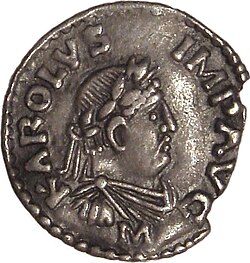
Pope Leo III crowned Charlemagne emperor in Rome, challenging the notion that the Roman imperial title resided solely with the ruler in Constantinople. This deepened the divide between the eastern and western halves of former Roman Christendom.
Image source: Charlemagne
860
% complete
A fleet of Kievan Rus' ships suddenly appeared outside Constantinople while Emperor Michael III was away campaigning. The raiders plundered suburbs before departing, prompting renewed attention to northern defenses and eventual Rus'-Byzantine treaties.
Image source: Siege of Constantinople (860)
867
% complete
The accession of Basil I began the Macedonian dynasty, ushering in a revival of art, scholarship, and law in Constantinople. Institutions like the Magnaura school and renewed church building marked a cultural golden age.
Image source: Macedonian Renaissance
900 - 1000
% complete
During the tenth century, the sprawling Great Palace complex served as the ceremonial heart of the empire, hosting elaborate court rituals described in the Book of Ceremonies. It symbolized the wealth and sophistication of medieval Constantinople.
Image source: Great Palace of Constantinople
904
% complete
Cretan Saracens led by Leo of Tripoli sacked the empire's second city, shocking Constantinople. The disaster spurred naval reforms that helped Byzantium regain dominance in the Aegean under emperors like Nikephoros Phokas and John Tzimiskes.
Image source: Sack of Thessalonica (904)
976 - 1025
% complete
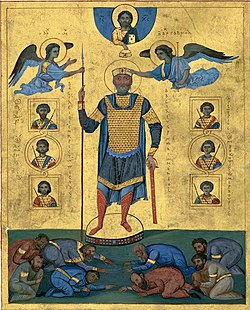
Basil II, ruling from Constantinople, defeated Bulgaria and expanded Byzantine territory across the Balkans and Anatolia. His death in 1025 marked the peak of medieval Byzantine power, though succession struggles soon followed.
Image source: Basil II
1054
% complete
Mutual excommunications between papal legates and Patriarch Michael Keroularios formalized the split between Roman Catholic and Eastern Orthodox churches. The division centered on disputes over authority, liturgy, and theology, permanently shaping Constantinople's religious role.
Image source: East–West Schism
Aug 26, 1071
% complete
Seljuk Turks decisively defeated Emperor Romanos IV near Lake Van, leading to the loss of most of Anatolia, the empire's demographic and economic core. Constantinople's fortunes declined as refugees flooded the capital and the empire relied more on Western allies.
Image source: Battle of Manzikert
1082
% complete
Emperor Alexios I Komnenos granted Venice extensive commercial privileges in exchange for naval help against the Normans. Venetian merchants came to dominate Constantinople's economy, fueling tensions with local merchants and rival Italian states.
Image source: Byzantine–Venetian treaty of 1082
Apr 12, 1204 - Apr 13, 1204
% complete
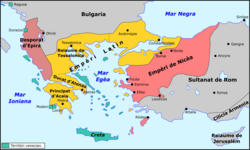
Crusaders diverted to Constantinople stormed the city's sea walls and subjected it to three days of brutal sack. The conquest established the Latin Empire and looted countless treasures, including bronze horses taken to Venice.
Image source: Sack of Constantinople
May 16, 1204 - 1261
% complete
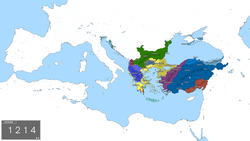
Count Baldwin IX of Flanders was crowned Latin Emperor in Hagia Sophia. For nearly six decades, Frankish and Venetian rulers governed a weakened Constantinople while Byzantine successor states formed at Nicaea, Epirus, and Trebizond.
Image source: Latin Empire
Jul 25, 1261
% complete
General Alexios Strategopoulos seized Constantinople almost bloodlessly from its small Latin garrison, allowing Michael VIII Palaiologos to restore the Byzantine Empire. The recovery was celebrated, but the city remained depopulated and impoverished.
Image source: Empire of Nicaea
1274
% complete
Michael VIII accepted union with the Roman Catholic Church at Lyon to deter Western attacks. The unpopular union was rejected by most Byzantines and later repudiated, highlighting enduring East-West religious divisions.
1394 - 1402
% complete
Sultan Bayezid I tightened Ottoman control around Constantinople, cutting supply lines and isolating the shrinking Byzantine capital. The blockade was lifted only after Timur's victory over Bayezid at Ankara in 1402.
Image source: Ottoman Empire
1439
% complete
Emperor John VIII Palaiologos signed a union of the Orthodox and Catholic churches in hopes of securing Western military aid against the Ottomans. The agreement was fiercely opposed at home and brought little practical help.
Image source: Council of Florence
Apr 6, 1453 - May 29, 1453
% complete
Sultan Mehmed II's army breached the Theodosian Walls after weeks of bombardment. Emperor Constantine XI died fighting as Ottoman troops stormed the city, ending the Byzantine Empire and making Constantinople the capital of the Ottoman Empire.
Image source: Fall of Constantinople
May 29, 1453
% complete
Immediately after conquering the city, Mehmed II converted Hagia Sophia into a mosque, adding minarets and Islamic features over subsequent decades. The building remained the principal mosque of Ottoman Istanbul and a symbol of the conquest.
1478
% complete
Mehmed II completed construction of Topkapı Palace, which served as the administrative headquarters and residence of Ottoman sultans for nearly four centuries, anchoring the transformed city's political life.
Image source: Topkapı Palace
1550 - 1557
% complete
Architect Sinan built the Süleymaniye Mosque on Istanbul's third hill, blending Byzantine influences with classical Ottoman design. It crowned the city's transformation into a magnificent imperial capital.
Image source: Süleymaniye Mosque
Or browse the full history timeline directory, with more than 2,000 topics.
This History of Constantinople timeline was generated with the help of AI, using information found on the internet.
We work hard to keep these timelines accurate, but mistakes do get through. If you spot one, email us at [email protected] and we'll fix it for future visitors.
Generate yours with AI or build it from scratch, for free.
Export your timeline, add your own events, edit or remove AI-generated events, and much more
No credit card required.
Cancel anytime.
Cancel anytime.
You can create an unlimited number of timelines with up to 10 events on each one, customize how they look, export them to PDF, PNG, PowerPoint, CSV, and Excel, and share them with a link. Paid plans raise the event limit and add features like spreadsheet imports and collaborators.
Yes. You can cancel your subscription from your account page at any time, and you will not be charged again. Your subscription stays active for the rest of the period you already paid for.
Yes. We will email you a reminder before the annual renewal, and we will also email you a receipt.
Yes. You can email us within 15 days of any payment, and we will issue you a full refund.
Check out our pricing docs or send us an email anytime: [email protected].