
-
Use Cases
-
Resources
-
Pricing
Denim is a durable cotton twill fabric that originated as sturdy workwear for laborers before evolving into one of the most popular and versatile materials in global fashion. This timeline traces denim's journey from its European roots and the invention of riveted jeans by Levi Strauss and Jacob Davis, through its adoption by American youth culture, Hollywood, and counterculture movements, to its modern status as a timeless wardrobe staple embraced worldwide. More Less
1500
% complete
Indigo dyed cotton textiles have been produced and traded from India for millennia. The textiles became known, in the 18th century, as 'blue goods' in English or 'guinée' in French, and were a core trade good of both the Indian Ocean and Atlantic slave trades.
Image source: Indigo dye
1500
% complete
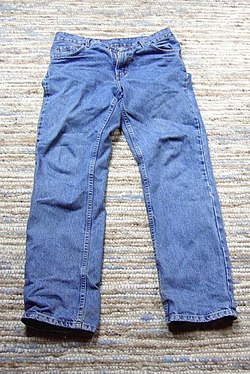
Research on the trade of jean fabric shows that it emerged in the city of Genoa, Italy, in the 16th century, followed by Nîmes, France, in the 17th century.
Image source: Jeans
1576
% complete
In 1576, a quantity of 'jean fustians' arrived into the port of Barnstaple on a vessel from Bristol, documenting early trade of jean fabric into England.
1580
% complete
Genre painting came to prominence in the late 16th century, and its non-nobility subject matter would later provide visual evidence of working-class clothing, including early jean garments.
Image source: Genre painting
1600
% complete
By the 17th century, jean was a crucial textile for working-class people in Northern Italy, valued for its durability and affordability.
1600
% complete
A series of genre paintings from around the 17th century attributed to an artist now referred to as the Master of the Blue Jeans depicts working-class figures wearing blue denim-like garments, providing rare visual evidence of early jean clothing.
Image source: Jeans
1613
% complete
Dungaree was mentioned for the first time in 1613, when it was referred to as coarse calico cloth, often colored blue but sometimes bleached white, worn by impoverished workers in Dongri, a dockside village in what was then a region of Bombay, India.
Image source: Dungaree (fabric)
1795
% complete
The term jeans appears first in 1795, when Swiss banker Jean-Gabriel Eynard and his brother Jacques went to Genoa and both were soon heading a flourishing commercial concern dealing in the fabric.
1800
% complete
In 1800, Massena's troops entered the town and Jean-Gabriel Eynard was entrusted with their supply, further cementing his role in the jean trade.
Image source: Jean-Gabriel Eynard
1878
% complete
Nearly all indigo needed for dyeing came from indigo bush plantations in India, until it was replaced by indigo synthesis methods developed in Germany in 1878.
1851
% complete
As a young man in 1851, Levi Strauss went from Germany to New York to join his older brothers who ran a goods store.
Image source: Levi Strauss
1853
% complete
In 1853, Levi Strauss moved to San Francisco to open his own dry goods business during the California Gold Rush era.
Image source: Levi Strauss & Co.
1871
% complete
Jacob Davis invented riveted work pants in 1871, reinforcing stress points on trousers with copper rivets — an innovation that would transform durable workwear.
Image source: Jacob W. Davis
1872
% complete
In 1872, Jacob Davis wrote to Levi Strauss asking to partner with him to patent and sell clothing reinforced with rivets, since Davis lacked the funds for the patent application himself.
1873
% complete
Having patented the modern, mass-produced prototype in 1873, the original jeans had two pockets in the front and a patch pocket on the back right, reinforced with copper rivets.
Image source: Levi Strauss & Co.
May 20, 1873
% complete
On May 20, 1873, Davis and Levi Strauss received patent 139,121 for an 'Improvement in Fastening Pocket-Openings,' marking the birth of the modern blue jean.
1901
% complete
In 1901, Levi Strauss added the back left pocket to their 501 model, creating the classic five-pocket jean design still recognized today.
Jun 1935
% complete
Examples of intentional denim distressing strictly to make them more fashionable can be seen as early as 1935 in Vogue's June issue.
Image source: Denim
1960
% complete
Until 1960, Levi Strauss called its flagship product 'waist overalls' rather than 'jeans,' after which the company adopted the now-standard name.
1962
% complete
In 1962, Levi Strauss introduced their own pre-shrunk jeans; Lee and Wrangler jeans had already long been pre-shrunk. These did not shrink further after purchase, allowing consumers to buy a correctly fitting size.
1965
% complete
Michael Belluomo wrote that in 1965, Limbo, a boutique in the New York East Village, was 'the first retailer to wash a new pair of jeans to get a used, worn effect, and the idea became a hit.' Limbo hired East Village artists to embellish jeans with patches and decals, selling them for $200.
Image source: Stone washing
1980
% complete
In the early 1980s the denim industry introduced the stone-washing technique developed by GWG, also known as 'Great Western Garment Co.' Donald Freeland of Edmonton, Alberta pioneered the method, which helped bring denim to a larger and more versatile market.
1987
% complete
Levi's 501s are featured prominently in the chapter on trousers in the 1987 book A Gentleman's Wardrobe: Classic Clothes and the Modern Man by British fashion journalist Paul Keers.
Image source: Paul Onuachu
1992 - 1998
% complete
In Rome, Italy, in 1992, a driving instructor was accused of rape. While he was convicted and sentenced, the Italian Supreme Court of Cassation overturned the conviction in 1998 because the victim wore tight jeans, sparking international outrage over the so-called 'denim defense.'
2001
% complete
In 2001, Japanese fashion designer Chuck Roaste secured a United States utility patent for a reversible jeans construction concept he had been developing since 1998.
Image source: Patent
2004 - 2011
% complete
United States consumers spent more than US$14 billion on jeans in 2004 and US$15 billion in 2005. In the year ending April 30, 2011, they bought US$13.8 billion of men's and women's jeans (~$18.9 billion in 2024), according to market-research firm NPD Group.
2008
% complete
In 2008 the Supreme Court of Cassation overturned its earlier ruling, so there is no longer a 'denim' defense to the charge of rape in Italy.
Image source: Supreme Court of Cassation (Italy)
2014
% complete
In 2014, teens were buying more fashion and athleisure clothing from brands such as Nike and Lululemon over denim classics like Abercrombie & Fitch. Activewear comprised 28% of teens' apparel purchases that year, up from 6% in 2008, with Nike, Lululemon, Under Armour, and Adidas the most popular athletic brands.
Image source: Athleisure
2015
% complete
As teens shifted spending toward activewear, Levi's sales decreased from over US$7 billion to US$4.8 billion in 2015.
2017
% complete
Media reported in 2017 that the trend of low-rise jeans, famous in the 1990s and 2000s, was coming back into fashion due to an interest in Y2K style.
Image source: Low-rise (fashion)
2021
% complete
In 2021, online searches for 'y2k fashion' had risen by 193%, showing the style was making a comeback, and low-rise jeans were becoming a common clothing item for teenagers and young adults.
Image source: 2000s in fashion
Feb 2021
% complete
In February 2021, it was found that sales for athleisure had risen by 84% since March 2020 as a result of the COVID-19 lockdowns, further pressuring traditional denim sales.
1957
% complete
During the 6th World Festival of Youth and Students held in Moscow, Soviet Union, Western-made jeans were first introduced to the communist state and sparked 'jeans fever.'
1961
% complete
According to a 1961 Soviet textile dictionary, jeans were initially referred to as a 'worker's uniform' (рабочий костюм, rabochii kostyum).
1977
% complete
In Japan in 1977, a professor of Osaka University, Philip Karl Pehda, chastised a female student wearing jeans in the classroom, highlighting cultural tensions over casual dress.
Or browse the full history timeline directory, with more than 2,000 topics.
This History of Denim timeline was generated with the help of AI, using information found on the internet.
We work hard to keep these timelines accurate, but mistakes do get through. If you spot one, email us at [email protected] and we'll fix it for future visitors.
Generate yours with AI or build it from scratch, for free.
Export your timeline, add your own events, edit or remove AI-generated events, and much more
No credit card required.
Cancel anytime.
Cancel anytime.
You can create an unlimited number of timelines with up to 10 events on each one, customize how they look, export them to PDF, PNG, PowerPoint, CSV, and Excel, and share them with a link. Paid plans raise the event limit and add features like spreadsheet imports and collaborators.
Yes. You can cancel your subscription from your account page at any time, and you will not be charged again. Your subscription stays active for the rest of the period you already paid for.
Yes. We will email you a reminder before the annual renewal, and we will also email you a receipt.
Yes. You can email us within 15 days of any payment, and we will issue you a full refund.
Check out our pricing docs or send us an email anytime: [email protected].