
-
Use Cases
-
Resources
-
Pricing
Gin is a distilled alcoholic spirit flavored primarily with juniper berries. Its history traces back to medieval herbal medicines, but it rose to prominence in the Netherlands in the 17th century as 'genever' before becoming hugely popular in England. The spirit survived periods of harsh regulation, the rise of London Dry style, its association with colonial trade and cocktails like the martini and gin and tonic, and finally experienced a global craft distilling revival in the 21st century. More Less
800
% complete
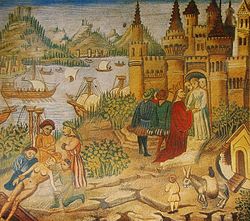
The Schola Medica Salernitana was founded in the 9th century in Salerno, Italy. Drawing on Arabic and Greek medical traditions, it became a leading centre of medical knowledge in Western Europe between the 10th and 13th centuries and played a key role in the earliest documented history of juniper-infused distilled tonics.
Image source: Schola Medica Salernitana
1055
% complete
A collection of remedies compiled around 1055 under the name Compendium Salernitanum includes a recipe for a juniper-infused tonic wine, made by Benedictine monks using distilling knowledge that had moved into Europe via the Moors' rule of Sicily. This is a medicinal precursor of gin from Salerno, Italy.
1100
% complete
The first traces of wine distillates infused with herbs date back to the 12th century in Italy, referenced in the Compendium Salernitanum of the Schola Medica Salernitana. Gin originated as a medicinal liquor made by monks and alchemists, predating its later association with Britain and the Netherlands by several centuries.
Image source: Gin
1200
% complete
Belgium's National Jenever museum in Hasselt credits Flanders in the 13th century as where jenever was created. Genever, developed in the Low Countries between the 13th and 16th centuries, is the direct ancestor of gin.
Image source: Jenever
1500
% complete
The first recorded mention of genever as a distilled beverage flavored with juniper appears in the 16th century, in Philippus Hermanni's Antwerp-published Een Constelijck Distileerboec.
1585
% complete
It is claimed that English soldiers who provided support in Antwerp against the Spanish in 1585, during the Eighty Years' War, were already drinking jenever for its calming effects before battle, from which the term Dutch courage is believed to have originated.
1606
% complete
In 1606 taxes were levied on distilled anise, gin or fennel water sold as alcoholic drinks — eight years before Franciscus Sylvius was born, further undermining claims that he invented gin.
1623
% complete
The existence of jenever is confirmed in Philip Massinger's play The Duke of Milan (1623). This disproves the false claim that physician Franciscus Sylvius invented gin in the mid-17th century, as Sylvius would have been about nine years old at the time.
1650
% complete
By the mid-17th century, numerous small Dutch and Flemish distillers had popularized the re-distillation of malted barley spirit or malt wine with juniper, anise, caraway and coriander, sold in pharmacies to treat kidney ailments, lumbago, stomach ailments, gallstones and gout.
1800 - 1900
% complete
The oude (old) style of jenever remained very popular throughout the 19th century, where it was referred to as Holland or Geneva gin in popular American pre-Prohibition bartender guides.
1639
% complete
A 1639 manuscript, The Distiller of London, contains a juniper/orange peel/lemon peel/orris root recipe — the template for London Dry Gin. Historians Jared Brown and Anistatia Miller argue this predates Dutch genever's arrival in Britain by roughly fifty years, displacing an earlier English gin tradition.
1660
% complete
Gin emerged in England in varying forms by the early 17th century, and at the time of the Stuart Restoration it enjoyed a brief resurgence in popularity.
Image source: Stuart Restoration
1688 - 1689
% complete
Although gin's development had been taking place since the early 17th century, it became widespread after the 1688 Glorious Revolution led by William of Orange. After he took the British throne in 1689, taxes on domestically distilled spirits dropped and heavy duties hit imports like French brandy — a political move against France, not a quality judgment.
Image source: Glorious Revolution
1695 - 1735
% complete
A larger market for poor-quality barley unfit for brewing beer emerged, and between 1695 and 1735 thousands of gin shops sprang up throughout England. Gin emerged as the national alcoholic drink of England during the Gin Craze.
Image source: Gin Craze
1700 - 1800
% complete
Gin in the 18th century was produced in pot stills, and thus had a maltier profile than modern London gin, quite different from the neutral spirit used today.
Image source: Pot still
1700
% complete
The 18th century gave rise to Old Tom gin, a softer, sweeter style of gin, often containing sugar, produced alongside the maltier pot-still gins of the era.
1726
% complete
In London in the early 18th century, much gin was distilled legally in residential houses, with an estimated 1,500 residential stills in 1726, often flavoured with turpentine to generate resinous woody notes in addition to the juniper.
1736
% complete
The Gin Act 1736 imposed high taxes on retailers and led to riots in the streets of England as drinkers resisted the prohibitive duty.
Image source: Gin Act 1736
1742
% complete
The prohibitive duty introduced by the Gin Act 1736 was gradually reduced and finally abolished in 1742 after widespread resistance and rioting.
1751
% complete
William Hogarth illustrated the contrasting reputations of beer and gin in his engravings Beer Street and Gin Lane (1751), described by the BBC as 'arguably the most potent anti-drug poster ever conceived'.
Image source: Beer Street and Gin Lane
1751
% complete
The Gin Act 1751 was more successful than earlier legislation: it forced distillers to sell only to licensed retailers and brought gin shops under the jurisdiction of local magistrates.
1826 - 1831
% complete
The invention and development of the column still in 1826 and 1831 made the distillation of neutral spirits practical, thus enabling the creation of the London dry style that evolved later in the 19th century.
Image source: Column still
1850 - 1900
% complete
Enabled by the column still, the London dry style evolved during the latter half of the 19th century, becoming the drier, cleaner gin profile known worldwide today.
1900 - 1920
% complete
Old Tom gin, the softer, sweeter 18th-century style, faded in popularity by the early 20th century as drier styles like London dry dominated the market.
1913
% complete
As late as 1913, Webster's Dictionary stated without further comment that 'common gin' is usually flavoured with turpentine, echoing a practice dating back to the early 18th century.
Image source: Webster's Dictionary
2000
% complete
Under its legal definition, London gin may not contain added sweetening exceeding 0.1 g of sugars per litre of the final product, nor colourants, nor any added ingredients other than water.
2013 - 2026
% complete
Since 2013, gin has been in a period of ascendancy worldwide, with many new brands and producers entering the category, leading to strong growth, innovation and change across the industry.
2018
% complete
In 2018, more than half the growth in the UK gin category was contributed by flavoured gin, highlighting shifting consumer tastes toward innovative new products.
Or browse the full history timeline directory, with more than 2,000 topics.
This History of Gin timeline was generated with the help of AI, using information found on the internet.
We work hard to keep these timelines accurate, but mistakes do get through. If you spot one, email us at [email protected] and we'll fix it for future visitors.
Generate yours with AI or build it from scratch, for free.
Export your timeline, add your own events, edit or remove AI-generated events, and much more
No credit card required.
Cancel anytime.
Cancel anytime.
You can create an unlimited number of timelines with up to 10 events on each one, customize how they look, export them to PDF, PNG, PowerPoint, CSV, and Excel, and share them with a link. Paid plans raise the event limit and add features like spreadsheet imports and collaborators.
Yes. You can cancel your subscription from your account page at any time, and you will not be charged again. Your subscription stays active for the rest of the period you already paid for.
Yes. We will email you a reminder before the annual renewal, and we will also email you a receipt.
Yes. You can email us within 15 days of any payment, and we will issue you a full refund.
Check out our pricing docs or send us an email anytime: [email protected].