-
Use Cases
-
Resources
-
Pricing
Sake is a traditional Japanese alcoholic beverage brewed from fermented rice, water, yeast, and koji mold. Its history spans over two thousand years, evolving from primitive village brews and sacred offerings in Shinto ceremonies into a refined national industry. Technological advances such as pasteurization, koji cultivation techniques, and modern brewing science have shaped sake production, which today enjoys a global renaissance as both a cultural heritage and a contemporary craft beverage. More Less
710 - 794
% complete
According to Bamforth (2005), the probable origin of true sake, made from rice, water, and koji (Aspergillus oryzae), lies in the Nara period (710–794), when brewing with cultivated mold began to produce the beverage recognizable as sake today.
Image source: Sake
794 - 1185
% complete
During the Heian period, sake played an important role in religious ceremonies, court festivals, and drinking games among the aristocracy, embedding the beverage deeply into courtly culture and ritual life.
900 - 1000
% complete
After a long period when sake production was a government monopoly, Buddhist temples and Shinto shrines began brewing sake in the 10th century, becoming the main centers of production for the next 500 years.
1141
% complete
The Sudo Honke brewery in Kasama, Ibaraki was founded during the Heian period. It remains the oldest sake brewing company still in operation today as confirmed by historical documents.
1333 - 1440
% complete
Before the 1440s in the Muromachi period, the Buddhist temple Shoryaku-ji invented various innovative methods for making sake, including the bodaimoto starter mash technique that influenced later brewing practices.
1355
% complete
Goshu no nikki, the oldest known technical book on sake brewing (written in 1355 or possibly 1489), describes advanced brewing methods of its era, alongside the Tamonin nikki diary kept by monks of Kofuku-ji Temple between 1478 and 1618.
1400 - 1477
% complete
The oldest known sake brewery from excavated archaeological evidence dates to the 15th century near land owned by Tenryu-ji in Ukyo-ku, Kyoto. A hollow for collecting pressed sake drops and 14th-century Bizen ware jars were found, and it is estimated to have been used until the Onin War (1467–1477).
1500 - 1600
% complete
In the 16th century, the technique of distillation was introduced into the Kyushu district from Ryukyu, paving the way for shochu production and later influencing sake brewing methods involving distilled alcohol.
Image source: Shōchū
1667
% complete
In 1667, the technique of kanzukuri (cold-weather brewing) for making sake in winter was improved, taking advantage of cooler temperatures that hinder bacterial growth and improve quality.
1670 - 1700
% complete
As early as the late 17th century, it was discovered that small amounts of distilled alcohol could be added to sake before pressing to extract aromas and flavors from the rice solids, an early precursor to modern brewing practice.
1673 - 1900
% complete
In 1673, facing a rice shortage, the Tokugawa shogunate banned brewing outside of kanzukuri, ending four-season brewing. Sake was made only in winter until industrial technology developed in the 20th century.
1688 - 1704
% complete
During the Genroku era of the Edo period, the hashira jochu brewing method was developed, adding a small amount of distilled shochu to the mash to make sake more aromatic and lighter in taste while preventing quality deterioration.
1700 - 1800
% complete
In the 18th century, Engelbert Kaempfer and Isaac Titsingh published accounts identifying sake as a popular Japanese alcoholic beverage, with Titsingh the first to explain and describe the brewing process. Their work spread widely through Europe at the start of the 19th century.
Image source: Isaac Titsingh
1860 - 1877
% complete
Starting around the beginning of the Meiji era, sake-making techniques developed rapidly. Representative early sake rice varieties included Ise Nishiki (1860), Omachi (1866), and Shinriki (1877).
Image source: Ōmachi, Nagano
1878 - 1899
% complete
The liquor tax grew from 12.3% of national tax revenue in 1878 to 26.4% in 1888, and by 1899 it reached 38.8%, finally surpassing the land tax's share of 35.6%.
1899
% complete
In 1899, anticipating financial pressure from the First Sino-Japanese War and preparing for the Russo-Japanese War, the government banned home brewing. This destroyed the market for aged koshu, which brewers only resumed making in 1955.
1904
% complete
In 1904, the National Brewing Laboratory developed yamahai, a new method of making starter mash that reduced labor while preserving traditional flavor characteristics.
1904
% complete
The government opened the National Brewing Laboratory in 1904, beginning detailed studies of yeast and laying the scientific foundation for rapid advances in sake production during the Meiji era.
Image source: Research Institute of Brewing and Malting
1906
% complete
In 1906, the Brewing Society of Japan was founded, establishing a system whereby superior yeasts discovered were registered as Kyokai yeast and distributed to breweries throughout Japan.
1907
% complete
In 1907, the first government-run sake-tasting competition was held, encouraging quality improvement and friendly rivalry among breweries across Japan.
1910
% complete
In 1910, sokujō, a further improvement on starter mash production, was developed. This quicker fermentation-starter method became widely adopted across the industry.
1894
% complete
The term ginzo (carefully brewed sake) first appeared at the end of the Edo period, and the term ginjō, meaning the same, first appeared in 1894, foreshadowing the later rise of ginjō-shu.
1923
% complete
In 1923, Yamada Nishiki, later called the 'king of sake rice,' was produced. Among more than 123 varieties of sake rice as of 2019, it ranks first in production, ahead of Omachi in fourth place.
Image source: Yamada Nishiki
1930 - 1931
% complete
From 1930 to 1931, new rice milling machines were invented that could polish rice down to about 50%, removing off-flavors from the grain's surface and enabling more aromatic, refreshing sake.
Image source: White rice
1930 - 1975
% complete
The ginjō-shu popular worldwide today was created through the development of various production techniques from the 1930s to around 1975, combining high rice polishing, refined yeasts, and precise temperature control.
1936
% complete
In 1936, Yamada Nishiki, considered the most suitable sake rice for brewing ginjō-shu, became the recommended variety of Hyogo Prefecture, cementing its status in premium sake production.
1973
% complete
In 1973, the National Tax Agency's brewing research institute developed kijōshu, an expensive sake made partly with finished sake instead of water, intended for government banquets serving state guests.
1975 - 1990
% complete
From around 1975, ginjō-shu began to be marketed and was widely distributed in the 1980s. In 1990, official labeling standards for ginjō-shu were established, prompting many more brewers to sell it.
1975 - 2007
% complete
While there were 3,229 sake breweries nationwide in fiscal 1975, the number had fallen to 1,845 by 2007, reflecting declining domestic consumption and industry consolidation.
1978
% complete
In 1978, October 1 was designated Sake Day by the Japan Sake and Shochu Makers Association, celebrating the traditional brew and promoting sake culture domestically and abroad.
2001
% complete
Since the 21st century, Aspergillus kawachii (white koji) and Aspergillus luchuensis (black koji), traditionally used for shochu and awamori, have been used to brew sake. Amaneko, using white koji, was released in 2009; black koji sake remained less popular as of 2022.
2001
% complete
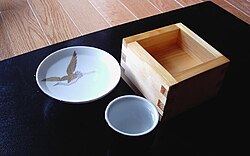
Since the 21st century, the use of wooden tubs for sake brewing has increased again thanks to the development of sanitary techniques, reviving traditional methods prized for the subtle character they impart.
Image source: Sake
2005
% complete
Circa 2005, teiseihaku-shu began to be produced as a specialty sake made with low polishing ratios around 80%, deliberately preserving the characteristic flavor of rice itself.
2008
% complete
In 2008, a total of 180,000 tons of polished rice were used in sake brewing, with sake rice accounting for 44,000 tons (24%) and table rice accounting for 136,000 tons (76%).
2009 - 2023
% complete
The value of sake exports in 2022 was over six times that of 2009. In 2022, sake ranked second in Japan's alcohol exports at 47.5 billion yen behind whisky, and exports rose another 70% since 2021, reaching 41.1 billion yen ($270.4 million) in 2023. Despite growth, sake held only 0.2% of the US alcohol market as of 2020.
2018
% complete
In 2018, Satake Corporation developed a new type of rice milling machine allowing dramatically faster and more focused milling of the long axis portion of rice, which has high mineral content and can add unwanted flavors.
2022
% complete
The Japan Craft Sake Breweries Association was founded in 2022 under the leadership of Shuhei Okazumi of Ine to Agave Brewery, supporting small-scale craft producers.
Image source: Craft beer
2023
% complete
As of 2023, the most polished sake achieves a remaining ratio of 0.85% or less, with at least 99.15% of the rice grain polished away — an extraordinary feat of milling technology.
Dec 2024
% complete
In December 2024, sake brewing — though not sake itself — was recognized by UNESCO as an intangible cultural heritage, honoring centuries of artisanal knowledge and craftsmanship.
Or browse the full history timeline directory, with more than 2,000 topics.
This History of Sake timeline was generated with the help of AI, using information found on the internet.
We work hard to keep these timelines accurate, but mistakes do get through. If you spot one, email us at [email protected] and we'll fix it for future visitors.
Generate yours with AI or build it from scratch, for free.
Export your timeline, add your own events, edit or remove AI-generated events, and much more
No credit card required.
Cancel anytime.
Cancel anytime.
You can create an unlimited number of timelines with up to 10 events on each one, customize how they look, export them to PDF, PNG, PowerPoint, CSV, and Excel, and share them with a link. Paid plans raise the event limit and add features like spreadsheet imports and collaborators.
Yes. You can cancel your subscription from your account page at any time, and you will not be charged again. Your subscription stays active for the rest of the period you already paid for.
Yes. We will email you a reminder before the annual renewal, and we will also email you a receipt.
Yes. You can email us within 15 days of any payment, and we will issue you a full refund.
Check out our pricing docs or send us an email anytime: [email protected].