-
Use Cases
-
Resources
-
Pricing
The history of GMOs (genetically modified organisms) traces the development of organisms whose DNA has been altered through genetic engineering. Beginning with foundational discoveries in molecular biology in the 1970s, GMOs evolved into commercial applications in agriculture and medicine by the 1980s and 1990s, transforming food production, sparking global debates over safety and labeling, and continuing to advance with modern gene-editing technologies like CRISPR. More Less
Apr 25, 1953
% complete
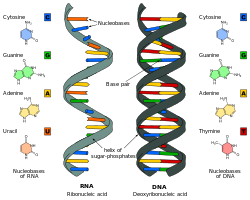
James Watson and Francis Crick published their model of the DNA double helix in Nature, revealing the molecular structure of genetic material. This discovery opened the door to understanding and eventually manipulating genes directly.
Image source: Nucleic acid
1970
% complete
Hamilton Smith and colleagues discovered restriction enzymes that cut DNA at specific sequences. These 'molecular scissors' became the essential tools of recombinant DNA technology, enabling scientists to splice genes from one organism into another.
1973
% complete
Herbert Boyer and Stanley Cohen successfully created the first genetically modified organism by inserting foreign DNA into a bacterium using plasmids. Their breakthrough demonstrated that genes could be transferred between species, founding the field of genetic engineering.
Image source: Recombinant DNA
Jun 26, 2000
% complete
An international consortium announced the first draft sequence of the human genome, completing a 13-year effort. The achievement accelerated genomics and provided tools for more precise genetic modification techniques.
Image source: Human Genome Project

Jun 28, 2012
% complete
Jennifer Doudna and Emmanuelle Charpentier published work demonstrating CRISPR-Cas9 as a programmable genome editing tool. The technique made precise, cheap gene editing possible in virtually any organism, transforming biotechnology and agriculture.
Image source: CRISPR gene editing
Feb 1975
% complete
Scientists gathered at Asilomar, California to discuss the biosafety risks of recombinant DNA research. The conference produced voluntary guidelines that shaped early regulation of genetic engineering and set a precedent for self-governance in biotechnology.
Image source: Asilomar Conference on Recombinant DNA
Oct 23, 1990
% complete
The European Union adopted Directive 90/220/EEC governing the deliberate release of genetically modified organisms into the environment. This established Europe's precautionary regulatory framework, which would later diverge sharply from US policy.
Jan 29, 2000
% complete
The Cartagena Protocol on Biosafety, an international treaty under the Convention on Biological Diversity, established rules for the safe handling, transport, and use of living modified organisms, particularly regarding cross-border trade.
Image source: Cartagena Protocol on Biosafety
Sep 2000
% complete
Aventis's StarLink corn, approved only for animal feed due to potential allergenicity of its Bt protein, was found in taco shells and other human foods, triggering massive recalls. The incident heightened public concern about GM food contamination.
Aug 2002
% complete
Zambia refused donations of GM maize during a severe famine, citing health and environmental concerns and fears about losing export markets to Europe. The decision sparked international debate about GMOs and food security in Africa.
Image source: Genetically modified food controversies
2005
% complete
European authorities pursued enforcement actions related to unauthorized GM material entering food chains, underscoring tensions between major biotech firms and strict EU traceability and labeling requirements for GMOs.
Image source: Monsanto
2009
% complete
China issued biosafety certificates for GM rice and phytase maize, signaling potential expansion of GM staple crops in Asia, although commercial planting was later delayed amid public concerns.
Image source: Genetically modified rice
Jul 29, 2016
% complete
The United States passed a federal law requiring mandatory disclosure of bioengineered foods, replacing state-level laws like Vermont's. Rules finalized in 2018 established national labeling standards for GM ingredients.
Image source: Genetically modified organism
Nov 26, 2018
% complete
Chinese scientist He Jiankui announced the birth of twin girls whose genomes he had edited with CRISPR to resist HIV infection. The announcement provoked worldwide condemnation, and He was sentenced to prison, prompting calls for moratoria on heritable human gene editing.
Image source: He Jiankui affair
Apr 2021
% complete
Following Brexit, the UK launched a consultation to deregulate gene-edited plants treated differently from transgenic GMOs, culminating in the Genetic Technology (Precision Breeding) Act, which eased pathways for precision-bred crops.
Image source: Advanced Research and Invention Agency
Jun 16, 1980
% complete
In Diamond v. Chakrabarty, the US Supreme Court ruled that a genetically modified bacterium capable of breaking down crude oil could be patented, declaring that 'anything under the sun made by man' is patentable. This decision paved the way for commercial investment in GM organisms.
Image source: Diamond v. Chakrabarty
1982
% complete
The FDA approved human insulin produced by genetically engineered bacteria, marketed by Genentech as Humulin. It was the first consumer product made with recombinant DNA technology, demonstrating the medical potential of genetic engineering.
Image source: Insulin (medication)
May 18, 1994
% complete
The FDA approved the Flavr Savr tomato, making it the first commercially grown genetically modified food to be granted a license for human consumption. It went on sale in US stores in 1994, though it was ultimately a commercial failure.
1995
% complete
The EPA approved Bt corn, engineered with a gene from Bacillus thuringiensis to produce a protein toxic to insect pests like the European corn borer. It reduced pesticide use and crop losses, becoming one of the most widely planted GM crops.
1996
% complete
Monsanto's Roundup Ready soybeans, resistant to glyphosate herbicide, were commercialized in 1996. Farmers could spray entire fields to kill weeds without harming crops, and adoption spread rapidly across the Americas.
Image source: Glyphosate
Dec 12, 2003
% complete
GloFish, zebrafish engineered with fluorescent protein genes to glow in bright colors, became the first genetically modified animal sold as a household pet in the United States, opening a new consumer market for GM organisms.
Image source: GloFish
May 2009
% complete
The Rainbow papaya, engineered for resistance to papaya ringspot virus, had rescued Hawaii's papaya industry since its 1998 introduction; by 2009 it accounted for the vast majority of Hawaiian papaya production, showcasing a clear agricultural success story.
Image source: Papaya ringspot virus
Feb 13, 2015
% complete
The USDA approved Arctic apples, engineered via RNA interference to resist browning when sliced. They reached stores in 2017, marketed as reducing food waste and appealing directly to consumers rather than farmers.
Nov 19, 2015
% complete
The FDA approved AquAdvantage salmon, engineered with growth hormone genes from Chinook salmon to grow faster year-round. It was the first GM animal approved for human consumption in the United States.
Image source: AquAdvantage salmon
Jun 2017
% complete
Brazil approved CTC's Bt sugarcane, the world's first commercial GM sugarcane, engineered to resist the cane borer pest. Brazil, a global sugar and ethanol leader, expanded its portfolio of GM crops beyond soybeans, corn, and cotton.
1982
% complete
Scientists produced the first transgenic mice by introducing foreign genes into embryos, creating animals whose genomes carried DNA from other species. These 'supermice' grew larger than normal and proved genetic engineering worked in mammals.
Image source: Genetically modified mouse
1986
% complete
The first authorized field trials of genetically modified plants took place in the United States and France, testing herbicide-resistant tobacco. These trials marked the transition of plant genetic engineering from laboratory to open environment.
1992
% complete
Calgene developed the Flavr Savr tomato, engineered to slow ripening through antisense RNA technology. It was designed to stay firm longer after harvest, offering consumers a vine-ripened taste with extended shelf life.
Jul 5, 1996
% complete
Scientists at the Roslin Institute in Scotland cloned Dolly the sheep from an adult somatic cell, the first mammal cloned from an adult cell. While not a transgenic animal, Dolly revolutionized thinking about genetic manipulation of animals.
Image source: Dolly (sheep)
1999
% complete
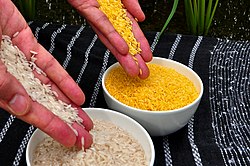
Researchers Ingo Potrykus and Peter Beyer developed Golden Rice, engineered to produce beta-carotene, a precursor of vitamin A. Designed to combat blindness and death from vitamin A deficiency in developing countries, it became a symbol of humanitarian biotechnology.
Image source: Golden rice
2005
% complete
Improved versions of Golden Rice with significantly higher beta-carotene levels were developed, advancing the grain toward eventual regulatory approval in the Philippines and Bangladesh decades after its invention.
2019
% complete
According to ISAAA reports, the global area planted with biotech crops exceeded 190 million hectares across dozens of countries, led by soybeans, maize, cotton, and canola, demonstrating broad worldwide adoption since 1996.
Dec 2020
% complete
Japan approved a CRISPR-edited tomato with elevated GABA levels, the first gene-edited food approved for sale in Japan. It marked a shift toward lighter regulation of gene-edited crops distinct from transgenic GMOs.
Image source: CRISPR gene editing
Jul 2021
% complete
The Philippines issued a permit allowing direct use as food, feed, or processing of Golden Rice, making it the first country to approve the vitamin A-enriched grain for propagation, two decades after its development.
Or browse the full history timeline directory, with more than 2,000 topics.
This History of GMOs timeline was generated with the help of AI, using information found on the internet.
We work hard to keep these timelines accurate, but mistakes do get through. If you spot one, email us at [email protected] and we'll fix it for future visitors.
Generate yours with AI or build it from scratch, for free.
Export your timeline, add your own events, edit or remove AI-generated events, and much more
No credit card required.
Cancel anytime.
Cancel anytime.
You can create an unlimited number of timelines with up to 10 events on each one, customize how they look, export them to PDF, PNG, PowerPoint, CSV, and Excel, and share them with a link. Paid plans raise the event limit and add features like spreadsheet imports and collaborators.
Yes. You can cancel your subscription from your account page at any time, and you will not be charged again. Your subscription stays active for the rest of the period you already paid for.
Yes. We will email you a reminder before the annual renewal, and we will also email you a receipt.
Yes. You can email us within 15 days of any payment, and we will issue you a full refund.
Check out our pricing docs or send us an email anytime: [email protected].