-
Use Cases
-
Resources
-
Pricing
The History of Hanoi spans over a thousand years, beginning with its establishment as Thăng Long by Emperor Lý Thái Tổ in 1010. As Vietnam's political and cultural center, Hanoi has endured Chinese rule, French colonialism, Japanese occupation, devastating wars, and reunification, evolving into the vibrant capital of modern Vietnam. More Less
300 BC
% complete
In around the third century BC, a fortified citadel later named Cổ Loa was constructed in what is now Hanoi. It became the first political center of Vietnamese civilization in the pre-Sinitic era, with an outer embankment covering 600 hectares.
Image source: Citadel of Cổ Loa
450
% complete
By the middle of the fifth century, a fortified settlement was founded in the center of what is now Hanoi by the Chinese Liu Song dynasty as the seat of a new district called Tống Bình (Songping) within Giao Chỉ commandery.
750
% complete
In the latter half of the eighth century, Zhang Boyi, a viceroy from the Tang dynasty, built Luocheng (Vietnamese: La Thành) to suppress uprisings. Over the first half of the ninth century it was expanded and renamed Jincheng (Kim Thành).
900
% complete
By the tenth century AD, what later became Hanoi was known to Muslim traders as Luqin. Arab manuscripts between the ninth and twelfth centuries used the term, derived from Longbian (Middle Chinese: Ljowng-pen), originally to mention the Vietnamese.
1010
% complete
In 1010, under the Lý dynasty, emperor Lý Thái Tổ moved the capital of imperial Đại Việt to the site of the Đại La Citadel in what would become central Hanoi, naming the city Thăng Long ('ascending dragon').
Image source: Lý Thái Tổ
1049
% complete
The One Pillar Pagoda (Chùa Một Cột) was built in 1049 based on a dream of king Lý Thái Tông (1028–1054) and stands among Hanoi's most iconic feudal-era structures.
Image source: One Pillar Pagoda
1397
% complete
Thăng Long remained the capital of Đại Việt until 1397, when the capital was moved to Thanh Hóa, then known as Tây Đô (西都), the 'Western Capital'.
1408
% complete
In 1408, the Chinese Ming dynasty attacked and occupied Vietnam, changing Đông Đô's name to Dongguan (東關; Đông Quan, meaning 'eastern gate').
Image source: Fourth Era of Northern Domination
1428
% complete
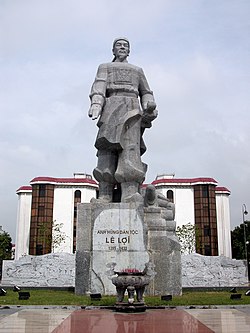
In 1428, the Lam Sơn uprising under the leadership of Lê Lợi overthrew Chinese rule. Lê Lợi renamed the city Đông Kinh ('eastern capital'), a name the city kept until 1789.
Image source: Lê Lợi
1600 - 1699
% complete
During the seventeenth century, Western diplomats estimated the population of Đông Kinh (Hanoi) at approximately 100,000 people.
Image source: Hanoi
1802
% complete
When the Nguyễn dynasty was established in 1802, emperor Gia Long moved the national capital to Huế, ending the city's role as the seat of Vietnamese royal power.
Image source: Gia Long
1831
% complete
In 1831, the Nguyễn king Minh Mạng renamed the city Hà Nội (河內), meaning 'inside the rivers', which remains its name today.
Image source: Minh Mạng
2004
% complete
In 2004, part of the 900-year-old Hanoi Citadel was discovered in central Hanoi near the site of Ba Đình Square, revealing layers of the city's long history.
1010
% complete
The Temple of Literature (Văn Miếu), site of the oldest university in Vietnam, was started in 1010 and remains one of the most prominent edifices from the feudal period in Hanoi.
Image source: Temple of Literature, Hanoi
May 1926
% complete
In May 1926, Hanoi recorded its highest ever temperature of 42.8 °C (109 °F). The lowest recorded temperature was later measured at 2.7 °C on 12 January 1955.
Image source: Hanoi
Jan 12, 1955
% complete
On 12 January 1955, Hanoi recorded its lowest ever temperature of 2.7 °C (37 °F), contrasting with the record high of 42.8 °C set in May 1926.
1956
% complete
After the Communist Party of Vietnam took control of Hanoi in 1954, new universities were built in the city, including the Hanoi University of Science and Technology.
Image source: Hanoi University of Science and Technology
1988
% complete
Thăng Long University was founded in 1988 by Vietnamese mathematics professors in Hanoi and France, expanding higher education options in the capital.
1997
% complete
Located northwest of Hanoi's historic center, the Vietnam Museum of Ethnology opened in 1997, consisting of two exhibition halls and an Architecture Garden.
Image source: Vietnam Museum of Ethnology
Jul 16, 1999
% complete
On 16 July 1999, UNESCO presented the title 'City for Peace' to Hanoi in recognition of exemplary action against exclusion, urban, environmental, cultural, and civic education efforts.
2009
% complete
The third Asian Indoor Games were held in Hanoi in 2009. Some venues also held events at the 2003 and 2021 SEA Games, both hosted in Hanoi.
Image source: 2009 Asian Indoor Games
Jan 24, 2016
% complete
During a January 2016 cold wave, snow appeared on the nearby Ba Vì mountain range northwest of Hanoi, where temperatures fell to 0 °C (32 °F) on 24 January 2016.
Image source: Ba Vì mountain range
Nov 6, 2018
% complete
On 6 November 2018 it was announced that Hanoi would host the first FIA Formula 1 Vietnamese Grand Prix in 2020 on a street circuit on the outskirts of the city. The race was postponed due to COVID-19 and removed from the 2021 calendar after corruption charges against Hanoi People's Committee chairman Nguyễn Đức Chung.
Image source: Vietnamese Grand Prix
1873 - 1883
% complete
Hanoi was conquered and occupied by the French military in 1873 and formally passed to them ten years later. It became part of the protectorate of Tonkin.
1888
% complete
The French took full control of Hanoi in 1888 and modeled the city's architecture to their tastes. Nominally still belonging to Nguyễn dynasty sovereignty under the Tonkin protectorate, it had since 1888 been a French concession directly ruled like Cochinchina.
Image source: French Indochina
1898 - 1902
% complete
Gouverneur-Général Paul Doumer (1898–1902) played a significant role in colonial Hanoi's urban planning, leaving a lasting imprint on the city's layout and architecture.
Image source: Paul Doumer
1902
% complete
As Hanoi, located in the protectorate of Tonkin, the city became the capital of French Indochina in 1902 and served as the administrative center for most of the colonial period.
Sep 1940
% complete
French Indochina including Hanoi was occupied by the Imperial Japanese Armed Forces in September 1940 following the Japanese invasion of French Indochina.
Image source: Japanese invasion of French Indochina
Mar 1945
% complete
In March 1945, Japan overthrew the French administration in Hanoi and installed the Empire of Vietnam, a short-lived Japanese client state that collapsed later that year.
Image source: Empire of Vietnam
Feb 1947
% complete
The French returned and reoccupied the city of Hanoi in February 1947, reigniting conflict with DRV forces that would continue until 1954.
Image source: First Indochina War
Jun 14, 1949
% complete
After France recognized Vietnam's nominal and partial independence through the Élysée Accords on 14 June 1949, Hanoi came under control of the State of Vietnam from 1949 to 1954, an associated state within the French Union.
Jan 1953
% complete
In January 1953, Hanoi held the free municipal elections of the State of Vietnam while it remained within the French Union.
Image source: State of Vietnam
Jun 4, 1954
% complete
The State of Vietnam gained full independence with the Matignon Accords on 4 June 1954, shortly before the Geneva Conference ended French involvement in northern Vietnam.
1899 - 1936
% complete
The Reunification Express line was established during French colonial rule and was completed over a period from 1899 to 1936, connecting Hanoi with southern Vietnam.
Image source: North–South railway (Vietnam)
1924
% complete
A development master plan for Hanoi was designed by Ernest Hebrard in 1924 and was partially implemented, shaping the colonial-era growth of the city.
Image source: Ernest Hébrard
1978
% complete
In 1978, the National Assembly decided to expand Hanoi for the second time to 2,136 km², bringing the population to 2.5 million people.
1981 - 1984
% complete
The previous relationship between the Soviet Union and Vietnam led to the creation of the first comprehensive plan for Hanoi with the assistance of Soviet planners between 1981 and 1984.
Apr 1992
% complete
The first major modern plan, the Hanoi Master Plan 1990–2010, was approved in April 1992, with land-use patterns meant to resemble a five-cornered star by 2010.
1998
% complete
In 1998, a revised version of the Hanoi Master Plan was approved, intended to be completed in 2020.
1999
% complete
Hanoi's population reached 2,672,122 people in 1999, after the city's area had decreased to 924 km² in 1991 while remaining above 2 million inhabitants.
Aug 1, 2008
% complete
On 29 May 2008, it was decided that Hà Tây Province, Mê Linh District of Vĩnh Phúc Province, and four communes in Lương Sơn District would merge into Hanoi effective 1 August 2008. The expanded Hanoi had a population of 6.233 million and ranked among the world's largest capitals by area.
Image source: Hà Tây province
Jul 4, 2017
% complete
On 4 July 2017, the Hanoi government voted to ban motorbikes entirely by 2030 to reduce pollution and congestion and encourage expansion and use of public transport.
Nov 6, 2021
% complete
Line 2A of the Hanoi Metro opened on 6 November 2021, marking the start of metro operations in the city, followed by Line 3 beginning operations on 8 August 2024.
Image source: Hanoi Metro
Sep 2, 1945
% complete
After the fall of the Empire of Vietnam, Hanoi became the capital of the Democratic Republic of Vietnam (DRV) when Ho Chi Minh proclaimed the independence of Vietnam on 2 September 1945 at Ba Đình Square.
Image source: Declaration of independence of the Democratic Republic of Vietnam
Jul 21, 1954
% complete
After eight years of fighting between the French and DRV forces, Hanoi became the capital of North Vietnam when the territory became sovereign and Vietnam was divided at the 17th parallel on 21 July 1954 under the Geneva Conference terms.
Image source: 1954 Geneva Conference
Oct 10, 1954
% complete
On 10 October 1954, the People's Army of Vietnam of the DRV and the International Control Commission occupied Hanoi under the terms of the 1954 Geneva Conference, as the army of the French Union withdrew to the South.
1955 - 1975
% complete
During the Vietnam War between North and South Vietnam (1955–1975), North Vietnam including Hanoi was attacked by the United States and South Vietnamese Air Forces.
Image source: Vietnam War
Jul 2, 1976
% complete
Following the end of the war with the fall of Saigon in 1975, Hanoi became the capital of the Socialist Republic of Vietnam when North and South Vietnam were reunited on 2 July 1976.
Image source: Vietnam
1986
% complete
After the Đổi Mới economic policies were approved in 1986, the Communist Party and national and municipal governments hoped to attract international investments for urban development projects in Hanoi.
Image source: Đổi Mới
Or browse the full history timeline directory, with more than 2,000 topics.
This History of Hanoi timeline was generated with the help of AI, using information found on the internet.
We work hard to keep these timelines accurate, but mistakes do get through. If you spot one, email us at [email protected] and we'll fix it for future visitors.
Generate yours with AI or build it from scratch, for free.
Export your timeline, add your own events, edit or remove AI-generated events, and much more
No credit card required.
Cancel anytime.
Cancel anytime.
You can create an unlimited number of timelines with up to 10 events on each one, customize how they look, export them to PDF, PNG, PowerPoint, CSV, and Excel, and share them with a link. Paid plans raise the event limit and add features like spreadsheet imports and collaborators.
Yes. You can cancel your subscription from your account page at any time, and you will not be charged again. Your subscription stays active for the rest of the period you already paid for.
Yes. We will email you a reminder before the annual renewal, and we will also email you a receipt.
Yes. You can email us within 15 days of any payment, and we will issue you a full refund.
Check out our pricing docs or send us an email anytime: [email protected].