
-
Use Cases
-
Resources
-
Pricing
The history of Italian cuisine spans over two millennia, evolving from the lavish feasts of ancient Rome through medieval spice trade influences to the tomato-based dishes that define Italy today. Shaped by geography, regional traditions, and foreign imports like tomatoes and rice, Italian cuisine became a global symbol of culinary artistry, celebrated for its simplicity, fresh ingredients, and deep cultural heritage. More Less
450 BC
% complete
The Sicilian cook Mithaecus, born during the 5th century BC, is credited with having brought knowledge of Sicilian gastronomy to Greece. His cookbook was the first in Greek, making him the earliest cookbook author in any language whose name is known.
400 BC
% complete
There is evidence that the Etruscans were making pasta in Italy during the 4th century BC, providing one of the earliest traceable roots of Italian cuisine. Although Italy did not unite until the 19th century, the cuisine can claim traceable roots this far back in antiquity.
350 BC
% complete
The first known Italian food writer was a Greek Sicilian named Archestratus from Syracuse in the 4th century BC. His writings mark the beginning of recorded culinary literature connected to Italy.
Image source: Archestratus
1 AD
% complete
By the time De re coquinaria was published in the 1st century AD, it contained 470 recipes calling for heavy use of spices and herbs, offering a rich picture of ancient Roman cooking.
Image source: Apicius
850
% complete
Arabs conquered Sicily in the 9th century, introducing spinach, almonds, and rice to the island. These ingredients became foundational elements of Sicilian cooking and shaped its distinctive character for centuries to come.
Image source: Emirate of Sicily
1150
% complete
During the 12th century, a Norman king surveyed Sicily and saw people making long strings made from flour and water called atriya, which eventually became trii, a term still used for spaghetti in southern Italy.
1250
% complete
The oldest Italian book on cuisine is the 13th-century Liber de coquina (Cookbook) written in Naples. It represents the earliest surviving written record of Italian culinary practice.
Image source: Liber de Coquina
1284
% complete
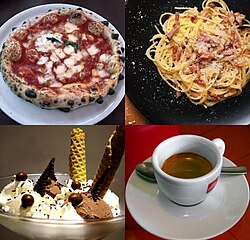
Milan is home to the oldest restaurant in Italy and the second in Europe, the Antica trattoria Bagutto, which has existed since at least 1284, making it a living monument to centuries of Lombard cooking.
Image source: Italian cuisine
1350
% complete
Two other books from the 14th century include recipes for Roman pastello and Lasagna pie, and call for the use of salt from Sardinia or Chioggia, showing growing regional diversity in medieval Italian cookbooks.
1450
% complete
In the 15th century, Maestro Martino was chef to the Patriarch of Aquileia at the Vatican. He was one of the most celebrated chefs of the Renaissance and his work codified refined Italian cooking of his era.
1475
% complete
Martino's text was included in a 1475 book by Bartolomeo Platina printed in Venice entitled De honesta voluptate et valetudine (On Honest Pleasure and Good Health), spreading Renaissance Italian cuisine through the new medium of print.
Image source: De honesta voluptate et valetudine
1549
% complete
Cristoforo di Messisbugo, steward to Ippolito d'Este, published Banchetti compositioni di vivande (Banquets Compositions of Food) in 1549, documenting the lavish banquets of the Ferrara court.
1550
% complete
Before the Council of Trent in the middle of the 16th century, the region was known for the simplicity of its peasant cuisine, after which its food culture began to evolve under broader religious and cultural currents.
1570
% complete
In 1570, Bartolomeo Scappi, personal chef to Pope Pius V, wrote his Opera (Work) in five volumes, giving a comprehensive view of Italian cooking of that period and remaining a landmark of culinary literature.
Image source: Bartolomeo Scappi
1605
% complete
In the first decade of the 17th century, Giacomo Castelvetro wrote Brieve racconto di tutte le radici, di tutte l'erbe e di tutti i frutti che crudi o cotti in Italia si mangiano, later translated into English by Gillian Riley, celebrating Italy's raw and cooked produce.
Image source: Giacomo Castelvetro
1662
% complete
In 1662, Bartolomeo Stefani, chef to the Duchy of Mantua, published L'Arte di ben cucinare (The Art of Well Cooking), an influential work of Baroque Italian gastronomy.
Image source: Agnolini
1500
% complete
Significant changes occurred with the colonization of the Americas and the consequent introduction of potatoes, tomatoes, capsicums, and maize, as well as sugar beet—the latter introduced in quantity in the 18th century—transforming Italian cooking forever.
1705
% complete
At the beginning of the 18th century, Italian culinary books began to emphasise the regionalism of Italian cuisine rather than French cuisine, asserting a distinct national culinary identity built on local traditions.
1750
% complete
In the 18th century, medical texts warned peasants against eating refined foods, as it was believed these were poor for their digestion and their bodies required heavy meals, reflecting contemporary views linking diet and social class.
1773
% complete
In 1773, the Neapolitan Vincenzo Corrado's Il cuoco galante (The Courteous Cook) gave particular emphasis to vitto pitagorico (pythagorean food), a vegetable-based diet inspired by Pythagorean ideals.
Image source: SSC Napoli
1779
% complete
In 1779, Antonio Nebbia from Macerata in the Marche region wrote Il cuoco maceratese (The Cook of Macerata), contributing to the growing corpus of regional Italian cookbooks.
1790
% complete
In 1790, Francesco Leonardi in his book L'Apicio moderno (The Modern Apicius) sketched a history of the Italian cuisine from the Roman Age and gave the first recipe for a tomato-based sauce, cementing the tomato's place at the heart of Italian cooking.
1794
% complete
Periodicals in booklet form such as La cuoca cremonese (The Cook of Cremona) in 1794 gave a sequence of ingredients according to season along with chapters on meat, fish, and vegetables. As the century progressed these books increased in size, popularity, and frequency.
1798
% complete
Corrado's 1798 edition introduced a 'Treatise on the Potato', following Frenchman Antoine-Augustin Parmentier's successful promotion of the tuber, helping integrate the potato into Italian kitchens.
1829
% complete
In 1829, Il nuovo cuoco milanese economico (The New Economic Milanese Chef) by Giovanni Felice Luraschi featured Milanese dishes such as kidney with anchovies and lemon and gnocchi alla romana.
1850
% complete
In the 19th century, Giovanni Vialardi, chef to King Victor Emmanuel II, wrote Trattato di cucina, pasticceria moderna, credenza e relativa confettureria (Treatise of Modern Cookery and Patisserie) with recipes 'suitable for a modest household'.
1871
% complete
Gian Battista and Giovanni Ratto's La cucina genovese (The Genoese cuisine) in 1871 addressed the cuisine of Liguria, whose cooking blends local wild herbs like preboggión with imported staples such as pecorino sardo used in pesto.
1891
% complete
La scienza in cucina e l'arte di mangiare bene by Pellegrino Artusi, first published in 1891, is widely regarded as the canon of classic modern Italian cuisine, and it is still in print today.
Image source: Pellegrino Artusi
1937
% complete
The modern espresso machine, invented in 1937 by Achille Gaggia, uses a pump and pressure system forcing water heated to 90–95 °C at high pressure through finely ground coffee, producing espresso as we know it today.
Image source: Gaggia
1963
% complete
The Italian government passed the denominazione di origine controllata (DOC) law in 1963 to regulate place of origin, quality, production method, and type of grape, protecting the integrity of Italian wines.
Image source: Denominazione di origine controllata
1975
% complete
The Italian chef Gualtiero Marchesi (1930–2017) is considered the founder of Italian nouvelle cuisine, revolutionizing fine dining in Italy with his minimalist, innovative approach rooted in tradition.
Image source: Gualtiero Marchesi
1980
% complete
In 1980, the government created the denominazione di origine controllata e garantita (DOCG), reserved for only the best wines, adding a stricter tier of quality assurance above the existing DOC classification.
1986
% complete
Following the spread of fast food imported from Anglo-Saxon countries, particularly from the United States, the Slow Food cultural and gastronomic movement was founded in 1986 in Bra, Piedmont. It was converted into an institution protecting culinary specificities and safeguarding regional products through the Slow Food Presidia.
1880
% complete
Around 1880, two decades after the unification of Italy, the beginning of the Italian diaspora started the spread of Italian cuisine around the world, carried by emigrants to the Americas and beyond.
Image source: Italian diaspora
1885 - 1920
% complete
Many Ligurians emigrated to Argentina in the late 19th and early 20th centuries, influencing Argentinian cuisine, which was otherwise dominated by meat and dairy products that Liguria's narrow hinterland could not have supported.
Image source: Cuisine of Liguria
1900
% complete
Pizza arrived in the United States in the early 20th century along with waves of Italian immigrants who settled primarily in the large cities of the Northeast, laying the groundwork for pizza's global popularity.
Image source: History of pizza
1952
% complete
In 1952, the first espresso machines began to appear in Sydney (probably the first in Australia) and a plethora of fine Italian coffee houses emerged in other Australian cities, such as Melbourne.
Image source: Espresso
2009
% complete
In 2009, upon Italy's request, Neapolitan pizza was registered with the European Union as a traditional speciality guaranteed dish, formally recognizing its authentic preparation methods.
Image source: Neapolitan pizza
2012
% complete
In 2012, a bottle of Trebbiano d'Abruzzo Colline Teramane ranked No. 1, demonstrating that Abruzzo's white wines had earned top international recognition alongside more famous Italian labels.
Image source: Montepulciano d'Abruzzo
2017
% complete
In 2017, the art of making Neapolitan pizza was included on UNESCO's list of intangible cultural heritage, honoring the craft of the pizzaiuoli of Naples.
2023
% complete
These ingredients are showcased in the English chef Norman Russell's 2023 cookbook, Brutto, reflecting continued international enthusiasm for authentic regional Italian cooking.
2024
% complete
Italian cuisine generated an estimated €251 billion in global foodservice revenue in 2024, according to Deloitte, underscoring its enormous worldwide economic and cultural impact.
2025
% complete
In 2025, Italian cuisine was listed as intangible cultural heritage by UNESCO, capping centuries of development in which ordinary people created many beloved dishes suited to home cooking while respecting regional specificities and seasonality.
Or browse the full history timeline directory, with more than 2,000 topics.
This History of Italian Cuisine timeline was generated with the help of AI, using information found on the internet.
We work hard to keep these timelines accurate, but mistakes do get through. If you spot one, email us at [email protected] and we'll fix it for future visitors.
Generate yours with AI or build it from scratch, for free.
Export your timeline, add your own events, edit or remove AI-generated events, and much more
No credit card required.
Cancel anytime.
Cancel anytime.
You can create an unlimited number of timelines with up to 10 events on each one, customize how they look, export them to PDF, PNG, PowerPoint, CSV, and Excel, and share them with a link. Paid plans raise the event limit and add features like spreadsheet imports and collaborators.
Yes. You can cancel your subscription from your account page at any time, and you will not be charged again. Your subscription stays active for the rest of the period you already paid for.
Yes. We will email you a reminder before the annual renewal, and we will also email you a receipt.
Yes. You can email us within 15 days of any payment, and we will issue you a full refund.
Check out our pricing docs or send us an email anytime: [email protected].