-
Use Cases
-
Resources
-
Pricing
Kyiv, one of Eastern Europe's oldest cities, has served as a political and cultural center for over 1,400 years. Founded as the capital of Kievan Rus', it endured Mongol destruction, Lithuanian, Polish, Russian Imperial, and Soviet rule before becoming the capital of independent Ukraine in 1991. Today it stands as Ukraine's vital heart of government, culture, and resilience. More Less
482
% complete
According to legend, the brothers Kyi, Shchek, Khoryv and their sister Lybid founded a settlement on the Dnipro River banks around 482. This legendary founding by the Polans tribe is commemorated in the city's official founding date of 482 AD, making it one of the oldest cities in Eastern Europe.
860 - 882
% complete
The Varangian rulers Askold and Dir established control over Kyiv and led a raid on Constantinople in 860. Their rule marked the early consolidation of power along the Dnipro before the arrival of the Rurik dynasty.
Image source: Askold and Dir
882
% complete
Prince Oleg captured Kyiv from Askold and Dir and made it his capital, traditionally marking the foundation of Kievan Rus'. Kyiv became known as 'the mother of Rus' cities' and grew into a major political center.
Image source: Oleg the Wise
945
% complete
Princess Olga ruled Kievan Rus' as regent after her husband Igor was killed by the Drevlians. She reformed the tribute system, converted to Christianity, and was later canonized as a saint of the Orthodox Church.
Image source: Olga of Kiev
962 - 972
% complete
Prince Sviatoslav I conducted ambitious military campaigns that destroyed Khazaria and expanded Kievan Rus' territory dramatically across Eastern Europe, though he spent little time in the capital itself.
Image source: Sviatoslav I
988
% complete
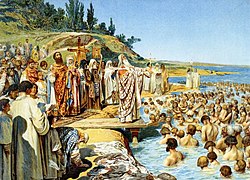
Grand Prince Volodymyr the Great adopted Byzantine Christianity and had the population of Kyiv baptized en masse in the Dnipro River. The Christianization transformed Kyiv into a major religious center and tied Rus' to the Byzantine cultural sphere.
Image source: Christianization of Kievan Rus'
1011 - 1037
% complete
Grand Prince Yaroslav the Wise commissioned the construction of Saint Sophia Cathedral, which became the spiritual heart of Kievan Rus'. Its mosaics and frescoes remain among the most important works of medieval art surviving today.
Image source: Saint Sophia Cathedral, Kyiv
1019 - 1054
% complete
Under Yaroslav the Wise, Kyiv reached its zenith as a political, cultural and economic powerhouse. He established libraries and schools, codified laws, arranged dynastic marriages with European royalty, and built fortifications including the famous Golden Gate.
Image source: Yaroslav the Wise
1169
% complete
An army led by Prince Andrey Bogolyubsky of Vladimir-Suzdal sacked Kyiv, plundering its churches and palaces. Though the city recovered, the event signaled the decline of Kyiv's primacy among the Rus' principalities.
Image source: Sack of Kiev (1169)
Dec 6, 1240
% complete
The Mongol army under Batu Khan besieged and destroyed Kyiv, reducing it to ruins and killing much of its population. The catastrophe ended Kievan Rus' as a unified state and left the city under Mongol domination for over a century.
Image source: Siege of Kiev (1240)
1362
% complete
Following the Battle of Blue Waters, the Grand Duchy of Lithuania took control of Kyiv. Under Lithuanian rule the city gradually recovered, serving as an important regional center while retaining some autonomy under local princes.
Image source: Grand Duchy of Lithuania
Jul 1, 1569
% complete
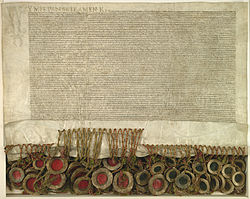
The Union of Lublin merged Poland and Lithuania into the Polish-Lithuanian Commonwealth, transferring Kyiv and other Ukrainian lands to the Polish Crown. Polish influence intensified, bringing tensions over religion and culture with the Orthodox population.
Image source: Union of Lublin
1615
% complete
The Kyiv Brotherhood Monastery school, later the Kyiv-Mohyla Academy, was founded by Metropolitan Petro Mohyla's circle. It became one of Eastern Europe's foremost centers of learning, producing generations of scholars and clerics.
Image source: National University of Kyiv-Mohyla Academy
1648 - 1657
% complete
Bohdan Khmelnytsky led a Cossack uprising that swept through Ukrainian lands, entering Kyiv triumphantly in December 1648. The revolt ended Polish control of the city for a time and reshaped the political landscape of Eastern Europe.
Image source: Khmelnytsky Uprising
Jan 18, 1654
% complete
Cossack Hetman Bohdan Khmelnytsky swore allegiance to the Tsar of Muscovy at Pereiaslav. Although the exact terms remain debated, the agreement began Moscow's gradual absorption of Cossack lands, eventually including Kyiv.
Image source: Pereiaslav Agreement
1686
% complete
The Treaty of Eternal Peace between Russia and the Polish-Lithuanian Commonwealth confirmed Russian possession of Kyiv, formalizing the city's transfer to the Tsardom of Muscovy and ending centuries of contested rule.
Image source: Polish–Russian Peace Treaty (1686)
1811
% complete
A catastrophic fire swept through Kyiv's bustling merchant quarter of Podil, destroying hundreds of buildings. The disaster prompted a redesign of the district on a regular street plan, transforming the city's urban fabric.
Image source: Great Fire of Podil
1838 - 1861
% complete
Ukraine's greatest national poet, Taras Shevchenko, lived and worked in Kyiv during various periods. His poetry and art inspired the Ukrainian national revival, and he remains a towering symbol of Ukrainian identity throughout the city today.
Image source: Taras Shevchenko
1868 - 1870
% complete
The first railway bridge over the Dnipro was completed and rail lines connected Kyiv to Kursk and Odessa. Rail transport spurred rapid industrialization and population growth, turning Kyiv into a major commercial hub of the Russian Empire.
Image source: Kyiv-Pasazhyrskyi railway station
Jun 13, 1892
% complete
Kyiv launched the first electric tram line in the Russian Empire, connecting Podil with the Upper Town. The innovative transit system reflected Kyiv's growing modernity and economic importance at the turn of the century.
Image source: Trams in Kyiv
Jun 27, 1934
% complete
The Soviet authorities moved the capital of the Ukrainian SSR from Kharkiv to Kyiv, restoring the city's historic status as Ukraine's political center and triggering major growth in administration, industry and population.
Image source: Ukrainian Soviet Socialist Republic
Sep 19, 1941 - Nov 6, 1943
% complete
Nazi Germany occupied Kyiv for over two years during World War II. The occupation brought brutal repression, deportations for forced labor, and mass executions. Soviet troops liberated the city in November 1943 after fierce fighting.
Image source: Reichskommissariat Ukraine
Sep 29, 1941
% complete
Nazi forces occupying Soviet Kyiv murdered 33,771 Jews at Babi Yar ravine over two days, one of the largest mass killings of the Holocaust. Thousands more victims were killed there during the German occupation until 1943.
Image source: Babi Yar
Nov 3, 1943 - Nov 6, 1943
% complete
The Red Army recaptured Kyiv from German forces in a swift offensive across the Dnipro River. The liberation came at enormous cost but restored Soviet control, and the city received the title 'Hero City' for its resistance.
Image source: Battle of Kiev (1943)
1955 - 1970
% complete
Massive construction of standardized apartment blocks expanded Kyiv rapidly to house its growing population. New districts such as Vynohradar and Obolon emerged, fundamentally changing the city's skyline and demographics.
Image source: Khrushchevka
Nov 6, 1960
% complete
The Kyiv Metro opened with the first section of the Sviatoshynsko-Brovarska line, becoming the third metro system in the USSR. The deep stations, many richly decorated, became iconic features of the city.
Image source: Kyiv Metro
Apr 26, 1986
% complete
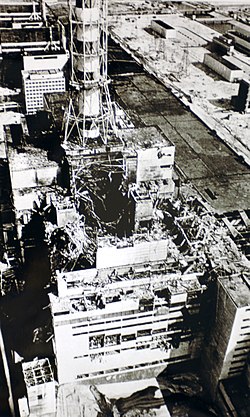
The explosion of Reactor No. 4 at the Chornobyl Nuclear Power Plant about 100 km north of Kyiv released massive radioactive contamination. The disaster exposed the failures of Soviet governance and profoundly affected Kyiv's residents and environment.
Image source: Chernobyl disaster
Jan 21, 1990
% complete
Hundreds of thousands of Ukrainians formed a human chain linking Kyiv to Lviv on the anniversary of the 1919 Unification Act, demonstrating mass support for Ukrainian independence and national revival.
Image source: Human chain (politics)
Aug 24, 1991
% complete
Ukraine's parliament declared independence following the failed August coup in Moscow, and over 90% of voters approved it in a December referendum. Kyiv became the capital of the newly independent Ukrainian state.
Image source: Declaration of Independence of Ukraine
Nov 22, 2004 - Dec 26, 2004
% complete
Hundreds of thousands of protesters gathered in Kyiv's Maidan Nezalezhnosti against a fraudulent presidential election won by Viktor Yanukovych. Mass demonstrations led to a court-ordered rerun vote won by Viktor Yushchenko.
Image source: Orange Revolution
Nov 21, 2013 - Feb 22, 2014
% complete
Protests began when President Yanukovych suspended an EU association agreement and escalated into months of confrontation on Maidan Nezalezhnosti. After deadly clashes with police killed over 100 protesters, Yanukovych fled and parliament removed him from office.
Image source: Euromaidan
Feb 24, 2022 - Feb 25, 2022
% complete
Russian airborne forces attacked Hostomel Airport northwest of Kyiv on the first day of the full-scale invasion, seeking a foothold to assault the capital. Ukrainian defenders repelled them, foiling Russia's plan for a rapid capture of Kyiv.
Image source: Battle of Antonov Airport
Feb 25, 2022 - Mar 29, 2022
% complete
Russian forces advanced toward Kyiv from multiple directions, shelling suburbs like Irpin, Bucha and Hostomel. Ukrainian resistance stalled the advance, and by late March Russian troops withdrew from the region, leaving evidence of atrocities behind.
Image source: Battle of Kyiv (2022)
Or browse the full history timeline directory, with more than 2,000 topics.
This History of Kyiv timeline was generated with the help of AI, using information found on the internet.
We work hard to keep these timelines accurate, but mistakes do get through. If you spot one, email us at [email protected] and we'll fix it for future visitors.
Generate yours with AI or build it from scratch, for free.
Export your timeline, add your own events, edit or remove AI-generated events, and much more
No credit card required.
Cancel anytime.
Cancel anytime.
You can create an unlimited number of timelines with up to 10 events on each one, customize how they look, export them to PDF, PNG, PowerPoint, CSV, and Excel, and share them with a link. Paid plans raise the event limit and add features like spreadsheet imports and collaborators.
Yes. You can cancel your subscription from your account page at any time, and you will not be charged again. Your subscription stays active for the rest of the period you already paid for.
Yes. We will email you a reminder before the annual renewal, and we will also email you a receipt.
Yes. You can email us within 15 days of any payment, and we will issue you a full refund.
Check out our pricing docs or send us an email anytime: [email protected].