-
Use Cases
-
Resources
-
Pricing
The History of Life on Earth spans nearly four billion years, beginning with the first simple single-celled organisms and evolving through major milestones such as photosynthesis, the Cambrian explosion, the colonization of land, the age of dinosaurs, mass extinction events, and ultimately the emergence of humans. More Less
1844
The idea that, along with other life forms, modern-day humans evolved from an ancient, common ancestor was proposed by Robert Chambers in 1844 in his controversial work Vestiges of the Natural History of Creation.
Image source: Vestiges of the Natural History of Creation

1871
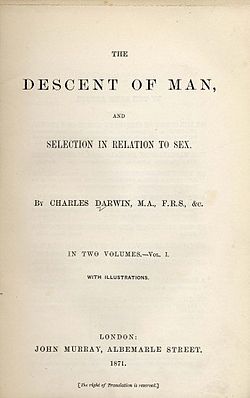
In 1871, Charles Darwin took up the idea of common descent in his work on human evolution, arguing that humans and other species share an ancient common ancestor and placing humanity within the broader tree of life.
Image source: The Descent of Man, and Selection in Relation to Sex
1900
In the twentieth century, physical chemist Svante Arrhenius proposed that life could be distributed across planets by radiation pressure carrying spores through space, reviving ancient ideas about the extraterrestrial seeding of life on Earth.
Image source: Panspermia

1970
Astronomers Fred Hoyle and Chandra Wickramasinghe proposed in the twentieth century that life, or its building blocks, is spread throughout the cosmos, contending that comets and interstellar dust could deliver organic material and even microorganisms to Earth.
1973
Molecular biologist Francis Crick and chemist Leslie Orgel suggested that life on Earth may have been deliberately seeded by intelligent beings from another world, a speculative idea known as directed panspermia, proposed in the twentieth century.
1987
Study of the 363-million-year-old Acanthostega fossils showed it could never have survived on land: its limbs and wrist and ankle joints were too weak to bear its weight, its ribs were too short to protect its lungs from being squeezed flat, and its fish-like tail fin would have been damaged by dragging on the ground.
Image source: Acanthostega

1987
In 1987, nearly complete fossils of Acanthostega from about 363 million years ago revealed that this Late Devonian transitional animal had legs and both lungs and gills, reshaping understanding of the water-to-land transition in vertebrate evolution.
May 2017
In May 2017, evidence of the earliest known life on land may have been found in 3.48-billion-year-old geyserite and other related mineral deposits, often formed around hot springs and geysers, uncovered in the Pilbara Craton of Western Australia.
Image source: Pilbara Craton

Jul 2018
In July 2018, scientists reported that the earliest life on land may have been bacteria living on land 3.22 billion years ago, extending the record of terrestrial microbial life far deeper into the Archean.
Image source: Timeline of life

May 2019
In May 2019, scientists reported the discovery of a fossilized fungus, named Ourasphaira giraldae, in the Canadian Arctic, that may have grown on land a billion years ago, well before plants were living on land.
This History of Life on Earth timeline was generated with the help of AI, using information found on the internet.
We work hard to keep these timelines accurate, but mistakes do get through. If you spot one, email us at [email protected] and we'll fix it for future visitors.
Generate yours with AI or build it from scratch, for free.