-
Use Cases
-
Resources
-
Pricing
Manga is the Japanese art form of comics and graphic storytelling that has evolved over centuries. From early illustrated scrolls like the Chōjū-jinbutsu-giga to the woodblock prints of the Edo period, and through the revolutionary post-war works of Osamu Tezuka, manga developed into a major cultural industry. Today, it encompasses diverse genres for all audiences and has become a globally influential medium shaping art, entertainment, and popular culture worldwide. More Less
1603 - 1867
% complete
During the Edo period (1603–1867), another book of drawings, Toba Ehon, embedded the concept of manga, further developing Japan's tradition of illustrated storytelling.
Image source: History of manga
1780 - 1800
% complete
Even though Eastern comics are generally held separate from the evolution of Western comics, Kern has suggested that kibyōshi, picture books from the late 18th century, may have been the world's first comic books.
Image source: Kibyōshi
1798
% complete
The word manga first came into common usage in the late 18th and early 19th centuries, beginning with Santō Kyōden's picture book Shiji no yukikai (1798). This also marks the first recorded use of the term manga to mean 'whimsical or impromptu pictures,' predating Hokusai's popular usage by several decades.
Image source: Santō Kyōden
1814
% complete
Aikawa Minwa's Manga hyakujo was published in 1814, contributing to the early common usage of the word manga for collections of drawings and sketches.
Image source: Manga
1814 - 1834
% complete
The celebrated Hokusai Manga books (1814–1834) contain assorted drawings from the sketchbooks of the famous ukiyo-e artist Hokusai (1760–1849), helping popularize the term manga.
1822
% complete
In the first half of the 19th century, Dehōdai mucharon (1822) is speculated to be an early example of manga-like publications, with prints from the artist Hiroshige, who illustrated several books of this kind between 1820 and 1837.
1870 - 1900
% complete
As illustrated magazines for Western expatriates introduced Western-style satirical cartoons to Japan in the late 19th century, new publications in both Western and Eastern styles became popular. Modern manga originated from these Western-style cartoons featured in late 19th century Japanese publications.
1890
% complete
The term manga first came into use in the late 18th century, though it only started to refer to various forms of cartooning in the 1890s and did not become a common word until the 1910s.
Image source: Manga
1900
% complete
1900 saw the debut of Rakuten's Jiji Manga in the Jiji Shinpō newspaper—the first use of the word manga in its modern sense—and where, in 1902, he began the first modern Japanese comic strip.
Image source: Kitazawa Rakuten
1900
% complete
Kitazawa Rakuten (1876–1955) was the first artist to use the word manga in the modern sense, laying the groundwork for modern Japanese comics.
1902
% complete
In 1902, Kitazawa Rakuten began the first modern Japanese comic strip in the Jiji Shinpō newspaper, establishing the multi-panel narrative format of modern manga.
1920 - 1929
% complete
The form of manga as speech-balloon based comics more specifically originated from translations of American comic strips in the 1920s; several early examples read left to right, with the longest running pre-1945 manga being the Japanese translation of Bringing Up Father.
Image source: Bringing Up Father
1880 - 1930
% complete
The roots of the wide-eyed look commonly associated with manga date back to illustrations of shōjo magazines published during the late 19th to early 20th centuries, such as Shōjo Gahō.
Image source: Shōjo manga
1900 - 1940
% complete
The most popular illustrators associated with this style at the time were Yumeji Takehisa and Jun'ichi Nakahara, who, influenced by his work as a doll creator, frequently drew female characters with big eyes in the early 20th century.
Image source: Jun'ichi Nakahara
1953 - 1956
% complete
Until 1969, shōjo manga was primarily drawn by adult men for young female readers. Tezuka's 1953–1956 Ribon no Kishi (Princess Knight) was one of two very popular and influential male-authored manga for girls from this period.
Image source: Princess Knight
1966
% complete
Mitsuteru Yokoyama's 1966 Mahōtsukai Sarī (Sally the Witch), the other influential male-authored manga for girls, helped create the mahō shōjo, or 'magical girl,' subgenre of manga, which became popular again in the early 21st century.
1969
% complete
In 1969, a variety of female manga artists, later called the Year 24 Group (also known as Magnificent 24s), made their shōjo manga debut. The name comes from Shōwa 24 (1949 on the Gregorian calendar), when some of these artists were born.
Image source: Year 24 Group
1971 - 1973
% complete
In 1971, Ikeda began her immensely popular shōjo manga Berusaiyu no Bara (The Rose of Versailles), the story of Oscar François de Jarjayes, a cross-dressing woman who was a captain in Marie Antoinette's Palace Guards in pre-Revolutionary France. At the end of the series (which ran from 1972 to 1973), Oscar dies as a revolutionary leading a charge against the Bastille.
Image source: The Rose of Versailles
1975
% complete
Moto Hagio's 1975 shōjo science fiction story They Were Eleven tells the story of a young female cadet in a future space academy, exemplifying the stylistic development of shōjo manga in the following decades (1975–present).
Image source: They Were Eleven
1945 - 1952
% complete
During and after the occupation of Japan by the Allies (1945–1952), manga was strongly shaped by American cultural influences, including comics brought to Japan by GIs and images and themes from U.S. media. Japanese artists subsequently gave life to their own style during the occupation and post-occupation years (1952–1972).
Image source: Occupation of Japan
Apr 1946
% complete
Machiko Hasegawa commenced Sazae-san in April 1946, making her heroine a stand-in for millions of Japanese citizens, especially women, rendered homeless by the war. Sazae faces the world with cheerful resilience—what psychologist Hayao Kawai calls a 'woman of endurance'—and the series sold more than 62 million copies over the next half-century.
1947
% complete
The 1947 Japanese Constitution (Article 21) prohibited all forms of censorship, which led to the growth of artistic creativity in manga and other media.
Image source: Constitution of Japan
Apr 1951
% complete
Osamu Tezuka's Mighty Atom (known as Astro Boy in the United States), begun in April 1951, was one of two series at the forefront of this period that influenced much of the future history of manga.
Image source: Astro Boy
2013
% complete
As of 2013, national censorship laws and local ordinances remain in Japan, continuing to shape what content can be published in manga.
1956
% complete
Early examples in the robot subgenre include Tezuka's Astro Boy and Yokoyama's 1956 Tetsujin 28-gō; the robot theme evolved extensively toward more complex stories where protagonists must learn to master themselves and cooperate with the mecha they control.
1959 - 1962
% complete
Sanpei Shirato's Chronicles of a Ninja's Military Accomplishments (Ninja Bugeichō) (1959–1962), the story of Kagemaru, leader of a peasant rebellion in the 16th century, dealt directly with oppression and class struggle.
Image source: Sanpei Shirato
1964
% complete
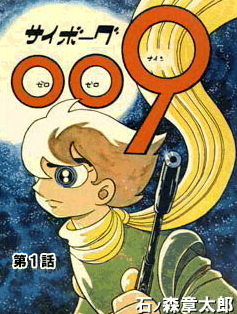
Of the nine cyborgs in Shotaro Ishinomori's 1964 Cyborg 009, only one is female, and she soon vanishes from the action, reflecting gender dynamics in early shōnen manga.
Image source: Cyborg 009
1968 - 1973
% complete
Tetsuya Chiba's 1968–1973 Tomorrow's Joe is a key example of sports-themed manga, alongside Rumiko Takahashi's 1987 One-Pound Gospel (boxing) and Takehiko Inoue's 1990 Slam Dunk (basketball).
Image source: Ashita no Joe
1969
% complete
Fujiko Fujio's 1969 Doraemon, about a robot cat and the boy he lives with, was aimed at younger boys and became one of the early examples of the robot subgenre.
Image source: Doraemon
1976
% complete
Osamu Tezuka's 1976 manga MW is a bitter story of the aftermath of the storage and possibly deliberate release of poison gas by the U.S., part of a wave of mature gekiga-influenced works such as Koike and Kojima's Lone Wolf and Cub.
1980
% complete
Akira Toriyama's Dr. Slump (1980) features the mischievous and powerful girl robot Arale Norimaki, a notable female robot character in manga.
Image source: Dr. Slump
1990
% complete
Takehiko Inoue's 1990 Slam Dunk is a landmark example of sports manga focused on basketball, following earlier successes like Tomorrow's Joe and One-Pound Gospel.
Image source: Slam Dunk (manga)
1994
% complete
In some cases, rape and lust-murder themes came to the forefront of certain manga, as in Urotsukidōji by Toshio Maeda and Blue Catalyst (1994) by Kei Taniguchi.
2000
% complete
Kia Asamiya's Batman: Child of Dreams was released in Japan by Kodansha in 2000, and in the US by DC Comics in 2003—a rare example of a Japanese manga adaptation of an American superhero.
2001
% complete
Ikebukuro West Gate Park (2001) by Ira Ishida and Sena Aritō is a story of street thugs, rape, and vengeance set on the social margins of the wealthy Ikebukuro district of Tokyo.
Image source: Ikebukuro West Gate Park
Or browse the full history timeline directory, with more than 2,000 topics.
This History of Manga timeline was generated with the help of AI, using information found on the internet.
We work hard to keep these timelines accurate, but mistakes do get through. If you spot one, email us at [email protected] and we'll fix it for future visitors.
Generate yours with AI or build it from scratch, for free.
Export your timeline, add your own events, edit or remove AI-generated events, and much more
No credit card required.
Cancel anytime.
Cancel anytime.
You can create an unlimited number of timelines with up to 10 events on each one, customize how they look, export them to PDF, PNG, PowerPoint, CSV, and Excel, and share them with a link. Paid plans raise the event limit and add features like spreadsheet imports and collaborators.
Yes. You can cancel your subscription from your account page at any time, and you will not be charged again. Your subscription stays active for the rest of the period you already paid for.
Yes. We will email you a reminder before the annual renewal, and we will also email you a receipt.
Yes. You can email us within 15 days of any payment, and we will issue you a full refund.
Check out our pricing docs or send us an email anytime: [email protected].