-
Use Cases
-
Resources
-
Pricing
610 BC
Anaximander defined wind as flowing air. Although the idea was not generally accepted for centuries, it was an early attempt to explain an atmospheric phenomenon through natural processes.
Image source: Anaximander

200 BC
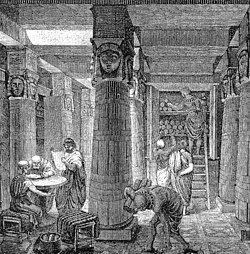
By the end of the second century BC, the center of science had shifted from Athens to Alexandria, whose famous library supported the preservation and development of natural philosophy, including early meteorological thought.
Image source: Library of Alexandria
100 BC
In the first century BC, Posidonius argued that clouds and winds reached only about five miles high, contrasting with the prevailing claim that they extended up to 111 miles before clear, luminous air began.
150
In the second century AD, Ptolemy's Almagest dealt with meteorology because the subject was regarded as a subset of astronomy.
Image source: Almagest

400 - 1100
From approximately 400 to 1100, scientific learning in Europe was preserved largely by the clergy, allowing elements of ancient natural philosophy to survive through the early Middle Ages.
500 - 1100
Aristotle's works, including Meteorologica, were largely lost in Europe until the twelfth century, limiting direct access to one of antiquity's most important systematic treatments of weather and atmospheric phenomena.
Image source: Meteorology (Aristotle)

850
In the ninth century, Al-Dinawari wrote Kitab al-Nabat, or Book of Plants, discussing the application of meteorological knowledge to agriculture during the Arab Agricultural Revolution.
1021
In Opticae thesaurus, Alhazen showed that atmospheric refraction contributes to twilight. He estimated that twilight begins when the Sun is 19 degrees below the horizon and used geometry to estimate the atmosphere's maximum height at about 49 miles, or 79 kilometers.
Image source: Ibn al-Haytham

1200
In the thirteenth century, Aristotelian theories were reestablished as dominant in meteorology. For roughly the next four centuries, much meteorological work consisted primarily of commentary on these theories.
1250 - 1650
More than 156 commentaries on Aristotle's Meteorologica are estimated to have been written before 1650, illustrating the work's enduring influence on European meteorological scholarship.
This History of Meteorology timeline was generated with the help of AI, using information found on the internet.
We work hard to keep these timelines accurate, but mistakes do get through. If you spot one, email us at [email protected] and we'll fix it for future visitors.
Generate yours with AI or build it from scratch, for free.