-
Use Cases
-
Resources
-
Pricing
The history of nanotechnology traces humanity's journey into manipulating matter at the atomic and molecular scale. Though the term was coined by Norio Taniguchi in 1974, the field's roots trace back to Richard Feynman's famous 1959 lecture 'There's Plenty of Room at the Bottom.' Key milestones include the development of electron microscopy, the invention of the scanning tunneling microscope in 1981, the discovery of fullerenes and carbon nanotubes, and the launch of the U.S. National Nanotechnology Initiative in 2000, which accelerated research in medicine, electronics, materials science, and energy. More Less
1850
% complete
Interface and colloid science had existed for nearly a century before it became associated with nanotechnology. Its study of materials at small scales laid important groundwork that would later be connected to the emerging field of nanoscience.
1900 - 1910
% complete
The first observations and size measurements of nanoparticles were made during the first decade of the 20th century by Richard Adolf Zsigmondy, winner of the 1925 Nobel Prize in Chemistry, who made a detailed study of gold sols and other nanomaterials with sizes down to 10 nm using an ultramicroscope capable of visualizing particles much smaller than the light wavelength.
Image source: Richard Adolf Zsigmondy
1920 - 1929
% complete
In the 1920s, Irving Langmuir, winner of the 1932 Nobel Prize in Chemistry, together with Katharine B. Blodgett, conducted pioneering work on thin films and surface chemistry that became part of the scientific foundation later associated with nanotechnology.
Image source: Irving Langmuir
Dec 29, 1959
% complete
The American physicist Richard Feynman lectured, 'There's Plenty of Room at the Bottom,' at an American Physical Society meeting at Caltech on December 29, 1959. The talk is often held to have provided inspiration for the field of nanotechnology, envisioning the manipulation of matter at atomic scales.
Image source: There's Plenty of Room at the Bottom
1974
% complete
Japanese scientist Norio Taniguchi of Tokyo University of Science was the first to use the term 'nano-technology' in a 1974 conference, to describe semiconductor processes such as thin film deposition and ion beam milling exhibiting characteristic control on the order of a nanometer. His definition was: 'Nano-technology' mainly consists of the processing of, separation, consolidation, and deformation of materials by one atom or one molecule.
1980
% complete
In 1980, Eric Drexler encountered Feynman's provocative 1959 talk 'There's Plenty of Room at the Bottom' while preparing his initial scientific paper on molecular engineering, an encounter that shaped his subsequent contributions to the conceptual framework of nanotechnology.
Image source: K. Eric Drexler
1981
% complete
Drexler published 'Molecular Engineering: An approach to the development of general capabilities for molecular manipulation' in the Proceedings of the National Academy of Sciences in 1981. Unaware of Taniguchi's prior use of the term, this was when 'nanotechnology' began to be used again after its 1974 coining.
Image source: Molecular engineering
1986
% complete
Eric Drexler published Engines of Creation: The Coming Era of Nanotechnology in 1986. The book took Feynman's concept of a billion tiny factories and added the idea that they could make copies of themselves via computer control instead of human operators. It proposed a nanoscale 'assembler' able to build a copy of itself and other items of arbitrary complexity, popularizing the term 'nanotechnology.'
Image source: Engines of Creation
1986
% complete
Drexler founded the Foresight Institute in 1986 with the mission of 'Preparing for nanotechnology.' The organization became a hub for advocacy and discussion of molecular nanotechnology, though Drexler is no longer a member.
Image source: Foresight Institute
1992
% complete
Drexler's doctoral work at the MIT Media Lab was the first doctoral degree on molecular nanotechnology. His thesis, 'Molecular Machinery and Manufacturing with Applications to Computation,' was published (after some editing) as Nanosystems: Molecular Machinery, Manufacturing, and Computation, which received the Association of American Publishers award for Best Computer Science Book of 1992.
1960 - 1990
% complete
Chris Toumey, a cultural anthropologist at the University of South Carolina, found that the published versions of Feynman's talk had a negligible influence in the twenty years after publication, as measured by citations in the scientific literature, and not much more influence in the decade after the scanning tunneling microscope was invented in 1981.
1986
% complete
Later in 1986, a cover article headlined 'Nanotechnology' was published in the mass-circulation science-oriented magazine Omni, bringing Drexler's ideas to a broad public audience alongside the release of Engines of Creation.
Image source: Omni (magazine)
1994
% complete
Klibanov wrote in 1994, '...using an enzyme in organic solvents eliminates several obstacles...' This work was later referenced in debates about molecular manufacturing feasibility; Drexler addressed the point in Nanosystems, showing mathematically that well-designed catalysts can provide the effects of a solvent and can be even more efficient than solvent/enzyme reactions.
Apr 2000
% complete
Bill Joy, then Chief Scientist at Sun Microsystems, wrote the article 'Why the future doesn't need us' in the April 2000 issue of Wired magazine. He argued that 'Our most powerful 21st-century technologies — robotics, genetic engineering, and nanotech — are threatening to make humans an endangered species,' warning that these technologies present greater dangers than any before them.
Image source: Why the Future Doesn't Need Us
2001
% complete
Richard Smalley introduced scientific objections to molecular assemblers in a 2001 Scientific American article, attacking the notion of universal assemblers. This led to a rebuttal from Drexler and colleagues later that year, and eventually to an exchange of open letters in 2003. Drexler and coworkers responded to these objections in a 2001 publication.
Image source: Richard Smalley
2001
% complete
In the AAAS Science and Technology Policy Yearbook 2001 article titled A Response to Bill Joy and the Doom-and-Gloom Technofuturists, Bill Joy was criticized for having technological tunnel vision in his predictions, failing to consider social factors shaping how technologies develop and are used.
2002
% complete
Prey is a 2002 novel by Michael Crichton which features an artificial swarm of nanorobots that develops intelligence and threatens its human inventors, reflecting and amplifying public anxieties about the risks of nanotechnology.
Image source: Prey (novel)
Dec 2003
% complete
After Drexler had difficulty getting Smalley to respond to his replies, Chemical & Engineering News carried a four-part debate between them in December 2003, publicly airing the disagreement over the feasibility of molecular assemblers and self-replicating nanomachines.
Image source: Drexler–Smalley debate on molecular nanotechnology
1974
% complete
The process of atomic layer deposition for depositing uniform thin films one atomic layer at a time was developed and patented by Tuomo Suntola and co-workers in Finland in 1974, providing precise control over material growth at the atomic scale.
Image source: Atomic layer deposition
1981
% complete
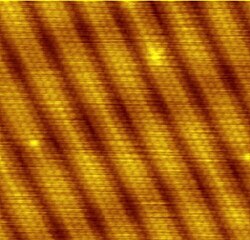
The scanning tunneling microscope, an instrument for imaging surfaces at the atomic level, was developed in 1981 by Gerd Binnig and Heinrich Rohrer at IBM Zurich Research Laboratory, for which they were awarded the Nobel Prize in Physics in 1986. Its invention was one of the key experimental advances behind the emergence of nanotechnology.
Image source: Scanning tunneling microscope
1985
% complete
Fullerenes were discovered in 1985 by Harry Kroto, Richard Smalley, and Robert Curl, who together won the 1996 Nobel Prize in Chemistry. This discovery, along with the invention of the scanning tunneling microscope, drove the emergence of nanotechnology in the 1980s.
Image source: Fullerene
1986
% complete
Gerd Binnig and Heinrich Rohrer were awarded the Nobel Prize in Physics in 1986 for developing the scanning tunneling microscope at IBM Zurich Research Laboratory in 1981, recognizing the transformative impact of atomic-level imaging on science.
Image source: Gerd Binnig
1986
% complete
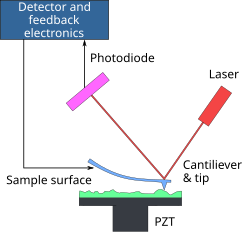
Gerd Binnig, Calvin Quate, and Christoph Gerber invented the first atomic force microscope in 1986, extending scientists' ability to image and manipulate surfaces with nanoscale resolution beyond what the scanning tunneling microscope could achieve with conductive materials.
Image source: Atomic force microscopy
1989
% complete
IBM researcher Don Eigler was the first to manipulate individual atoms using a scanning tunneling microscope in 1989, famously arranging xenon atoms to spell out 'IBM' and demonstrating direct atomic-scale control. He shared the 2010 Kavli Prize in Nanoscience for this work.
Image source: Don Eigler
1991
% complete
The discovery of carbon nanotubes is largely attributed to Sumio Iijima of NEC in 1991, who observed multi-walled carbon nanotubes in the insoluble material of arc-burned graphite rods, although carbon nanotubes had been produced and observed under a variety of conditions prior to 1991.
Image source: Carbon nanotube
1991
% complete
Mintmire, Dunlap, and White independently predicted in 1991 that if single-walled carbon nanotubes could be made, they would exhibit remarkable conducting properties. This prediction, together with Iijima's discovery, helped create initial interest in carbon nanotubes.
1996
% complete
Harry Kroto, Richard Smalley, and Robert Curl won the 1996 Nobel Prize in Chemistry for their 1985 discovery of fullerenes, cementing the importance of nanoscale carbon structures in modern chemistry.
2010
% complete
IBM researcher Don Eigler shared the 2010 Kavli Prize in Nanoscience for his pioneering work manipulating atoms with a scanning tunneling microscope, which he first accomplished in 1989.
1989
% complete
The first commercially available atomic force microscope was introduced in 1989, making powerful nanoscale imaging tools accessible to researchers and industry worldwide and accelerating progress in nanoscience.
1999
% complete
Mihail Roco formally proposed the National Nanotechnology Initiative to the Office of Science and Technology Policy during the Clinton administration in 1999 and was a key architect in its development, spearheading coordinated federal investment in nanotechnology research.
Image source: National Nanotechnology Initiative
Dec 3, 2003
% complete
On December 3, 2003, President Bush signed into law the 21st Century Nanotechnology Research and Development Act, which authorizes expenditures for five participating agencies totaling US$3.63 billion over four years, formalizing federal support for nanotechnology development.
2004
% complete
The Royal Society and Royal Academy of Engineering released their 2004 report on the implications of nanoscience and nanotechnologies. The report was inspired by Prince Charles' concerns about nanotechnology, including molecular manufacturing, and helped shape regulatory discussion of the field.
Image source: Royal Society
Mar 10, 2011
% complete
As of March 10, 2011, the Project on Emerging Nanotechnologies estimated that over 1300 manufacturer-identified nanotech products were publicly available, with new ones hitting the market at a pace of 3–4 per week, showing rapid commercial adoption.
Image source: Project on Emerging Nanotechnologies
2020 - 2029
% complete
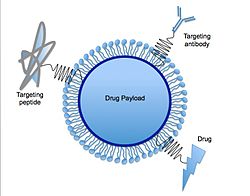
Invention of ionizable cationic lipids at the turn of the 21st century allowed the development of solid lipid nanoparticles, which in the 2020s became the most successful and well-known non-viral nanoparticle drug delivery system due to their use in several mRNA vaccines during the COVID-19 pandemic.
Image source: Lipid-based nanoparticle
2024
% complete
A 2024 review stated that over 5,000 tons of nanotubes are produced annually, with industrial applications including biosensors, satellite sensors, and marine coatings, illustrating the large-scale industrial maturation of nanotechnology decades after the initial discoveries.
Or browse the full history timeline directory, with more than 2,000 topics.
This History of Nanotechnology timeline was generated with the help of AI, using information found on the internet.
We work hard to keep these timelines accurate, but mistakes do get through. If you spot one, email us at [email protected] and we'll fix it for future visitors.
Generate yours with AI or build it from scratch, for free.
Export your timeline, add your own events, edit or remove AI-generated events, and much more
No credit card required.
Cancel anytime.
Cancel anytime.
You can create an unlimited number of timelines with up to 10 events on each one, customize how they look, export them to PDF, PNG, PowerPoint, CSV, and Excel, and share them with a link. Paid plans raise the event limit and add features like spreadsheet imports and collaborators.
Yes. You can cancel your subscription from your account page at any time, and you will not be charged again. Your subscription stays active for the rest of the period you already paid for.
Yes. We will email you a reminder before the annual renewal, and we will also email you a receipt.
Yes. You can email us within 15 days of any payment, and we will issue you a full refund.
Check out our pricing docs or send us an email anytime: [email protected].