
-
Use Cases
-
Resources
-
Pricing
Naples is one of the oldest continuously inhabited cities in the world, founded by Greek colonists around 600 BCE. Throughout its history, it has been ruled by Romans, Byzantines, Normans, Swabians, Angevins, Aragonese, Spaniards, and Bourbons, serving as the capital of the Kingdom of Naples and later the Kingdom of the Two Sicilies. The city played a key role in Italian unification in 1861 and remains a major cultural and economic center of southern Italy. More Less
700 BC
% complete
The city of Parthenope was founded by Cumae, the earliest Greek city on mainland Italy, at the end of the 8th century BC. Little archaeology for Parthenope has come to light, but a necropolis of the 7th century BC was discovered in via Nicotera.
566 BC
% complete
These athletic events occurred in conjunction with the Panathenaic Games, which were held in Athens and began in 566 BC. The games continued for several centuries, as evidenced by names recorded on the portico and temple associated with the games, revealed by modern construction excavations.
550 BC
% complete
During the end of the Greek Dark Ages a larger mainland colony – initially known as Parthenope – developed on the Pizzofalcone hill in the 8th century BC, and was refounded as Neapolis in the 6th century BC: it held an important role in Magna Graecia.
450 BC
% complete
Neapolis eventually had strong walls (5th century), an odeon, a theatre and the temple of the city's patron gods, the Dioscuri.
400 BC
% complete
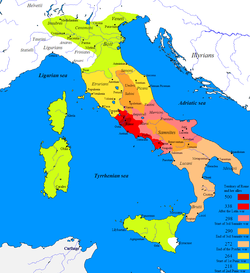
At the end of the 5th century BC the political and social equilibrium of Neapolis was severely threatened by the Samnites, an Oscan-speaking tribe expanding towards the more fertile plains.
Image source: History of Naples
350 BC
% complete
In the second half of the 4th century, during the First Samnite War, Neapolis made an alliance with the Samnites against Rome, which had already taken Capua.
Image source: Samnite Wars
305
% complete
Saint Januarius, patron saint of Naples, was decapitated in nearby Pozzuoli in 305. Since the 5th century he has been commemorated by the basilica of San Gennaro extra Moenia.
Image source: Januarius
661 - 1139
% complete
Naples served as the capital of the Duchy of Naples from 661 to 1139, one of the independent southern Italian states that emerged after the fall of Roman authority in the region.
Image source: Duchy of Naples
878
% complete
Neapolitan dukes rose to prominence under the Duke-Bishop Athanasius and his successors; among these, Gregory IV and John II participated at the Battle of the Garigliano in 915. Naples then declined in importance in the 10th century until it was captured by its traditional rival, Pandulf IV of Capua.
1027
% complete
In 1027, duke Sergius IV donated the county of Aversa to a band of Norman mercenaries led by Rainulf Drengot, whose support he had needed in the war with the principality of Capua.
Image source: Rainulf Drengot
1137
% complete
Last of the rulers of such independent southern Italian states, Sergius VII was forced to surrender to Roger II of Sicily in 1137; Roger had had himself proclaimed king of Sicily seven years earlier.
1191
% complete
After a period of Norman rule, in 1189 the Kingdom of Sicily fell into a succession dispute between Tancred and the Hohenstaufens. In 1191 Henry invaded Sicily after being crowned Holy Roman Emperor; many cities surrendered, but Naples resisted him from May to August before the Germans suffered from disease and were forced to retreat.
Image source: Siege of Naples (1191)
1191 - May 1192
% complete
Tancred had the empress imprisoned at Castel dell'Ovo at Naples before her release in May 1192.
Image source: Castel dell'Ovo
1194
% complete
In 1194 Henry started his second campaign upon the death of Tancred. This time Aligerno surrendered without resistance, and finally Henry conquered Sicily, putting it under the rule of the Hohenstaufens.
Image source: Henry VI, Holy Roman Emperor
1224
% complete
Frederick II Hohenstaufen founded the university in 1224, considering Naples his intellectual capital while Palermo retained its political role. The university remained unique in southern Italy for seven centuries.
Image source: University of Naples Federico II
1266
% complete
After the defeat of Frederick's son, Manfred, in 1266 Naples and the kingdom of Sicily were assigned by Pope Clement IV to Charles of Anjou, who moved the capital from Palermo to Naples.
Image source: Charles I of Anjou
1284
% complete
After the Sicilian Vespers, the kingdom was split in two parts, with an Aragonese king ruling the island of Sicily and the Angevin king ruling the mainland portion; while both kingdoms officially called themselves the Kingdom of Sicily, the mainland portion was commonly referred to as the Kingdom of Naples, which served as Naples' seat of power until 1816.
Image source: Kingdom of Naples
1442
% complete
In 1442 Alfonso V of Aragon conquered Naples after his victory against the last Angevin king, Rene, and made his triumphal entry into the city in February 1443.
Image source: Alfonso V of Aragon
1495
% complete
After the brief conquest by Charles VIII of France in 1495, the two kingdoms were united under Aragonese rule in 1501. In 1502 Castilian general Gonzalo Fernández de Córdoba entered the city, beginning nearly two centuries of rule of the almost omnipotent viceroys in Naples.
Image source: Italian Wars
1500 - 1699
% complete
In the 16th and 17th centuries Naples was home to great artists such as Caravaggio, Salvator Rosa and Bernini, philosophers such as Bernardino Telesio, Giordano Bruno, Tommaso Campanella and Giambattista Vico, and writers such as Gian Battista Marino. It was also a capital of the Baroque, beginning with Caravaggio's career in the 17th century.
1504
% complete
The partnership of the Catholic Monarchs ceased with Isabella's death in 1504, and Ferdinand expelled the Castilians from leadership in Aragonese possessions in Italy, including Naples.
Image source: Ferdinand II of Aragon
1532 - 1560
% complete
Toledo opened the main street which still today bears his name; he paved other roads, strengthened and expanded the walls, restored old buildings, and erected new buildings and fortresses, essentially turning the city of Naples by 1560 into the largest and best fortified city in the Spanish empire.
Image source: Pedro de Toledo (viceroy of Naples)
Jul 1647
% complete
All the strains of an increasingly over-populated city exploded in July 1647, when the legendary Masaniello led the populace in violent rebellion against the foreign, oppressive rule of the Spanish.
Image source: Masaniello
1656
% complete
In 1656 the plague killed almost half of the inhabitants of the city; this led to the beginning of a period of decline.
Image source: Naples Plague (1656)
1734
% complete
The Spanish Habsburgs were replaced in 1714 by Austrian ones, until in 1734 the two kingdoms were united under a single independent crown, that of Charles of Bourbon.
Image source: Charles III of Spain
Jan 1799
% complete
When in January 1799 French revolutionary troops entered the city they were hailed by a pro-revolutionary minor part of the middle class, but faced strong resistance by the royalist lazzari, who were fervidly religious and did not support the new ideas.
Jun 1799
% complete
The short-lived Neapolitan Republic tried to gain popular support by abolishing feudal privileges, but the mass of the people rebelled and in June 1799 the republicans surrendered. The Parthenopaean Republic was suppressed by the British and Russians in 1799, followed in 1805 by a full invasion.
Image source: Parthenopean Republic
1806
% complete
In early 1806 Napoleon conquered the Kingdom of Naples. He first named his brother Joseph Bonaparte King, and then his brother-in-law Marshal Joachim Murat in 1808, when Joseph was given the Spanish crown.
Image source: Kingdom of Naples (Napoleonic)
1815
% complete
Joachim Murat created a communal administration led by a mayor, left almost intact by Ferdinand when he regained his kingdom in 1815 after the Neapolitan War, in which the Austrians defeated Murat.
Image source: Neapolitan War
1839
% complete
In 1839 Naples became the first city in Italy to have a railway, with the Napoli–Portici line, reflecting the kingdom's modernization despite growing social divisions.
Image source: Naples–Portici railway
Jun 25, 1860
% complete
In spite of a little cultural revival and the proclamation of a Constitution on 25 June 1860, in the last years of the kingdom the gap between the court and the intellectual class continued to grow.
Image source: Kingdom of the Two Sicilies
Sep 6, 1860
% complete
On 6 September 1860, the kingdom was conquered by the Garibaldines and was handed over to the King of Sardinia. Garibaldi entered the city by train, descending in the square that today still bears his name.
Image source: Giuseppe Garibaldi
Oct 1860 - 1861
% complete
In October 1860 a plebiscite sanctioned the end of the Kingdom of Sicily and the birth of a new Italian state, the united Kingdom of Italy, completed in 1861.
Image source: Proclamation of the Kingdom of Italy
1880
% complete
The opening of the funicular railway to Mount Vesuvius was occasion for the writing of the famous song "Funiculì, Funiculà", one more song in the centuries-long tradition of Neapolitan song.
Image source: Funiculì, Funiculà
Apr 7, 1906
% complete
On 7 April 1906 nearby Mount Vesuvius erupted, devastating Boscotrecase and seriously damaging Ottaviano.
Image source: Mount Vesuvius
1925
% complete
Italy's first Metropolitan railway (now Linea 2) was opened in Naples in 1925. Four funicular railways were opened between 1889 and 1931.
Image source: Line 2 (Naples)
1927
% complete
In 1927 Naples absorbed some nearby communities; the 1860 population of 450,000 increased to 1,250,000 in 1971, reflecting rapid urban growth over the following decades.
Sep 28, 1943 - Oct 1, 1943
% complete
During World War II, Naples was the first Italian city to rise up against the Nazi military occupation. Between 28 September and 1 October 1943 the people of the city rose up and pushed the Germans out, in what became known as the "four days of Naples".
Image source: Four Days of Naples
Mar 1944
% complete
In 1944 another devastating eruption from Vesuvius occurred; images from this eruption were used in the film The War of the Worlds.
1990 - 2010
% complete
Cosmetically, at least, Naples improved in the decades either side of the turn of the 21st century: Piazza del Plebiscito returned to its historic role as the largest open square instead of a parking lot between WWII's end and 1990; landmarks such as the San Carlo theater and Galleria Umberto have been restored; the tangenziale di Napoli alleviated traffic; construction continues on the Naples Metro. Naples became the world's 91st richest city by purchasing power in 2005, with a GDP of US$43 billion, surpassing Budapest and Zürich, and unemployment decreased dramatically between the 1990s and 2010.
2004
% complete
During 2004 over 120 people died in Naples in Camorra killings; many of the deaths were related to the drug trade, highlighting the ongoing struggle with organized crime in the city.
Image source: Camorra
Or browse the full history timeline directory, with more than 2,000 topics.
This History of Naples timeline was generated with the help of AI, using information found on the internet.
We work hard to keep these timelines accurate, but mistakes do get through. If you spot one, email us at [email protected] and we'll fix it for future visitors.
Generate yours with AI or build it from scratch, for free.
Export your timeline, add your own events, edit or remove AI-generated events, and much more
No credit card required.
Cancel anytime.
Cancel anytime.
You can create an unlimited number of timelines with up to 10 events on each one, customize how they look, export them to PDF, PNG, PowerPoint, CSV, and Excel, and share them with a link. Paid plans raise the event limit and add features like spreadsheet imports and collaborators.
Yes. You can cancel your subscription from your account page at any time, and you will not be charged again. Your subscription stays active for the rest of the period you already paid for.
Yes. We will email you a reminder before the annual renewal, and we will also email you a receipt.
Yes. You can email us within 15 days of any payment, and we will issue you a full refund.
Check out our pricing docs or send us an email anytime: [email protected].