-
Use Cases
-
Resources
-
Pricing
Sarajevo, the capital of Bosnia and Herzegovina, is a city shaped by centuries of cultural convergence. Founded by the Ottomans in the 15th century, it flourished as a center of trade and Islamic culture, later becoming part of the Austro-Hungarian Empire. The city gained global attention in 1914 as the site of Archduke Franz Ferdinand's assassination, which sparked World War I. Sarajevo hosted the 1984 Winter Olympics but suffered greatly during the Bosnian War (1992-1995), enduring one of the longest sieges in modern history. Today, it stands as a symbol of resilience and multicultural coexistence, blending Eastern and Western influences in its architecture, religion, and daily life. More Less
600 - 699
% complete
In the 7th century, Slavic peoples came to Bosnia, settling the region and laying the demographic and cultural foundations for the medieval Bosnian state.
1100 - 1199
% complete
When Bosnia became a vassal of Hungary in the 12th century, the population of the region consisted primarily of members of the Bosnian Church, a distinctive Christian community.
1238
% complete
Papal documents indicate that in 1238, a cathedral dedicated to Saint Paul was built in the city. It is speculated to have been located in the present-day Skenderija neighborhood, where Roman-style columns dating to the 12th century were found during late 19th-century construction.
1263 - 1429
% complete
Vrhbosna served as a Slavic citadel from 1263 until its occupation by the Ottoman Empire in 1429. It may have been destroyed sometime between the 13th century and the Ottoman occupation, possibly razed by one of the foreign armies that frequently made their way there during wars with Bosnia.
Image source: Archdiocese of Vrhbosna
1461
% complete
Sarajevo was founded when the Ottoman Empire conquered the region, with 1461 typically regarded as the date of the city's founding. By the time of the occupation, there had been little settlement in the area.
1660
% complete
By 1660, the population of Sarajevo was estimated to be over 80,000, making it one of the largest cities in the Balkans at the time.
1683
% complete
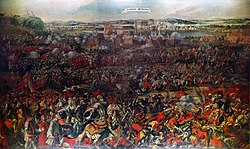
Following the Battle of Vienna in 1683, the western portion of the Ottoman Empire, including Sarajevo, became subject to raids as the empire's fortunes declined.
Image source: Battle of Vienna
1762
% complete
In 1762, a plague epidemic hit the city, taking about 15,000 lives and devastating Sarajevo's population.
1783
% complete
In 1783, another plague outbreak struck Sarajevo; some 8,000 people died. The same year also saw a major flood, with another flood occurring in 1791.
1788
% complete
The largest fire in Sarajevo's history occurred in 1788, compounding the disasters of plague and flooding that plagued the city in the late 18th century.
1832
% complete
The last major uprising culminated in the Battle of Sarajevo Field in 1832, where the Bosnian leader was betrayed by a fellow Bosniak and lost, ending hopes of greater autonomy from the Ottomans.
1875 - 1899
% complete
Under Austro-Hungarian rule, for the first time in centuries, the city significantly expanded outside its traditional borders, developing new infrastructure and architecture.
Jul 1875 - 1877
% complete
The 1875–1877 Herzegovina uprising, an armed revolt by the local ethnic Serb population, began in July 1875 before spreading to the rest of the Bosnia Vilayet, weakening the Ottoman position in the region.
Image source: Herzegovina uprising (1875–1877)
Dec 30, 1875
% complete
Shaped by foreign minister Count Gyula Andrássy, Austria-Hungary identified the Near East as its next area of expansion. On 30 December 1875, Andrássy sent a dispatch to his predecessor Von Beust, then ambassador to the United Kingdom, advancing this policy.
Image source: Gyula Andrássy
Mar 3, 1878
% complete
The Treaty of San Stefano, imposed on 3 March 1878 by Russia upon the defeated Ottomans, confirmed the weakness of Ottoman authority. By spring, many Ottoman troops in the vilayet deserted after being left to their own means.
Image source: Treaty of San Stefano
Apr 1878
% complete
Members of Sarajevo's Muslim landowning elite publicly supported the Austro-Hungarian occupation at an April 1878 meeting at the Emperor's Mosque, reasoning that the Ottoman Empire lacked the power to rule the land, while conservative clerics circulated petitions opposing it.
Image source: Emperor's Mosque
Apr 21, 1878
% complete
In a 21 April 1878 memorandum to the European powers, Austro-Hungarian foreign minister Gyula Andrássy proposed his Bosnia policy, making a case for a Habsburg occupation of the Bosnia Vilayet.
Jun 2, 1878
% complete
On 2 June 1878, a new petition, seen as a win for the leading Muslim landowners who purged it of its anti-Christian provisions, was formally submitted to governor Mazhar. On 8 June, an all-Muslim assembly appealed for recognition of a multi-confessional representative body drawn largely from Sarajevo.
Jun 28, 1878
% complete
On 28 June 1878, the terms of the Treaty of Berlin were announced. Its 25th point gave Austria-Hungary a mandate to 'occupy and administer the Bosnian Vilayet', though not to annex it. Simultaneously, over 80,000 Austro-Hungarian troops mobilized on the southeast border.
Image source: Treaty of Berlin (1878)
Jul 29, 1878
% complete
One day after the People's Government was proclaimed in Sarajevo, the Austro-Hungarian Army under feldzeugmeister Josip Filipović entered the Bosnia Vilayet at four crossings, swiftly seizing Banja Luka, Maglaj, and Jajce despite resistance ambushes.
Image source: Austro-Hungarian campaign in Bosnia and Herzegovina in 1878
1908
% complete
In 1908, the territory was formally annexed and turned into a condominium jointly controlled by both Austrian Cisleithania and Hungarian Transleithania.
Image source: Bosnian Crisis
1910
% complete
By 1910, Sarajevo was populated by just under 52,000 people, reflecting growth under Austro-Hungarian administration.
1919
% complete
At the end of the Great War and as part of the 1919 Paris Peace Conference, Austria-Hungary ceased to exist, and Sarajevo became part of the newly formed South Slav state.
Image source: Paris Peace Conference (1919–1920)
Apr 15, 1941
% complete
Following a German bombing campaign, Sarajevo was taken by the Wehrmacht on 15 April 1941. At the time, the city had 85,000 people: 34% Muslim, 29% Catholic Croat, 25% Orthodox Serb, and 10% Jewish.
Image source: World War II in Yugoslavia
Apr 20, 1941 - Apr 30, 1941
% complete
By late April 1941, over a thousand Ustaše Militiamen had been assigned to Sarajevo, beginning a period of persecution. In August 1941, about 100 Sarajevo Serbs were arrested on allegations of belonging to the Chetniks or Partisans.
Image source: Ustaše
Oct 12, 1941
% complete
On 12 October 1941, a group of 108 notable Muslim citizens signed the Resolution of Sarajevo Muslims, condemning Ustaše persecution of Serbs, distinguishing participating Muslims from the whole population, and demanding security for all citizens regardless of identity.
Apr 5, 1943 - Apr 9, 1943
% complete
Between 5–9 April 1943, Sarajevo was visited by the Grand Mufti of Jerusalem, Amin al-Husseini, as part of a recruiting tour for the 13th Waffen SS Handschar division.
Image source: 13th Waffen Mountain Division of the SS Handschar (1st Croatian)
Apr 6, 1945
% complete
Sarajevo was liberated on 6 April 1945 by Partisan forces. Valter, the legendary resistance figure, was killed in the fighting on the day of the city's liberation.
1984 - Feb 19, 1984
% complete
Sarajevo hosted the 1984 Winter Olympics, a moment of international prestige for the city and Yugoslavia, leaving lasting sports infrastructure including the Trebević Cable Car.
Image source: 1984 Winter Olympics
Aug 25, 1992
% complete
During the siege, on the night of 25 August 1992, the besiegers intentionally shelled and destroyed with incendiary shells the irreplaceable Bosnia National and University Library. Among the losses were about 700 manuscripts and incunabula and a unique collection of Bosnian serial publications.
Image source: Vijećnica
Jul 22, 1993
% complete
During the Siege of Sarajevo, an average of 329 shell impacts occurred per day, with a high of 3,777 shell impacts recorded on 22 July 1993, making it one of the most intense bombardments of a capital city in modern history.
Image source: Siege of Sarajevo
Feb 29, 1996
% complete
Following the Dayton Accords and a period of stabilization, the Bosnian government declared the siege officially over on 29 February 1996. Most Serbs left Sarajevo shortly afterward in early 1996.
2003
% complete
By 2003, following extensive post-war reconstruction, there were practically no ruins left in the city and bullet holes had become a rarity, marking Sarajevo's remarkable recovery.
2010 - 2019
% complete
One of the most widely accepted goals for post-war Sarajevo was to hold the Winter Olympics again in 2014. The bid ultimately failed, but the city continued pursuing major sporting events.
2014
% complete
The Sarajevo City Center, which started construction in 2008, opened early to the public in 2014, becoming a major modern commercial landmark in the recovering city.
Image source: Sarajevo City Center
Apr 6, 2018
% complete
The Trebević Cable Car transportation system was rebuilt following its use during the 1984 Winter Olympic Games. The project cost 12,109,000 euros and was completed and opened to the public on 6 April 2018, symbolically on liberation day.
Image source: Sarajevo cable car
2019
% complete
Though its Olympic bid failed, Sarajevo managed to hold the 2019 European Youth Olympic Winter Festival, the second major winter sports event in the city after the 1984 Winter Olympic Games.
Image source: 2019 European Youth Olympic Winter Festival
Nov 2019 - Mar 3, 2021
% complete
Between late 2019 and 2021, Sarajevo was hit with six aftershocks. The first three came in November 2019 from an earthquake in Nevesinje, followed by aftershocks from the Zagreb earthquake on 22 March 2020, the Petrinja earthquake on 29 December 2020, and the most recent reported on 3 March 2021.
Image source: 2020 Zagreb earthquake
Or browse the full history timeline directory, with more than 2,000 topics.
This History of Sarajevo timeline was generated with the help of AI, using information found on the internet.
We work hard to keep these timelines accurate, but mistakes do get through. If you spot one, email us at [email protected] and we'll fix it for future visitors.
Generate yours with AI or build it from scratch, for free.
Export your timeline, add your own events, edit or remove AI-generated events, and much more
No credit card required.
Cancel anytime.
Cancel anytime.
You can create an unlimited number of timelines with up to 10 events on each one, customize how they look, export them to PDF, PNG, PowerPoint, CSV, and Excel, and share them with a link. Paid plans raise the event limit and add features like spreadsheet imports and collaborators.
Yes. You can cancel your subscription from your account page at any time, and you will not be charged again. Your subscription stays active for the rest of the period you already paid for.
Yes. We will email you a reminder before the annual renewal, and we will also email you a receipt.
Yes. You can email us within 15 days of any payment, and we will issue you a full refund.
Check out our pricing docs or send us an email anytime: [email protected].