-
Use Cases
-
Resources
-
Pricing
Seville, the capital of Andalusia in southern Spain, boasts a history spanning over two millennia. Founded as Hispalis by the Romans, it flourished under Moorish rule as a center of culture and learning before being reconquered by Christian forces in 1248. In the 16th century, Seville became Europe's gateway to the Americas, holding a monopoly on Spanish colonial trade and growing into one of the wealthiest cities in the world. Its historic landmarks—including the Gothic Cathedral, the Giralda tower, and the Real Alcázar—reflect this layered past of Roman, Islamic, Jewish, and Christian influences. More Less
800 BC
% complete
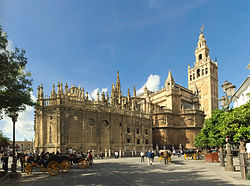
The area of present-day Seville was first settled by the Tartessians, an ancient Iberian civilization, who established a settlement along the Guadalquivir River. Its strategic riverine location made it a hub for trade with Phoenician and Greek merchants, laying the foundations for one of the oldest cities in Europe.
Image source: Seville
500 BC
% complete
The Carthaginians extended their influence over the Guadalquivir valley, taking control of the settlement known as Hispalis. They developed it as a trading outpost, exploiting its position as a navigable inland port connected to the Atlantic.
206 BC
% complete
Roman general Scipio Africanus captured Hispalis during the Second Punic War, expelling the Carthaginians from the region. Under Roman rule, Hispalis grew into an important commercial center of Hispania Baetica.
Image source: Seville
45 BC
% complete
Julius Caesar elevated Hispalis to the rank of Roman colony, renaming it Colonia Julia Romula. The city was rebuilt with Roman urban planning, including forums, temples, aqueducts, and walls, cementing its role as a major city in southern Hispania.
Image source: Hispania Baetica
53 AD
% complete
The nearby Roman city of Italica, just north of Seville, became famous as the birthplace of emperors Trajan (53 AD) and Hadrian (76 AD). This connection underscored the prosperity and prominence of the region during the height of the Roman Empire.
Image source: Italica
428
% complete
Following the decline of Roman authority, the Vandals sacked Seville in 428 before moving on to North Africa. The city subsequently fell under Visigothic control, becoming a significant political and ecclesiastical center within their kingdom.
590 - 636
% complete
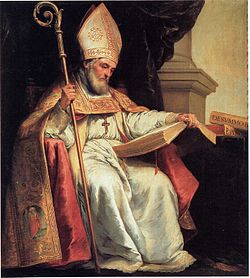
Under bishops Leander and Isidore of Seville, the city flourished as a religious and intellectual capital of Visigothic Spain. Isidore's Etymologiae became a foundational encyclopedia of medieval knowledge, earning him recognition as a Doctor of the Church.
Image source: Isidore of Seville
711 - 712
% complete
Muslim forces under Musa ibn Nusayr conquered Seville around 711-712, incorporating it into al-Andalus. The city, now called Ishbiliya, gradually transformed with new architecture, irrigation systems, and a thriving multicultural society.
Image source: Muslim conquest of Spain
859
% complete
A Viking fleet sailed up the Guadalquivir and attacked Seville in 859. The Umayyad authorities responded by strengthening the city's defenses and building a navy to protect against future raids from the north.
1023 - 1091
% complete
After the collapse of the Caliphate of Córdoba, Seville became the capital of the Taifa of Seville under the Abbadid dynasty. Rulers like al-Mu'tamid ibn Abbad made the court a celebrated center of poetry and culture, though the era ended with the Almoravid conquest.
Image source: Taifa of Seville
1091
% complete
The Almoravids, a Berber dynasty from North Africa, annexed Seville in 1091 after defeating the last Abbadid ruler, al-Mu'tamid. Their rule brought religious orthodoxy and military discipline to al-Andalus amid growing Christian advances.
Image source: Almoravid dynasty
1147 - 1198
% complete
Under the Almohads, Seville became the capital of al-Andalus and one of the greatest cities of the Islamic West. The Giralda minaret, completed in 1198, was built as part of the great mosque, along with other landmarks such as Torre del Oro and expanded Alcázar palaces.
Image source: Giralda
1248
% complete
King Ferdinand III of Castile besieged and captured Seville in 1248 after a prolonged siege lasting over a year, using naval forces on the Guadalquivir to cut off supplies. The Reconquista of the city marked a major step in Christian expansion across Andalusia.
Image source: Siege of Seville
1250
% complete
After the Christian conquest, Seville's Jewish population was concentrated in a designated quarter, today's Santa Cruz neighborhood. The community thrived for decades, contributing to commerce, medicine, and scholarship until later persecution.
Image source: Santa Cruz, Seville
1252 - 1284
% complete
Alfonso X the Wise favored Seville as a residence and administrative center, commissioning works such as the Gothic parts of the Royal Alcázar and promoting translation scholarship that blended Christian, Muslim, and Jewish traditions.
Image source: Alfonso X of Castile
1391
% complete
In 1391, violent anti-Jewish riots erupted in Seville, led by Archdeacon Ferrán Martínez, destroying much of the Jewish quarter and forcing conversions. These pogroms spread throughout Castile and Aragon, devastating centuries-old Jewish communities.
Image source: Massacre of 1391
1401 - 1506
% complete
Work began on Seville Cathedral in 1401 on the site of the former Almohad mosque, with builders reportedly vowing to create a church so grand that future generations would call them mad. Completed in 1506, it remains the largest Gothic cathedral in the world.
Aug 3, 1492
% complete
Christopher Columbus set sail from Palos de la Frontera near Seville on his first voyage across the Atlantic. His discoveries opened the New World to Spain, positioning Seville as the gateway to the Americas.
Image source: Voyages of Christopher Columbus
1503
% complete
Queen Isabella I established the Casa de Contratación in Seville to regulate all trade between Spain and its American colonies. Every ship, cargo, and passenger traveling to the Indies had to pass through Seville, making it the exclusive entrepôt of empire.
Image source: Bartolomé de las Casas
1519
% complete
Ferdinand Magellan's fleet departed from Sanlúcar de Barrameda near Seville in 1519 on the first circumnavigation of the globe. The expedition, completed by Juan Sebastián Elcano in 1522, proved the Earth could be circumnavigated by sea.
Image source: Magellan expedition
1526
% complete
Holy Roman Emperor Charles V commissioned extensive additions to the Royal Alcázar of Seville, blending Mudéjar craftsmanship with Renaissance design. The palace remains a masterpiece of architectural synthesis and is still used by the Spanish royal family.
Image source: Alcázar of Seville
1649 - 1651
% complete
The Great Plague of Seville killed roughly half the city's population, dealing a catastrophic blow to a metropolis that had been among Europe's largest. The disaster accelerated Seville's economic decline relative to Madrid and Cádiz.
Image source: Great Plague of Seville
1600 - 1700
% complete
Siltation of the Guadalquivir River progressively hindered ocean-going vessels from reaching Seville's port. Combined with the monopoly transfer, trade shifted decisively to Cádiz, ending Seville's Golden Age dominance of Atlantic commerce.
1717
% complete
The Casa de Contratación was moved from Seville to Cádiz in 1717, formally transferring the American trade monopoly. The decision reflected Cádiz's superior deepwater harbor and marked the end of Seville's exclusive role as gateway to the colonies.
Image source: Casa de Contratación
1810 - 1812
% complete
French forces under Marshal Soult occupied Seville during the Peninsular War, holding the city until 1812. The occupation prompted resistance across Andalusia and ended when Allied forces recaptured the city, contributing to Napoleon's eventual defeat in Spain.
Image source: Peninsular War
May 9, 1929 - Jun 21, 1930
% complete
Seville hosted the Ibero-American Exposition, showcasing ties with Latin America. The event transformed the city with landmarks like Plaza de España and María Luisa Park, leaving a lasting architectural legacy and revitalizing urban infrastructure.
Image source: Ibero-American Exposition of 1929
Jul 18, 1936
% complete
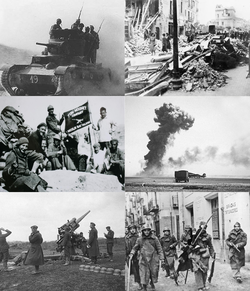
At the outbreak of the Spanish Civil War, Nationalist forces under General Gonzalo Queipo de Llano quickly seized Seville, making it a key rebel stronghold. The city suffered repression and remained under Francoist control throughout the conflict.
Image source: Spanish Civil War
Apr 20, 1992 - Oct 12, 1992
% complete
Seville hosted the Universal Exposition of 1992 on La Cartuja island, commemorating the 500th anniversary of Columbus's voyage. The event brought massive investment, including a high-speed rail link to Madrid and a new airport, modernizing the city's economy and image.
Image source: Expo '92
Apr 21, 1992
% complete
Spain's first high-speed rail line opened between Madrid and Seville just before Expo '92, cutting travel time to about two and a half hours. The AVE service integrated Seville into Spain's modern transport network and boosted tourism and business travel.
Image source: AVE
Mar 27, 2011
% complete
The Metropol Parasol, popularly known as Las Setas (the mushrooms), opened in La Encarnación square as one of the world's largest wooden structures. Designed by Jürgen Mayer, it symbolized contemporary Seville and became a major tourist attraction.
Image source: Metropol Parasol
Or browse the full history timeline directory, with more than 2,000 topics.
This History of Seville timeline was generated with the help of AI, using information found on the internet.
We work hard to keep these timelines accurate, but mistakes do get through. If you spot one, email us at [email protected] and we'll fix it for future visitors.
Generate yours with AI or build it from scratch, for free.
Export your timeline, add your own events, edit or remove AI-generated events, and much more
No credit card required.
Cancel anytime.
Cancel anytime.
You can create an unlimited number of timelines with up to 10 events on each one, customize how they look, export them to PDF, PNG, PowerPoint, CSV, and Excel, and share them with a link. Paid plans raise the event limit and add features like spreadsheet imports and collaborators.
Yes. You can cancel your subscription from your account page at any time, and you will not be charged again. Your subscription stays active for the rest of the period you already paid for.
Yes. We will email you a reminder before the annual renewal, and we will also email you a receipt.
Yes. You can email us within 15 days of any payment, and we will issue you a full refund.
Check out our pricing docs or send us an email anytime: [email protected].