-
Use Cases
-
Resources
-
Pricing
Krakow is one of Poland's oldest and most historically significant cities. Founded around the 7th century and serving as the royal capital of Poland for centuries, it flourished as a center of trade, culture, and learning—home to Jagiellonian University, founded in 1364. The city survived World War II relatively intact and today is celebrated for its remarkably preserved Old Town, Wawel Castle, and Jewish heritage in Kazimierz. More Less
600 - 699
% complete
Situated on the Vistula river in the Lesser Poland region, the city of Kraków dates back to the 7th century, growing into one of the oldest cities in Poland.
Image source: History of Kraków
900 - 999
% complete
By the end of the 10th century, Kraków had developed into a leading center of trade in the region, laying the economic foundations for its future importance.
1038 - 1596
% complete
Kraków served as the capital of Poland from 1038 to 1596, functioning as the political and cultural heart of the Polish state for over five centuries.
Image source: Kraków
1042
% complete
Sometime after 1042, Casimir I the Restorer made Kraków the seat of the Polish government, cementing the city's role as the center of power in Poland.
Image source: Casimir I the Restorer
1079
% complete
In 1079, on a hillock in nearby Skałka, the Bishop of Kraków, Saint Stanislaus of Szczepanów, was slain by the order of the Polish king Bolesław II the Generous, an event that shocked medieval Poland.
Image source: Stanislaus of Szczepanów
1138
% complete
In 1138, the Testament of Bolesław III Wrymouth came into effect upon his death, establishing a seniorate system among his sons. Infighting among the brothers soon collapsed the system, sparking a century-long struggle between Bolesław's descendants.
Image source: Bolesław III Wrymouth
1150
% complete
There had already been a cathedral school in Kraków since 1150, functioning under the auspices of the city's bishop and providing education long before the founding of the university.
Image source: Jagiellonian University
1200 - 1299
% complete
By the end of the thirteenth century, German-speaking burghers formed the majority of Kraków's magistrates and merchant classes, shaping the city's commercial and civic life.
1241
% complete
Kraków was almost entirely destroyed during the first Mongol invasion of Poland in 1241, after the Polish attempt to repulse the invaders had been crushed in the Battle of Chmielnik.
Image source: First Mongol invasion of Poland
1257
% complete
Kraków was rebuilt in 1257, in a form which was practically unaltered, and received Magdeburg rights from the king, attracting mostly German-speaking burghers to settle in the city.
Image source: Magdeburg rights
1259
% complete
In 1259, the city was again ravaged by the Mongols during the second Mongol invasion of Poland, just 18 years after the first devastating raid.
Image source: Second Mongol invasion of Poland
1285
% complete
A permit from Leszek Biały to encircle the city with high defensive walls was granted in 1285. The fortifications were erected over the course of two centuries, extending and reinforcing the city's defenses.
Image source: City walls of Kraków
1287
% complete
A third Mongol attack on Kraków, though unsuccessful, followed in 1287, ending the era of Mongol incursions against the city.
Image source: Third Mongol invasion of Poland
1311
% complete
The year 1311 saw the Rebellion of wójt Albert against Polish High Duke Władysław I, an uprising by German-speaking townspeople that was ultimately suppressed.
1315
% complete
In 1315, a large alliance of Poland, Denmark, Norway, Sweden and the duchies of Pomerania and Mecklenburg was formed in Kraków, demonstrating the city's diplomatic significance.
1320
% complete
The fragmentation of Poland, triggered by the division of the realm among Bolesław III's heirs, lasted until 1320, when the kingdom was reunified with Kraków at its center.
Image source: Testament of Bolesław III Wrymouth
1364
% complete
Kraków rose to new prominence in 1364, when Casimir III of Poland founded the Cracow Academy (now Jagiellonian University), the second university in central Europe after the University of Prague.
1386 - 1572
% complete
The city continued to grow under the joint Lithuanian-Polish Jagiellon dynasty, which ruled from 1386 to 1572 and ushered in a golden age for Kraków and the Polish-Lithuanian union.
Image source: Jagiellonian dynasty
1400 - 1499
% complete
The Renaissance, whose influence originated in Italy, arrived in Kraków in the late 15th century along with numerous Italian artists including Francesco Fiorentino, Bartolommeo Berrecci, Santi Gucci, Mateo Gucci, Bernardo Morando, and Giovanni Baptista di Quadro.
Image source: Renaissance in Poland
1468
% complete
In 1468, the Italian humanist Filip Callimachus came to Kraków, where he worked as the teacher of the children of Casimir IV Jagiellon, helping bring Renaissance humanism to the city.
Image source: Filippo Buonaccorsi
1469
% complete
During the 15th century extremist clergymen advocated violence towards the Jews, who gradually lost their positions. In 1469 Jews were expelled from their old settlement to Spiglarska Street.
1475
% complete
In 1475, delegates of the elector George the Rich of Bavaria came to Kraków to negotiate the marriage of Princess Jadwiga of Poland, daughter of King Casimir IV Jagiellon, to George the Rich.
Image source: Jadwiga of Poland
1485
% complete
In 1485 Jewish elders were forced into a renunciation of trade in Kraków, which led many Jews to leave for Kazimierz, which did not fall under the restrictions due to its status as a royal town.
1488
% complete
In 1488, the imperial Poet Laureate and humanist Conrad Celtes founded the Sodalitas Litterarum Vistulana ('Literary Society on the Vistula'), a learned society based on the Roman Academies.
Image source: Conrad Celtes
1489
% complete
In 1489, sculptor Veit Stoss (Wit Stwosz) of Nuremberg finished his work on the high altar of St. Mary's Basilica, one of the finest examples of late Gothic art in Europe.
Image source: Veit Stoss altarpiece in Kraków
1494
% complete
Following the 1494 fire in Kraków, a wave of anti-Jewish attacks took place, worsening conditions for the city's Jewish community.
1495
% complete
In 1495, King John I Albert expelled the Jews from within the city walls of Kraków; they moved to Kazimierz, now a district of Kraków, where a vibrant Jewish community flourished for centuries.
1500
% complete
By 1500, Johann Haller had established a printing press in the city, making Kraków an important early center of printing in Central Europe.
Image source: Johann Haller
1502
% complete
Around 1502, Kraków was already featured in the works of Albrecht Dürer as well as in those of Hartmann Schedel (Nuremberg Chronicle) and Georg Braun (Civitates orbis terrarum), reflecting the city's European fame.
Image source: Nuremberg Chronicle
1507
% complete
Art and architecture flourished under the watchful eye of King Sigismund I the Old, who ascended to the throne in 1507, presiding over the golden age of the Polish Renaissance.
Image source: Sigismund I the Old
1511
% complete
Around 1511, Hans von Kulmbach painted a series of panels for the Church of the Pauline Fathers at Skałka and other churches in Kraków, enriching the city's artistic heritage.
Image source: Hans von Kulmbach
1520
% complete
In 1520, Hans Behem made the largest church bell in Poland, named the Sigismund Bell after King Sigismund I. It remains one of the most famous symbols of Kraków.
Image source: The Sigismund Bell
1558
% complete
In 1558, a permanent postal connection between Kraków and Venice, the capitals of the Kingdom of Poland and the Republic of Venice respectively, was established and Poczta Polska was founded.
Image source: Polish Post
1572
% complete
In 1572, King Sigismund II died childless, and the throne passed briefly to Henry of Valois, then to Sigismund II's sister Anna Jagiellon and her husband Stephen Báthory, and then to Sigismund III of the Swedish House of Vasa.
Image source: Sigismund II Augustus
1596
% complete
The reign of Sigismund III changed Kraków dramatically, as he moved the government to Warsaw in 1596, ending Kraków's role as the capital of Poland.
Image source: Sigismund III Vasa
1655
% complete
The city was besieged and captured during the Swedish invasion in 1655, part of the devastating conflict known as the Deluge.
Image source: Deluge (history)
Dec 1656
% complete
In December 1656, Kraków was occupied by the Transylvanian Prince George II Rákóczi, who was an ally of the Swedish king Charles X Gustav.
Image source: George II Rákóczi
1772 - 1795
% complete
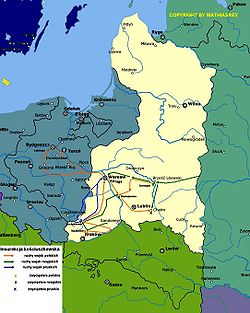
In the late 18th century, the Polish–Lithuanian Commonwealth was partitioned three times by Imperial Russia, the Austrian Empire, and the Kingdom of Prussia. After the first two partitions (1772 and 1793), Kraków remained part of the substantially reduced Polish nation.
Image source: Partitions of Poland
1794
% complete
In 1794, Tadeusz Kościuszko initiated a revolt against the partitioning powers, the Kościuszko Uprising, in Kraków's market square, becoming a symbol of Polish national resistance.
Image source: Kościuszko Uprising
Jun 15, 1794
% complete
The Prussian army specifically took Kraków on June 15, 1794, and looted the Polish royal treasure kept at Wawel Castle. The stolen regalia, valued at 525,259 thalers, was secretly melted down in March 1809, while precious stones and pearls were appropriated in Berlin.
Image source: Polish crown jewels
1795
% complete
Poland was partitioned for the third time in 1795, and Kraków became part of the Austrian province of Galicia, losing its status as a Polish city.
Image source: Kingdom of Galicia and Lodomeria
1807
% complete
When Napoleon Bonaparte of the French Empire captured part of what had once been Poland, he established the Duchy of Warsaw in 1807 as an independent but subordinate state.
Image source: Duchy of Warsaw
1809
% complete
West Galicia, including Kraków, was taken from the Austrian Empire and added to the Duchy of Warsaw in 1809 by the Treaty of Schönbrunn, which ended the War of the Fifth Coalition.
Image source: Treaty of Schönbrunn
1815 - 1846
% complete
The Congress of Vienna restored the partition of Poland but gave Kraków partial independence as the Free City of Cracow, a small nominally independent republic under joint Austrian, Prussian, and Russian protection.
Image source: Free City of Cracow
1846
% complete
The city again became the focus of a struggle for national sovereignty in 1846 during the Kraków Uprising. After its suppression, Kraków became the capital of the Grand Duchy of Kraków under Austrian rule until 1918.
Image source: Kraków Uprising
1850
% complete
In 1850, around 10% of the city was destroyed in a large fire, causing extensive damage and prompting significant rebuilding efforts.
Image source: Kraków Fire of 1850
1866
% complete
After the Austro-Prussian War of 1866, Austria granted partial autonomy to Galicia, making Polish a language of government and establishing a provincial Diet, allowing Kraków's cultural life to flourish.
Image source: History of Galicia (Eastern Europe)
1901
% complete
In 1901, the city installed running water and witnessed the introduction of its first electric streetcars, modernizing urban life ahead of many European cities including Warsaw.
Image source: Trams in Kraków
1904 - 1915
% complete
The most significant development of the early 20th century was the creation of Greater Kraków (Wielki Kraków), incorporating surrounding suburban communities into a single administrative unit. Overseen by mayor Juliusz Leo (1904–1918), it helped double the population from approx. 91,000 to 183,000 between 1910 and 1915.
Image source: Płaszów
1910
% complete
Several important commemorations took place in Kraków between 1866 and 1914, including the 500th Anniversary of the Battle of Grunwald in 1910, in which world-renowned pianist Ignacy Paderewski unveiled a monument.
Image source: Grunwald Monument
1914 - 1915
% complete
Russian troops besieged Kraków during the first winter of the First World War. Thousands of residents left the city for Moravia and other safer locales, generally returning in the spring and summer of 1915.
Image source: Eastern Front (World War I)
1918
% complete
With the fall of the Austro-Hungarian Empire, Poles liberated the city and it was included with the newly reborn Polish state in 1918.
Image source: History of Poland (1918–1939)
1939 - Mar 1940
% complete
During the occupation, arrested Kraków academics were sent to Sachsenhausen concentration camp after two weeks, and in March 1940 further to Dachau, part of the Nazi campaign against Polish intellectual life.
Image source: Sonderaktion Krakau
Sep 1939 - Dec 1939
% complete
From September to December 1939, the occupiers also operated a Dulag transit camp for Polish prisoners of war in the city.
Sep 1939
% complete
Already in September 1939, the Organizacja Orła Białego resistance organization was founded, one of the earliest Polish underground movements opposing Nazi occupation.
Image source: Riflemen's Association
Sep 6, 1939
% complete
The Nazi German forces entered Kraków on September 6, 1939, beginning a brutal occupation during which the city served as the seat of the General Government.
Image source: Occupation of Poland (1939–1945)
1942 - 1944
% complete
The German government operated several forced labour camps in the city, and from 1942 to 1944 they also operated the Stalag 369 prisoner-of-war camp for Dutch, Belgian and French POWs.
Image source: German prisoner-of-war camps in World War II
1944
% complete
In 1944, during and following the Warsaw Uprising, the Germans deported many captured Poles from Warsaw to Kraków, swelling the city's population with displaced persons.
Image source: Warsaw Uprising
1978
% complete
In 1978, UNESCO placed Kraków on the list of World Heritage Sites, recognizing the exceptional value of the city's historic architecture and urban fabric.
Image source: Historic Centre of Kraków
Oct 16, 1978
% complete
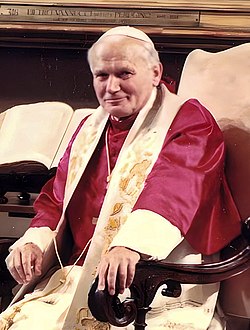
On October 16, 1978, Kraków's archbishop Karol Wojtyła was elevated to the papacy as John Paul II, the first non-Italian pope in 455 years, bringing worldwide attention to his home city.
Image source: Pope John Paul II
May 29, 1990
% complete
On May 29, 1990, following the end of communism in Poland, Tadeusz Piekarz was temporarily appointed Voivode of Kraków; the appointment was formally confirmed a month later, on June 28, 1990.
2016 - 2023
% complete
In recent history, Kraków has co-hosted various international sports competitions, including the 2016 European Men's Handball Championship, the 2017 and 2021 Men's European Volleyball Championships, the 2023 World Men's Handball Championship, and the 2023 European Games.
Image source: 2023 European Games
Or browse the full history timeline directory, with more than 2,000 topics.
This History of Krakow timeline was generated with the help of AI, using information found on the internet.
We work hard to keep these timelines accurate, but mistakes do get through. If you spot one, email us at [email protected] and we'll fix it for future visitors.
Generate yours with AI or build it from scratch, for free.
Export your timeline, add your own events, edit or remove AI-generated events, and much more
No credit card required.
Cancel anytime.
Cancel anytime.
You can create an unlimited number of timelines with up to 10 events on each one, customize how they look, export them to PDF, PNG, PowerPoint, CSV, and Excel, and share them with a link. Paid plans raise the event limit and add features like spreadsheet imports and collaborators.
Yes. You can cancel your subscription from your account page at any time, and you will not be charged again. Your subscription stays active for the rest of the period you already paid for.
Yes. We will email you a reminder before the annual renewal, and we will also email you a receipt.
Yes. You can email us within 15 days of any payment, and we will issue you a full refund.
Check out our pricing docs or send us an email anytime: [email protected].