-
Use Cases
-
Resources
-
Pricing
The history of photography traces the evolution of capturing images with light, beginning with early experiments in camera obscura and heliography in the 1820s. Key milestones include Louis Daguerre's daguerreotype (1839), William Henry Fox Talbot's calotype process, George Eastman's roll film and Kodak camera (1888), color photography, 35mm cameras, instant photography by Polaroid, and the revolutionary shift to digital sensors and smartphone cameras that made photography accessible to billions worldwide. More Less
1500
% complete
Until the 16th century the camera obscura was mainly used to study optics and astronomy, especially to safely watch solar eclipses without damaging the eyes.
Image source: Camera obscura
1550 - 1568
% complete
In the later half of the 16th century some technical improvements were developed: a biconvex lens in the opening (first described by Gerolamo Cardano in 1550) and a diaphragm restricting the aperture (Daniel Barbaro in 1568) gave a brighter and sharper image.
1558
% complete
In 1558 Giambattista della Porta was the first to write a description of using the camera obscura as a drawing aid in his popular and influential books. His proposal was widely adopted by artists.
Image source: Giambattista della Porta
1600
% complete
Since the 17th century portable versions of the camera obscura were commonly used by artists—first as a tent, later as boxes. It was abandoned when light-sensitive materials were discovered.
1614
% complete
In 1614 Angelo Sala noted that sunlight will turn powdered silver nitrate black, and that paper wrapped around silver nitrate for a year will turn black—an early observation of light-sensitive materials.
Image source: Angelo Sala
1694
% complete
In 1694 Wilhelm Homberg described how light darkened some chemicals, further establishing scientific knowledge of photochemical reactions before any attempt at photography.
1717
% complete
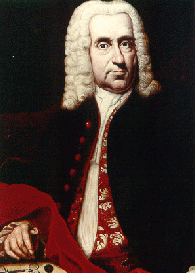
Around 1717, Johann Heinrich Schulze accidentally discovered that a slurry of chalk and nitric acid with dissolved silver particles was darkened by sunlight, and used this light-sensitive slurry to capture images of cut-out letters on a bottle.
Image source: Johann Heinrich Schulze
1719
% complete
Schulze named the substance "Scotophors" when he published his findings in 1719, documenting one of the earliest scientific studies of light-sensitive materials.
1760
% complete
The early science fiction novel Giphantie (1760) by the Frenchman Tiphaigne de la Roche described something quite similar to (color) photography, a process that fixes fleeting images formed by rays of light: "They coat a piece of canvas with this material, and place it in front of the object to capture."
1777
% complete
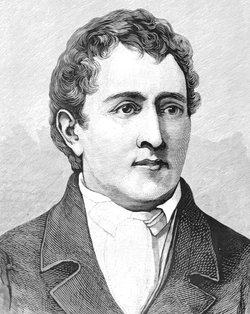
In 1777, the chemist Carl Wilhelm Scheele was studying the more intrinsically light-sensitive silver chloride and determined that light darkened it by disintegrating it into microscopic dark particles of metallic silver.
Image source: Carl Wilhelm Scheele
1800
% complete
Around 1800, Thomas Wedgwood made the first reliably documented, although unsuccessful attempt at capturing camera images in permanent form. He found no method to fix the photogram and shadow images he managed to capture.
Image source: Darwin–Wedgwood family
1800 - 1801
% complete
French balloonist, professor and inventor Jacques Charles is believed to have captured fleeting negative photograms of silhouettes on light-sensitive paper at the start of the 19th century, prior to Wedgwood. Charles died in 1823 without having documented the process; it was not publicized until François Arago mentioned it in 1839.
Image source: Jacques Charles
1802
% complete
In 1802, an account by Humphry Davy detailing Wedgwood's experiments was published in an early journal of the Royal Institution with the title An Account of a Method of Copying Paintings upon Glass, and of Making Profiles, by the Agency of Light upon Nitrate of Silver. It was reviewed by David Brewster in December 1802 and appeared in chemistry textbooks as early as 1803.
Image source: Humphry Davy
1816
% complete
In 1816, using paper coated with silver chloride, Nicéphore Niépce succeeded in photographing the images formed in a small camera, but the photographs were negatives and not permanent, as he could find no way to prevent the coating from darkening all over when exposed to light for viewing.
Image source: Nicéphore Niépce
1826 - 1827
% complete
In 1826, Nicéphore Niépce first managed to fix an image captured with a camera, but at least eight hours or even several days of exposure were required and the earliest results were very crude. The oldest surviving photograph of the image formed in a camera was created by Niépce in 1826 or 1827.
Image source: View from the Window at Le Gras
1832 - 1833
% complete
French-born Hércules Florence developed his own photographic technique in 1832 or 1833 in Brazil, with some help of pharmacist Joaquim Corrêa de Mello. He reportedly referred to the technique as "photographie" as early as 1833, but did not properly fix his images or publish his findings.
Image source: Hércules Florence
1832 - Jun 1838
% complete
Charles Wheatstone developed his mirror stereoscope around 1832, but did not really publicize his invention until June 1838, laying groundwork for stereoscopic photography.
Image source: Charles Wheatstone
1833
% complete
Niépce died suddenly in 1833, leaving his notes to Louis Daguerre, who continued developing the photographic process that would become the daguerreotype.
1835
% complete
Henry Fox Talbot had already succeeded in creating stabilized photographic negatives on paper in 1835, but worked on perfecting his own process after reading early reports of Daguerre's invention.
Image source: Henry Fox Talbot
1837
% complete
In 1837, mineralist-writer Franz von Kobell shot finely detailed salt-paper negatives of different perspectives of the Munich Frauenkirche and other local buildings. Kobell revealed his work in 1839, together with Carl August von Steinheil.
Image source: Wolfgang Franz von Kobell
1839
% complete
In 1839, John Herschel made the first glass negative, but his process was difficult to reproduce. Herschel also provided Talbot with an effective fixer based on hyposulfite of soda (sodium thiosulfate).
Image source: John Herschel
1839
% complete
The coining of the word photography is usually attributed to Sir John Herschel in 1839, giving the new medium its enduring name.
Image source: Photography
1839
% complete
In 1839, François Arago reported the invention of photography to stunned listeners by displaying the first photo taken in Egypt; that of Ras El Tin Palace.
Image source: François Arago
Jan 7, 1839
% complete
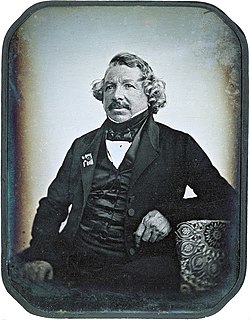
On 7 January 1839, Daguerre's complete practical photographic process was announced at a meeting of the French Academy of Sciences, and the news quickly spread around the world.
Image source: Daguerreotype
Aug 2, 1839
% complete
On August 2, 1839 Daguerre demonstrated the details of the daguerreotype process to the Chamber of Peers in Paris, building public and governmental support for the invention.
Aug 19, 1839
% complete
Complete instructions for the daguerreotype process were made public on 19 August 1839, allowing anyone to practice the first commercially successful form of photography.
1841
% complete
In 1841, Talbot invented the calotype process, which, like Daguerre's process, used the principle of chemical development of a faint or invisible "latent" image to reduce the exposure time to a few minutes.
Image source: Calotype
1841 - Jun 17, 1852
% complete
Slovene Janez Puhar invented a process for making photographs on glass in 1841; it was recognized on June 17, 1852, in Paris by the Académie National Agricole, Manufacturière et Commerciale.
Image source: Johann Pucher
1841 - 1842
% complete
Between 1841 and 1842 Henry Collen made calotypes of statues, buildings and portraits, including a portrait of Charles Babbage shot in August 1841.
Image source: Henry Collen
1844
% complete
David Brewster developed a stereoscope with lenses and a binocular camera in 1844, advancing stereoscopic photography. He presented two stereoscopic self portraits made by John Adamson in March 1849.
Image source: David Brewster
1848
% complete
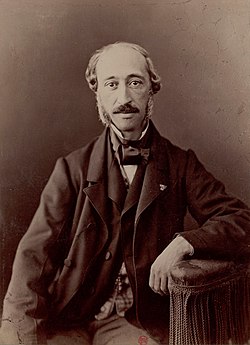
Results were demonstrated by Edmond Becquerel as early as 1848, but exposures lasting for hours or days were required and the captured colors were so light-sensitive they would only bear very brief inspection in dim light.
Image source: Edmond Becquerel
1861
% complete
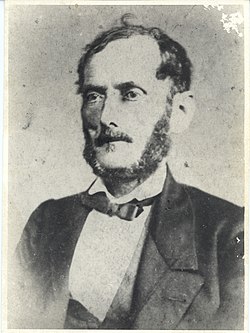
The first color photograph was taken by Thomas Sutton in 1861 for use in a lecture by the Scottish physicist James Clerk Maxwell, who had proposed the three-color method in 1855.
Image source: James Clerk Maxwell
1869
% complete
Two French inventors, Louis Ducos du Hauron and Charles Cros, working unknown to each other during the 1860s, famously unveiled their nearly identical ideas on the same day in 1869.
Image source: Louis Arthur Ducos du Hauron
1873
% complete
Maxwell's color method was made practical by Hermann Wilhelm Vogel's 1873 discovery of a way to make emulsions sensitive to the rest of the spectrum, gradually introduced into commercial use beginning in the mid-1880s.
Image source: Hermann Wilhelm Vogel
1907
% complete
The first widely used method of color photography was the Autochrome plate, a process inventors and brothers Auguste and Louis Lumière began working on in the 1890s and commercially introduced in 1907.
Image source: Autochrome Lumière
1935 - 1936
% complete
A new era in color photography began with the introduction of Kodachrome film, available for 16 mm home movies in 1935 and 35 mm slides in 1936. Its multilayer emulsion approach pioneered modern color film.
Image source: Kodachrome
1950
% complete
In the mid-20th century, developments made it possible for amateurs to take pictures in natural color as well as in black-and-white, transforming everyday photography.
Image source: Color photography
1851
% complete
In 1851, English sculptor Frederick Scott Archer invented the collodion process, which dramatically reduced exposure times and became the dominant photographic method of the mid-19th century.
Image source: Collodion process
1851
% complete
Other mid-nineteenth-century photographers established the medium as a more precise means than engraving or lithography of making a record of landscapes and architecture: for example, Robert Macpherson's broad range of photographs of Rome, the interior of the Vatican, and the surrounding countryside became a sophisticated tourist's visual record of his own travels.
1851
% complete
In America, by 1851 a broadsheet by daguerreotypist Augustus Washington was advertising prices ranging from 50 cents to $10, showing how portrait photography had become a commercial service.
Image source: Augustus Washington
1881
% complete
Nineteenth-century experimentation with photographic processes frequently became proprietary. In 1881, Theodore Lilienthal published his discovery, and the German-born, New Orleans photographer successfully sought legal redress in an 1881 infringement case involving his "Lambert Process" in the Eastern District of Louisiana.
Image source: History of photography
1884
% complete
In 1884 George Eastman, of Rochester, New York, developed dry gel on paper, or film, to replace the photographic plate so that a photographer no longer needed to carry boxes of plates and toxic chemicals around.
Image source: George Eastman
Jul 1888
% complete
In July 1888 Eastman's Kodak camera went on the market with the slogan "You press the button, we do the rest". Now anyone could take a photograph and leave the complex parts of the process to others.
Image source: Kodak
1901
% complete
Photography became available for the mass-market in 1901 with the introduction of the Kodak Brownie, an inexpensive camera that put picture-taking within reach of ordinary people.
Image source: Kodak Brownie
1957
% complete
In 1957, a team led by Russell A. Kirsch produced one of the earliest digital images by scanning a photograph, marking the beginning of digital imaging technology.
Image source: Russell Kirsch
1969
% complete
The charge-coupled device (CCD), which enables electronic capture of images, was invented in 1969 by Willard Boyle and George E. Smith, laying the foundation for digital cameras.
Image source: Charge-coupled device
1973
% complete
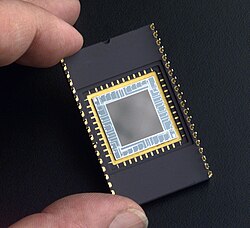
In 1973 Fairchild Semiconductor released the first large image-capturing CCD chip: 100 rows and 100 columns, bringing solid-state image sensors closer to practical use.
Image source: Fairchild Semiconductor
1986
% complete
In 1986 Kodak scientists developed the world's first megapixel sensor, a milestone in the resolution of digital image capture.
1992
% complete
The web has been a popular medium for storing and sharing photos ever since the first photograph was published on the web by Tim Berners-Lee in 1992 (an image of the CERN house band Les Horribles Cernettes).
Image source: Les Horribles Cernettes
2000 - 2010
% complete
During the first decade of the 21st century, film declined as digital cameras became cheaper, easier to use, and better in image quality, fundamentally changing how people take and share photographs.
Image source: Digital camera
2004
% complete
Since then sites and apps such as Facebook, Flickr, Instagram, Picasa (discontinued in 2016), Imgur, Photobucket and Snapchat have been used by many millions of people to share their pictures.
Image source: Instagram
Or browse the full history timeline directory, with more than 2,000 topics.
This History of Photography timeline was generated with the help of AI, using information found on the internet.
We work hard to keep these timelines accurate, but mistakes do get through. If you spot one, email us at [email protected] and we'll fix it for future visitors.
Generate yours with AI or build it from scratch, for free.
Export your timeline, add your own events, edit or remove AI-generated events, and much more
No credit card required.
Cancel anytime.
Cancel anytime.
You can create an unlimited number of timelines with up to 10 events on each one, customize how they look, export them to PDF, PNG, PowerPoint, CSV, and Excel, and share them with a link. Paid plans raise the event limit and add features like spreadsheet imports and collaborators.
Yes. You can cancel your subscription from your account page at any time, and you will not be charged again. Your subscription stays active for the rest of the period you already paid for.
Yes. We will email you a reminder before the annual renewal, and we will also email you a receipt.
Yes. You can email us within 15 days of any payment, and we will issue you a full refund.
Check out our pricing docs or send us an email anytime: [email protected].