-
Use Cases
-
Resources
-
Pricing
The history of Puerto Rico spans thousands of years, beginning with the indigenous Taíno people, followed by Spanish colonization starting in 1493 under Christopher Columbus. The island remained a Spanish colony for over 400 years before being ceded to the United States in 1898 after the Spanish-American War. Puerto Rico became a U.S. territory in 1950 and a commonwealth (Estado Libre Asociado) in 1952, navigating complex questions of identity, autonomy, and statehood ever since. More Less
Nov 19, 1493
% complete
On his second voyage, Christopher Columbus landed on the western coast of the island and claimed it for Spain, naming it San Juan Bautista. This marked the beginning of European colonization and contact with the Taíno people.
Image source: History of Puerto Rico
1508
% complete
Juan Ponce de León established the first European settlement on the island at Caparra, near present-day San Juan, after receiving royal authorization to colonize Borikén. He later became the island's first governor.
Image source: Juan Ponce de León
1513
% complete
As the Taíno population collapsed, Spain began importing enslaved Africans to work sugar plantations and mines. Africans and their descendants became a foundational part of Puerto Rico's demographic and cultural heritage.
Image source: Afro–Puerto Ricans
1521
% complete
The capital was relocated from Caparra to a more defensible islet site and renamed Ciudad de Puerto Rico de San Juan. It became a key Spanish military and commercial hub in the Caribbean.
Image source: San Juan, Puerto Rico
1539
% complete
Spain began building Castillo San Felipe del Morro to guard the entrance to San Juan Bay. Over centuries it was expanded into one of the mightiest fortresses in the Americas, repelling repeated attacks by rival powers.
Image source: Castillo San Felipe del Morro
Nov 1595
% complete
English privateer Francis Drake attacked San Juan with a large fleet but failed to capture El Morro or the city. The successful defense cemented the fortress's reputation as impregnable.
Image source: Battle of San Juan (1595)
Sep 1625
% complete
Dutch forces under Captain Boudewijn Hendricksz captured and looted San Juan, burning much of the city, but could not take El Morro and were driven off by Spanish defenders.
Image source: Battle of San Juan (1625)
Apr 17, 1797 - Apr 30, 1797
% complete
A major British invasion force under General Ralph Abercromby attacked San Juan during the French Revolutionary Wars. Spanish defenders, aided by local militia including free men of color, repelled the assault after fierce fighting.
Image source: British invasions of the River Plate
1806
% complete
Puerto Rico's first newspaper began publication, becoming an important vehicle for official announcements, commerce, and eventually political debate during the era of liberal reforms.
Image source: Gaceta de Puerto Rico
1815
% complete
Spain issued the Royal Decree of Graces to encourage immigration and economic development, granting land and incentives to Catholic settlers from Europe and Latin America, transforming the island's economy and demographics through sugar and coffee booms.
Image source: Royal Decree of Graces of 1815
Sep 23, 1868
% complete
Independence-minded rebels proclaimed the Republic of Puerto Rico in the town of Lares, demanding freedom from Spain and the abolition of slavery. The revolt was quickly crushed by Spanish authorities but became a symbol of Puerto Rican national identity.
Image source: Grito de Lares
Mar 22, 1873
% complete
The Spanish Cortes abolished slavery in Puerto Rico, freeing roughly 31,000 enslaved people. Formerly enslaved workers were required to serve apprenticeship contracts for several years before gaining full freedom.
Nov 25, 1897
% complete
Spain granted Puerto Rico significant self-government with its own bicameral legislature and autonomy in domestic affairs. An autonomous government took office in 1898, but it was short-lived due to war with the United States.
Image source: Autonomy Charter of Puerto Rico
1511
% complete
Led by the cacique Agüeybana II, the Taíno rose up against Spanish colonizers, attacking settlements in response to brutal labor demands and violence. The revolt was ultimately suppressed, and disease and forced labor devastated the indigenous population.
Jul 25, 1898 - Aug 13, 1898
% complete
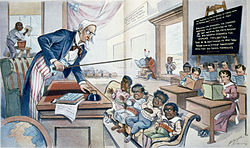
American troops under General Nelson Miles landed at Guánica and quickly overran the island during the Spanish-American War. Spain ceded Puerto Rico to the United States under the Treaty of Paris signed in December 1898.
Image source: Puerto Rico campaign
Aug 8, 1899
% complete
One of the deadliest Atlantic hurricanes on record struck Puerto Rico, killing thousands and destroying crops and homes. The disaster deepened the island's postwar economic hardship and accelerated migration to Hawaii and New York.
Image source: 1899 San Ciriaco hurricane
Apr 12, 1900
% complete
The Foraker Act ended U.S. military rule and created a civil government with an appointed governor, executive council, and elected house of delegates. It also defined islanders as citizens not fully covered by the U.S. Constitution.
Image source: Foraker Act
1901
% complete
In a series of Supreme Court decisions known as the Insular Cases, the Court held that full constitutional rights did not automatically extend to unincorporated territories like Puerto Rico, establishing the legal framework that persists today.
Image source: Insular Cases
Mar 2, 1917
% complete
The Jones Act conferred U.S. citizenship on Puerto Ricans, created an elected senate, and expanded civil rights. Weeks later, many Puerto Ricans were drafted into World War I service.
1922
% complete
The Nationalist Party was formed to pursue complete independence from the United States. Under Pedro Albizu Campos it became a militant voice of anti-colonial resistance during the following decades.
Image source: Puerto Rican Nationalist Party insurgency
Mar 21, 1937
% complete
Police fired on an unarmed Nationalist parade in Ponce, killing nineteen people and wounding dozens more. The massacre became a defining moment in Puerto Rico's independence movement and a lasting symbol of repression.
Image source: Ponce massacre
1947
% complete
Under Governor Luis Muñoz Marín, Puerto Rico pursued rapid industrialization through tax incentives attracting U.S. manufacturers. The program transformed the economy from agrarian to industrial and spurred massive urbanization and migration to the mainland.
Oct 30, 1950
% complete
Nationalists launched armed revolts in several towns, including Jayuya where Blanca Canales proclaimed a republic. The U.S.-backed government declared martial law and suppressed the uprisings; Oscar Collazo's related assassination attempt on President Truman drew international attention.
Image source: Puerto Rican Nationalist Party insurgency
Jul 25, 1952
% complete
After voters approved a constitution drafted by a constituent assembly, Puerto Rico became the Commonwealth of Puerto Rico (Estado Libre Asociado), gaining greater self-government while remaining a U.S. territory under federal authority.
Mar 4, 1971
% complete
Police opened fire on student demonstrators protesting Navy presence on Vieques at the University of Puerto Rico's Río Piedras campus, killing two people. The event intensified activism against militarization of Vieques.
1999 - 2003
% complete
Following the death of civilian David Sanes from a stray Navy bomb, mass civil disobedience campaigns demanded the Navy leave Vieques. Sustained protests succeeded: live-fire training ended in 2003 and the Navy withdrew from the island municipality.
Image source: Vieques, Puerto Rico
Nov 6, 2012
% complete
In a two-part referendum, a majority rejected the current territorial status, and among alternatives, statehood received the most votes. The ambiguous results prompted renewed debate in Washington about Puerto Rico's political future.
Jun 30, 2016
% complete
Facing an unpayable $70 billion debt, Congress passed PROMESA, creating an unelected fiscal control board and enabling bankruptcy-like restructuring. Austerity measures imposed by the board reshaped public services and sparked widespread protest.
Image source: La Promesa
Sep 20, 2017
% complete
Category 5 Hurricane Maria made landfall, destroying the power grid, killing thousands according to later studies, and triggering the largest exodus in modern Puerto Rican history. The federal response controversy galvanized debates over the island's colonial status.
Image source: Hurricane Maria
Or browse the full history timeline directory, with more than 2,000 topics.
This History of Puerto Rico timeline was generated with the help of AI, using information found on the internet.
We work hard to keep these timelines accurate, but mistakes do get through. If you spot one, email us at [email protected] and we'll fix it for future visitors.
Generate yours with AI or build it from scratch, for free.
Export your timeline, add your own events, edit or remove AI-generated events, and much more
No credit card required.
Cancel anytime.
Cancel anytime.
You can create an unlimited number of timelines with up to 10 events on each one, customize how they look, export them to PDF, PNG, PowerPoint, CSV, and Excel, and share them with a link. Paid plans raise the event limit and add features like spreadsheet imports and collaborators.
Yes. You can cancel your subscription from your account page at any time, and you will not be charged again. Your subscription stays active for the rest of the period you already paid for.
Yes. We will email you a reminder before the annual renewal, and we will also email you a receipt.
Yes. You can email us within 15 days of any payment, and we will issue you a full refund.
Check out our pricing docs or send us an email anytime: [email protected].