-
Use Cases
-
Resources
-
Pricing
The history of radioactivity traces the discovery and understanding of spontaneous radiation emitted by certain elements. Beginning with Henri Becquerel's accidental discovery of uranium rays in 1896, the field expanded rapidly through the pioneering work of Marie and Pierre Curie, Ernest Rutherford's identification of alpha and beta particles, and later developments in nuclear fission, leading to applications in medicine, energy, and weapons. More Less
Oct 1975
% complete
The song "Radioactivity" was drawn from Kraftwerk's fifth studio album Radio-Activity, released in 1975, an album whose title referenced both radio broadcasting and nuclear radiation.
Image source: Radio-Activity
Feb 1976
% complete
In its original 1976 form, "Radioactivity" celebrated radio itself, with lyrics referencing radio waves and broadcasting rather than nuclear danger.
Image source: Radioactivity (song)
Feb 1976
% complete
Kraftwerk released "Radioactivity" in February 1976 as the only single from their fifth studio album, Radio-Activity (1975). The song became one of the band's signature tracks.
Feb 1976
% complete
"Radioactivity" served as the only single issued from the Radio-Activity album, making it the primary promotional track representing the record to the public.
1976
% complete
"Radioactivity" appeared in Rainer Werner Fassbinder's film Chinese Roulette, bringing the Kraftwerk track to cinema audiences.
Image source: Chinese Roulette
1980
% complete
The song "Radioactivity" was also featured in Rainer Werner Fassbinder's Berlin Alexanderplatz, further cementing its presence in his work.
Image source: Berlin Alexanderplatz (miniseries)
2010
% complete
"Radioactivity" appeared in the 2010 documentary Into Eternity, a film about nuclear waste storage, where its themes aligned powerfully with the subject matter.
Image source: Into Eternity (film)
2020
% complete
Also in 2020, The Guardian placed "Radioactivity" at number two on its list of the greatest Kraftwerk songs, highlighting its status within the band's catalog.
Image source: The Guardian
2020
% complete
In 2020, Billboard ranked "Radioactivity" number five on its list of the greatest Kraftwerk songs, recognizing the track's enduring significance.
Feb 1976
% complete
The light-beam operated percussion cage trialed during 1976 performances of "Radioactivity" was an early example of interactive electronic instrumentation in live pop performance.
Feb 1976
% complete
On stage in 1976, percussionist Wolfgang Flür attempted to play electronic drums by breaking light beams with arm gestures inside the experimental percussion cage used during "Radioactivity" performances.
Image source: Wolfgang Flür
Feb 1976
% complete
During original performances of "Radioactivity" in 1976, Kraftwerk tried out an experimental light-beam operated "percussion cage", with Wolfgang Flür attempting to trigger electronic drum sounds by interrupting light beams using arm gestures.
1991
% complete
Since 1991, "Radioactivity" has been performed during the majority of Kraftwerk's live shows, becoming a fixture of the band's concerts.
Image source: Kraftwerk
Jun 1992
% complete
Kraftwerk performed the Mix version of "Radioactivity" at the "Stop Sellafield" concert in 1992, aligning the band publicly with the anti-nuclear cause.
Image source: Sellafield
Jul 2012
% complete
In 2012, Kraftwerk performed a new remix of "Radioactivity" during No Nukes 2012, held in Japan, in support of the anti-nuclear movement following Fukushima.
Image source: Yellow Magic Orchestra
Jul 2012
% complete
The No Nukes 2012 festival in Japan provided the setting for Kraftwerk's performance of the new "Radioactivity" remix, resonating with post-Fukushima anti-nuclear sentiment.
Feb 1976 - 1991
% complete
Between its 1976 release and the 1991 re-recording, "Radioactivity" evolved from a celebration of radio broadcasting into a pointed anti-nuclear protest anthem, reflecting changing times.
1991
% complete
For their 1991 remix album The Mix, Kraftwerk re-recorded "Radioactivity" as a radically different version, transforming the song's sound and message.
1991
% complete
The revised lyrics of "Radioactivity" mentioned Hiroshima by name, recalling the atomic bombing and anchoring the song's anti-nuclear theme in history.
Image source: Atomic bombings of Hiroshima and Nagasaki
1991
% complete
The 1991 version of "Radioactivity" mentioned Sellafield by name, pointing to the British nuclear site that had become a focus of environmental concern.
1991
% complete
The updated lyrics of "Radioactivity" named Harrisburg, referencing the Three Mile Island accident near Harrisburg, Pennsylvania, among sites of nuclear crisis.
Image source: Three Mile Island accident
1991
% complete
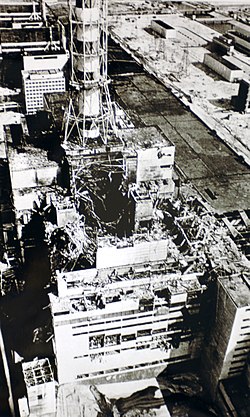
The 1991 version of "Radioactivity" mentioned Chernobyl by name, invoking the 1986 nuclear disaster as part of its anti-nuclear message.
Image source: Chernobyl disaster
1991
% complete
The 1991 re-recording of "Radioactivity" for The Mix was radically different from the original, updating the arrangement and completely revising the song's lyrical focus.
1991
% complete
The 1991 single release of "Radioactivity" featured remixes by François Kevorkian and William Orbit, giving the song new club-oriented interpretations.
Image source: François Kevorkian
1991
% complete
In 1991, "Radioactivity" was re-issued as a single from Kraftwerk's remix album The Mix, featuring remixes by François Kevorkian and William Orbit.
1991
% complete
The 1991 single of "Radioactivity" was issued in an edited form, accompanied by remixes from François Kevorkian and William Orbit.
1991
% complete
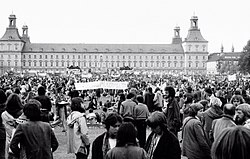
The 1991 version of "Radioactivity" dropped all references to radio and incorporated additional lyrics with a pointed anti-nuclear theme, remaking the central hook as "stop radioactivity".
Image source: Anti-nuclear movement
1991
% complete
In the 1991 reworking, the central lyrical hook of "Radioactivity" was remade as "stop radioactivity", transforming the song into an explicit protest statement.
1991
% complete
The revised 1991 lyrics of "Radioactivity" referred to a "contaminated population", underscoring the human cost of nuclear accidents and warfare.
2005
% complete
A live version of "Radioactivity" appears on the English version of Kraftwerk's 2005 live album Minimum-Maximum, documenting the band's world tour performances.
Image source: Maximum and minimum
2005
% complete
Live versions of "Radioactivity" feature on both English and German versions of Minimum-Maximum, reflecting Kraftwerk's bilingual presentation of their repertoire.
Dec 2017
% complete
The No Nukes-era remix version of "Radioactivity" also appears on Kraftwerk's 2017 live album 3-D The Catalogue, preserving it in the band's official discography.
Image source: 3-D The Catalogue
Or browse the full history timeline directory, with more than 2,000 topics.
This History of Radioactivity timeline was generated with the help of AI, using information found on the internet.
We work hard to keep these timelines accurate, but mistakes do get through. If you spot one, email us at [email protected] and we'll fix it for future visitors.
Generate yours with AI or build it from scratch, for free.
Export your timeline, add your own events, edit or remove AI-generated events, and much more
No credit card required.
Cancel anytime.
Cancel anytime.
You can create an unlimited number of timelines with up to 10 events on each one, customize how they look, export them to PDF, PNG, PowerPoint, CSV, and Excel, and share them with a link. Paid plans raise the event limit and add features like spreadsheet imports and collaborators.
Yes. You can cancel your subscription from your account page at any time, and you will not be charged again. Your subscription stays active for the rest of the period you already paid for.
Yes. We will email you a reminder before the annual renewal, and we will also email you a receipt.
Yes. You can email us within 15 days of any payment, and we will issue you a full refund.
Check out our pricing docs or send us an email anytime: [email protected].