-
Resources
-
Pricing
The history of electromagnetism traces how scientists gradually revealed the relationship between electric charges, currents, and magnetic fields, leading to major advances in physics, communication, power generation, electronics, and modern technology. More Less
Build a timeline like this one in minutes, for free. Start Yours →
Part of our collection of science timelines.
1044
Chinese technological texts from the Song dynasty describe magnetized needles and their use for navigation. These developments established practical knowledge of magnetism centuries before magnetism and electricity were scientifically unified.
Image source: History of the compass
1600
William Gilbert published De Magnete, a systematic study of magnets, lodestones, and the Earth’s magnetic behavior. He argued that Earth itself acts like a giant magnet and distinguished magnetic attraction from the effects of rubbed amber, helping establish experimental physics.
Image source: De Magnete
1663
Otto von Guericke constructed a sulfur-globe generator that produced static electricity when rotated and rubbed. It was among the first machines capable of generating electrical effects repeatedly and influenced later experiments with electrical attraction, repulsion, and sparks.
Image source: Otto von Guericke
1729
Stephen Gray showed that electrical influence could travel through long threads and rods, while some materials interrupted its transmission. His experiments introduced the distinction between conductors and insulators, a central concept in electrical science.
1733
Charles du Fay proposed that electricity occurred in two forms, which he called vitreous and resinous electricity. He observed that like kinds repelled and unlike kinds attracted, anticipating the modern distinction between positive and negative charge.
Image source: Charles François de Cisternay du Fay
1745
Ewald Georg von Kleist and, independently, Pieter van Musschenbroek developed the Leyden jar. It was the first practical capacitor, allowing substantial electric charge to be accumulated and discharged suddenly for controlled experiments.
Image source: Leyden jar
1747
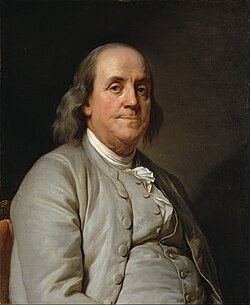
Benjamin Franklin developed a one-fluid model in which electrical effects resulted from an excess or deficit of electric fluid. His terminology of positive and negative charge survived, and his experiments helped popularize the idea that lightning was electrical.
Image source: Benjamin Franklin
Jun 1752
Benjamin Franklin’s famous kite experiment, reported in 1752, demonstrated that storm clouds could produce electrical sparks. The work supported the identification of lightning with electricity and encouraged the practical development of lightning rods.
1767
Joseph Priestley suggested that electric force might follow an inverse-square law like gravitation. His proposal helped direct later quantitative investigations of the force between charges.
Image source: Joseph Priestley
1780 - 1791
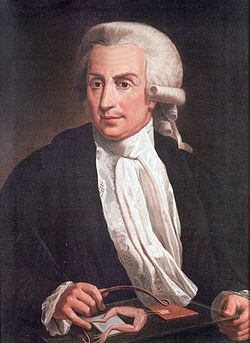
Luigi Galvani studied muscular contractions in dissected frog legs and argued that animals possessed an intrinsic form of electricity. His work initiated the scientific debate over animal electricity and helped inspire the invention of the battery.
Image source: Luigi Galvani
1785 - 1789
Using a torsion balance, Charles-Augustin de Coulomb measured the force between electrically charged bodies and found it varied inversely with the square of their separation. Coulomb’s law provided the mathematical foundation for electrostatics.
Image source: Coulomb's law
1800
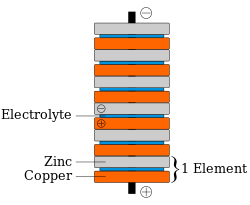
Alessandro Volta announced the voltaic pile, the first continuous source of electric current. Alternating discs of different metals separated by electrolyte-soaked material produced sustained voltage and transformed electrical experiments from brief sparks into continuous processes.
Image source: Voltaic pile
1827
Georg Ohm published a quantitative relation between voltage, current, and resistance. Ohm’s law made it possible to analyze electrical circuits systematically and became fundamental to electrical engineering.
Image source: Ohm's law
1820
François Arago found that an electric current could magnetize iron and demonstrated the strong connection between currents and magnetic materials. The observation contributed to the development of electromagnets and practical electrical devices.
Image source: François Arago
1820 - 1826
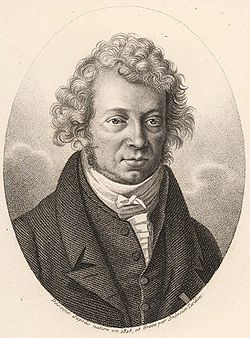
André-Marie Ampère rapidly investigated the forces between current-carrying conductors and formulated mathematical laws for electrodynamics. His work introduced the concept of electric current as a fundamental quantity and later gave the ampere its name.
Image source: André-Marie Ampère
1820
Jean-Baptiste Biot and Félix Savart measured the magnetic effect of current-carrying wires and established the law describing the magnetic field produced by a current element. Their result became a cornerstone of magnetostatics.
Apr 1820
Hans Christian Ørsted observed that a current-carrying wire deflected a nearby magnetic compass needle. Published in 1820, the discovery established a direct relationship between electricity and magnetism and launched modern electromagnetism.
Image source: Hans Christian Ørsted
Sep 1821
Michael Faraday demonstrated continuous rotation produced by the interaction of electric current and a magnetic field. This experiment was an early electric motor and showed that electrical energy could be converted into mechanical motion.
Image source: Michael Faraday
Aug 1831
Michael Faraday showed that a changing magnetic field induces an electric current in a nearby circuit. Electromagnetic induction established the operating principle of generators, transformers, and much of modern electric power.
Image source: Electromagnetic induction
1833 - 1834
Faraday established quantitative laws relating the amount of chemical change at an electrode to the quantity of electricity passed through an electrolyte. His work connected electricity with matter and introduced important electrochemical terminology.
Image source: Faraday's laws of electrolysis
1834
Heinrich Lenz formulated the rule that an induced current opposes the change in magnetic flux that produces it. Lenz’s law expresses conservation of energy in electromagnetic induction and remains essential to generator and motor analysis.
1845
Faraday used lines of magnetic and electric force to represent fields in space, moving beyond action-at-a-distance descriptions. His field concept strongly influenced James Clerk Maxwell’s later mathematical formulation of electromagnetism.
1853 - 1855
William Thomson, later Lord Kelvin, developed mathematical treatments of electric potential, capacitance, and electrostatic images. His work helped formalize field-based electrical theory and introduced concepts used throughout mathematical physics.
Image source: Lord Kelvin
1865
James Clerk Maxwell published A Dynamical Theory of the Electromagnetic Field, presenting equations that unified electricity, magnetism, and induction. The theory predicted electromagnetic waves and identified light as an electromagnetic phenomenon.
Image source: A Dynamical Theory of the Electromagnetic Field
1873
Maxwell’s two-volume Treatise synthesized experimental results and mathematical theory into a comprehensive account of electromagnetism. It introduced generations of scientists to the field and became a foundation of modern physics.
Image source: A Treatise on Electricity and Magnetism
1887 - 1888
Heinrich Hertz generated and detected radio-frequency electromagnetic waves in the laboratory. His measurements confirmed Maxwell’s prediction that changing electric and magnetic fields propagate through space at finite speed.
Image source: Heinrich Hertz
1837
Samuel Morse and collaborators developed a practical electric telegraph using pulses of current and a coded alphabet. Telegraphy was one of the first large-scale applications of electromagnetism and revolutionized long-distance communication.
Image source: Electrical telegraph
1849
Hippolyte Fizeau measured the speed of light using a rapidly rotating toothed wheel. The experiment improved knowledge of a key electromagnetic constant and helped connect optical and electromagnetic theories.
Image source: Hippolyte Fizeau
Mar 7, 1876
Alexander Graham Bell received a landmark patent for transmitting speech electrically. The telephone converted sound into varying electrical signals and back again, making electromagnetic communication a central technology of modern society.
Image source: Telephone
1879
Thomas Edison demonstrated a commercially practical incandescent light bulb and developed supporting electrical distribution systems. Electric lighting helped drive the expansion of power generation, wiring, and applied electromagnetism.
Image source: Incandescent light bulb
1887 - 1888
Nikola Tesla developed and patented practical alternating-current induction motors based on rotating magnetic fields. The technology made efficient AC power transmission and industrial electrification possible.
Image source: Induction motor
1887
Albert A. Michelson and Edward Morley found no detectable difference in the speed of light caused by Earth’s motion through the proposed luminiferous ether. The result challenged classical ideas about light propagation and later influenced special relativity.
Image source: Michelson–Morley experiment
1887
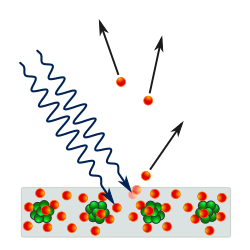
While studying electromagnetic waves, Hertz observed that ultraviolet light affected spark discharge. The effect was subsequently recognized as a form of photoelectric behavior and became important evidence in the development of quantum theory.
Image source: Photoelectric effect
1892 - 1895
Hendrik Lorentz developed a theory in which electrical and optical effects arose from charged particles, later called electrons. His work connected Maxwell’s fields with matter and introduced transformations that became important to relativity.
1895
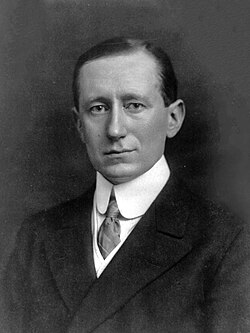
Guglielmo Marconi transmitted coded signals by radio over increasingly long distances, transforming Hertz’s laboratory waves into a communication system. Wireless telegraphy became the precursor of radio broadcasting and modern wireless technologies.
Image source: Guglielmo Marconi
1897
J. J. Thomson’s cathode-ray experiments showed that cathode rays consisted of negatively charged particles much smaller than atoms. The discovery of the electron established the first identified subatomic particle and reshaped theories of electricity and matter.
Image source: Electron
Dec 1900
Max Planck proposed that electromagnetic energy is emitted and absorbed in discrete quanta to explain black-body radiation. This hypothesis marked the beginning of quantum theory and ultimately changed the understanding of electromagnetic radiation.
Image source: Max Planck
1905
Albert Einstein proposed that light itself consists of localized quanta whose energy depends on frequency. His explanation of the photoelectric effect provided a decisive application of quantum ideas to electromagnetism.
1905
Einstein’s special theory of relativity established that the laws of physics, including Maxwell’s equations, have the same form in all inertial frames and that the speed of light is invariant. It unified space and time and clarified the relativistic structure of electric and magnetic fields.
Image source: Special relativity
1909 - 1911
Robert Millikan’s oil-drop experiment measured the elementary electric charge and showed that charge occurs in discrete units. The result gave quantitative support to the electron theory of electricity.
Image source: Oil drop experiment
1911
Ernest Rutherford’s scattering experiments demonstrated that atoms contain a tiny, dense, positively charged nucleus. The nuclear model provided a new framework for understanding electric charge and the structure of matter.
Image source: Ernest Rutherford
1928
Paul Dirac formulated a relativistic wave equation for the electron that combined quantum mechanics with special relativity and predicted antimatter. His work was a major step toward quantum electrodynamics.
Image source: Paul Dirac
Dec 2, 1942
Under Enrico Fermi’s leadership, Chicago Pile-1 achieved the first controlled, self-sustaining nuclear chain reaction. The achievement applied electromagnetic and quantum understanding of matter within the broader development of nuclear physics.
Image source: Chicago Pile-1
Dec 23, 1947
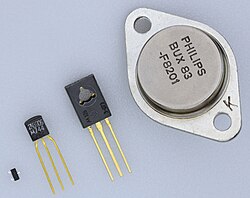
John Bardeen, Walter Brattain, and William Shockley developed the transistor at Bell Laboratories. Semiconductor control of electric current replaced many vacuum tubes and initiated the electronics and information revolutions.
Image source: Transistor
1948 - 1949
Julian Schwinger, Sin-Itiro Tomonaga, and Richard Feynman independently developed renormalized quantum electrodynamics. Their theories accurately described interactions between charged particles and photons and established the modern quantum theory of electromagnetism.
Image source: Quantum electrodynamics
May 16, 1960
Theodore Maiman demonstrated the first functioning laser, using a ruby crystal to produce coherent light. Lasers applied quantum principles of electromagnetic emission to communications, medicine, manufacturing, and measurement.
Image source: Laser
1965
Arno Penzias and Robert Wilson detected persistent microwave noise from every direction, later identified as the cosmic microwave background. The discovery demonstrated the importance of electromagnetic radiation in observational cosmology and supported the hot Big Bang model.
Image source: Cosmic microwave background
Build a timeline like this one in minutes, for free. Start Yours →
Or browse the full history timeline directory, with more than 2,500 topics.
This History of Electromagnetism timeline was generated with the help of AI, using information found on the internet.
We work hard to keep these timelines accurate, but mistakes do get through. If you spot one, email us at [email protected] and we'll fix it for future visitors.
Generate yours with AI or build it from scratch, for free.
Export your timeline, add your own events, edit or remove AI-generated events, and much more
No credit card required.
15-day money-back guarantee.
You can create an unlimited number of timelines with up to 10 events on each one, customize how they look, export them to PDF, PNG, PowerPoint, CSV, and Excel, and share them with a link. Timelines made with Timeline Maker AI keep every event the generator created, and you can add up to 5 events of your own. Paid plans remove the event limit, add spreadsheet imports and hide Preceden's branding, and the higher-priced plan also adds collaborators, a custom logo and a custom domain.
Yes. You can cancel your subscription from your account page at any time, and you will not be charged again. Your subscription stays active for the rest of the period you already paid for.
Yes. We email you a reminder 15 days before your annual renewal, and we email you a receipt after every payment.
Yes. You can email us within 15 days of any payment, and we will issue you a full refund.
Check out our pricing docs or send us an email anytime: [email protected].