-
Use Cases
-
Resources
-
Pricing
The history of sugar traces humanity's relationship with one of the world's most influential commodities. First cultivated from sugarcane in New Guinea and refined in ancient India around 500 BCE, sugar spread through Persia and the Arab world to medieval Europe, where it was a luxury good. The age of exploration transformed sugar into a mass commodity produced on plantations in the Caribbean and Americas, fueled by the transatlantic slave trade. The 19th century brought beet sugar and industrialization, while the 20th century saw sugar become ubiquitous in processed foods, raising modern concerns about health. More Less
4000 BC
% complete
Beginning at around 4000 BC, sugarcane was selectively bred from the native Saccharum robustum, laying the foundation for the domesticated sugarcane varieties that would later spread across the world.
Image source: Saccharum officinarum
3500 BC
% complete
Sugarcane was one of the original major crops of the Austronesian peoples from at least 3500 BC, cultivated as they spread across island Southeast Asia.
Image source: Austronesian peoples
1500 BC
% complete
Saccharum officinarum was spread eastward into Polynesia and Micronesia by Austronesian voyagers as a canoe plant by around 1500 BC, carried on their long-distance seafaring expeditions.
1500 BC - 500 BC
% complete
Between 1500 and 500 BCE, Indian works that were transmitted orally for centuries provide the first references to the cultivation of sugar cane and the manufacture of sugar in the Indian subcontinent.
Image source: History of sugar
1000 BC
% complete
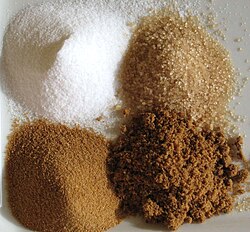
By around 1000 BC, sugarcane was spread westward and northward to China and India by Austronesian traders, where it further hybridized with Saccharum sinense and Saccharum barberi.
Image source: Sugar
800 BC
% complete
One of the earliest historical references to sugarcane appears in Chinese manuscripts dating to the 8th century BCE, which described sugar cane farming and production in Ancient India.
40 AD - 90 AD
% complete
Pedanius Dioscorides attested to the quality of Indian sugar in his 1st century CE medical treatise De Materia Medica, describing sakcharon found in reeds in India and Eudaimon Arabia, similar in consistency to salt and brittle enough to be broken between the teeth.
Image source: De materia medica
77 AD
% complete
The Roman Pliny the Elder described sugar in his 1st century CE Natural History, writing: 'Sugar is made in Arabia as well, but Indian sugar is better.'
Image source: Natural History (Pliny)
500 AD
% complete
By the sixth century AD, sugar cultivation and processing had reached Persia, spreading the crop westward through the Middle East.
600 AD
% complete
China established its first sugarcane plantations in the seventh century, expanding domestic sugar production in East Asia.
1100 AD
% complete
Early in the 12th century, the Republic of Venice acquired some villages near Tyre and set up estates to produce sugar for export to Europe.
Image source: Republic of Venice
1170 AD
% complete
Crusade chronicler William of Tyre, writing in the late 12th century, described sugar as 'very necessary for the use and health of mankind'.
Image source: William of Tyre
1400 AD
% complete
In the 15th century, Venice was the chief sugar refining and distribution center in Europe, dominating the continent's sugar trade.
Image source: Venice
1457 AD
% complete
A feast given in Tours in 1457 by Gaston de Foix includes the first mention of sugar sculptures, as the final food brought in was 'a heraldic menagerie sculpted in sugar: lions, stags, monkeys...'
Image source: Gaston of Foix, Duke of Nemours
1425 AD
% complete
Spanish and Portuguese exploration in the fifteenth century carried sugar southwest of Iberia. Henry the Navigator introduced cane to Madeira in 1425, while the Spanish introduced sugar cane to the Canary Islands after subduing them.
Image source: Prince Henry the Navigator
1492 AD
% complete
By 1492, Madeira was producing over 1,400,000 kilograms (3,000,000 lb) of sugar annually, making it a major Atlantic sugar producer.
Image source: Madeira
1493 AD
% complete
In 1493, on his second voyage, Christopher Columbus carried sugarcane seedlings to the New World, in particular Hispaniola, beginning the history of sugar cultivation in the Americas.
Image source: Christopher Columbus
1501 AD
% complete
The first sugar harvest happened in Hispaniola in 1501; many sugar mills had been constructed in Cuba and Jamaica by the 1520s.
Image source: Hispaniola
1540 AD
% complete
By 1540, there were 800 cane sugar mills in Santa Catarina Island and another 2,000 on the north coast of Brazil, Demarara, and Surinam.
Image source: Santa Catarina Island
1550 AD
% complete
Approximately 3,000 small sugar mills built before 1550 in the New World created an unprecedented demand for cast iron gears, levers, axles and other implements, sparking technological development.
1625 AD
% complete
After 1625, sugarcane was introduced to the Caribbean islands from South America by the Dutch, transforming the region's economy.
Image source: Dutch West India Company
1710 AD - 1770 AD
% complete
During the 18th century, sugar became enormously popular. Great Britain consumed five times as much sugar in 1770 as in 1710, and by the end of the century all levels of society had become common consumers of the former luxury product.
Image source: Great Britain
1750 AD
% complete
By 1750, sugar surpassed grain as 'the most valuable commodity in European trade', making up a fifth of all European imports. From the 1740s until the 1820s, sugar was Britain's most valuable import.
1747 AD
% complete
In 1747, German chemist Andreas Sigismund Marggraf announced the discovery of sugar in beets and devised a method using alcohol to extract it, founding the beet sugar industry.
Image source: Andreas Sigismund Marggraf
1768 AD
% complete
Beginning in the late 18th century, sugar production became increasingly mechanized. The steam engine first powered a sugar mill in Jamaica in 1768, and soon steam replaced direct firing as the source of process heat.
Image source: Jamaica
1783 AD
% complete
Marggraf's student, Franz Karl Achard, devised an economical industrial method to extract sugar in pure form in the late 18th century, and first produced beet sugar in 1783 in Kaulsdorf.
Image source: Franz Karl Achard
1801 AD
% complete
In 1801, under the patronage of King Frederick William III of Prussia, the world's first beet sugar production facility was established in Cunern, Silesia. Though never profitable, it operated until its destruction during the Napoleonic Wars.
Image source: Konary, Wołów County
1813 AD
% complete
Cut off from Caribbean imports by a British blockade, Napoleon banned imports of sugar in 1813 and ordered the planting of 32,000 hectares with beetroot, boosting French beet sugar production.
Image source: Napoleon
1813 AD
% complete
In 1813 the British chemist Edward Charles Howard invented a method of refining sugar involving boiling cane juice not in an open kettle, but in a closed vessel heated by steam and held under partial vacuum.
Image source: Edward Charles Howard
1832 AD
% complete
The United Kingdom Beetroot Sugar Association was established in 1832, but efforts to establish sugar beet in the UK were not very successful initially.
Image source: Sugar beet
1845 AD
% complete
Further gains in fuel-efficiency came from the multiple-effect evaporator, designed by American engineer Norbert Rillieux, perhaps as early as the 1820s, although the first working model dates from 1845.
Image source: Norbert Rillieux
1852 AD
% complete
The process of separating sugar from molasses received mechanical attention when David Weston first applied the centrifuge to this task in Hawaii in 1852.
1850 AD - 1900 AD
% complete
In the second half of the nineteenth century, over 450,000 indentured labourers went from India to the British West Indies, while others went to Natal, Mauritius and Fiji, where they became a majority of the population.
Image source: Indian indenture system
1899 AD
% complete
By 1899, sugar beets provided approximately two-thirds of world sugar production, having transformed the global sugar industry since their invention in Germany.
1901 AD
% complete
The industrialization of the Colombian industry started in 1901 with the establishment of Manuelita, the first steam-powered sugar mill in South America, by Latvian Jewish immigrant James Martin Eder.
Image source: Manuelita (film)
1915 AD
% complete
The British Sugar Beet Society was set up in 1915, and by 1930 there were 17 factories in England and one in Scotland, supported by the British Sugar (Subsidy) Act 1925. By 1935 homegrown sugar was 27.6% of British consumption.
Image source: History of sugar
1965 AD - 1970 AD
% complete
At the Agency of Industrial Science and Technology of Japan's Ministry of International Trade and Industry, Takasaki developed key technology between 1965 and 1970 that enabled industrial production of high-fructose corn syrup.
Image source: High-fructose corn syrup
1984 AD
% complete
Soft drink makers such as Coca-Cola and Pepsi use sugar in other nations, but switched to high-fructose corn syrup in the United States in 1984, reshaping American sweetener consumption.
2008 AD
% complete
The average American consumed approximately 37.8 lb (17.1 kg) of high-fructose corn syrup in 2008, versus 46.7 lb (21.2 kg) of sucrose, reflecting decades of shifting sweetener preferences.
Or browse the full history timeline directory, with more than 2,000 topics.
This History of Sugar timeline was generated with the help of AI, using information found on the internet.
We work hard to keep these timelines accurate, but mistakes do get through. If you spot one, email us at [email protected] and we'll fix it for future visitors.
Generate yours with AI or build it from scratch, for free.
Export your timeline, add your own events, edit or remove AI-generated events, and much more
No credit card required.
Cancel anytime.
Cancel anytime.
You can create an unlimited number of timelines with up to 10 events on each one, customize how they look, export them to PDF, PNG, PowerPoint, CSV, and Excel, and share them with a link. Paid plans raise the event limit and add features like spreadsheet imports and collaborators.
Yes. You can cancel your subscription from your account page at any time, and you will not be charged again. Your subscription stays active for the rest of the period you already paid for.
Yes. We will email you a reminder before the annual renewal, and we will also email you a receipt.
Yes. You can email us within 15 days of any payment, and we will issue you a full refund.
Check out our pricing docs or send us an email anytime: [email protected].