-
Use Cases
-
Resources
-
Pricing
Vanilla, derived from the orchid genus Vanilla, has a rich history spanning over a thousand years. First cultivated by the Totonac people of Mexico, it was prized by the Aztecs for flavoring chocolate. After Spanish conquest, vanilla spread to Europe and eventually to tropical colonies worldwide, becoming one of the most valuable spices. More Less
1185
% complete
The Totonac people, who live along the eastern coast of Mexico in the present-day state of Veracruz, were among the first people to domesticate vanilla, cultivating it on farms since at least 1185.
1427
% complete
In 1427, Aztecs from the central highlands of Mexico invaded the Totonacs, developed a taste for the vanilla pods, and began using vanilla to flavor their foods and drinks.
Image source: Vanilla
1427
% complete
After conquering the Totonacs, the Aztecs began using vanilla to flavor foods and drinks, often mixing it with cocoa in a drink called 'xocolatl' that later inspired modern hot chocolate.
1600
% complete
In Europe, vanilla was seen mostly as an additive to chocolate until the early 17th century when Hugh Morgan, a creative apothecary in the employ of Queen Elizabeth I, created chocolate-free, vanilla-flavored 'sweetmeats'.
1700
% complete
By the 18th century, the French were using vanilla to flavor ice cream, helping establish vanilla as a beloved standalone flavor across Europe.
1754
% complete
The word 'vanilla' entered the English language in 1754, when the botanist Philip Miller wrote about the genus in his Gardener's Dictionary.
1800 - 1850
% complete
Until the mid-19th century, Mexico was the chief producer of vanilla, holding a natural monopoly thanks to its native pollinating bees and hummingbirds.
1819
% complete
In 1819, French entrepreneurs shipped vanilla fruits to the islands of Réunion and Mauritius in hopes of producing vanilla there, beginning the spread of cultivation beyond Mexico.
1841
% complete
After 1841, when Edmond Albius discovered how to pollinate the flowers quickly by hand, vanilla pods began to thrive on Réunion and beyond, transforming the industry.
1889
% complete
By 1889, Mexican exports of vanilla exceeded 70,000 kilograms, making the region one of the world leaders in vanilla production at the time.
1898
% complete
By 1898, Madagascar, Réunion, and the Comoros Islands produced 200 metric tons of vanilla beans, about 80% of world production in that year.
1900
% complete
An average of 2,000 vanilla cuttings can be planted per hectare (2.5 acres), a cultivation density that became standard practice on commercial vanilla farms around the world.
2018
% complete
According to United Nations Food and Agriculture Organization 2019 data, Madagascar, followed by Indonesia, were the largest producers of vanilla in 2018.
2023
% complete
In 2023, world production of raw vanilla was 7,433 tonnes, led by Madagascar with 42% of the total and Indonesia with 25%.
1806
% complete
The first vanilla orchid to flower in Europe bloomed in 1806, in the London collection of the Honourable Charles Greville.
Image source: Vanilla planifolia
1837
% complete
In 1837, the Belgian botanist Charles François Antoine Morren discovered how vanilla is pollinated and pioneered a method of artificially pollinating the plant, experimenting with hand pollination of Vanilla orchids in cultivation in Europe.
Image source: Charles François Antoine Morren
1841
% complete
In 1841, Edmond Albius, a 12-year-old enslaved child who lived on the French island of Réunion in the Indian Ocean, discovered that the plant could be hand-pollinated with a simple and efficient method still used today.
Image source: Edmond Albius
2000
% complete
By the end of the 20th century, Edmond Albius was considered the true discoverer of vanilla hand-pollination, receiving belated recognition for his pivotal contribution.
1858
% complete
Vanillin was first isolated from vanilla pods by Gobley in 1858, marking a major milestone in the chemistry of natural flavors.
Image source: Vanillin
1874
% complete
By 1874, vanillin had been obtained from glycosides of pine tree sap, temporarily causing a depression in the natural vanilla industry.
1980
% complete
In the mid-1980s, the cartel that had controlled vanilla prices and distribution since its creation in 1930 disbanded, reshaping the global vanilla market.
1986
% complete
Prices dropped 70% over the next few years after the cartel disbanded, falling to nearly US$20 per kilogram.
1996
% complete
In 1996, the US Food and Drug Administration cautioned that some vanilla products sold in Mexico were made from the cheaper tonka bean, which contains the toxin coumarin alongside vanillin.
Image source: Dipteryx odorata
Apr 2000
% complete
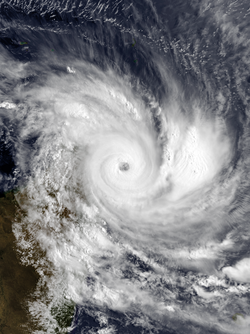
Prices rose sharply again after tropical cyclone Hudah struck Madagascar in April 2000, damaging crops and disrupting supply.
Image source: Cyclone Hudah
2004
% complete
The cyclone, political instability, and poor weather in the third year drove vanilla prices to US$500/kg in 2004, bringing new countries into the vanilla industry.
2004
% complete
Regarded as the world's most popular aroma and flavor, vanilla is widely used in foods, beverages and cosmetics; as of 2004, around half of the vanilla flavor consumed in the US was eaten in ice cream.
Image source: Vanilla ice cream
2005
% complete
A good crop, coupled with decreased demand caused by the production of imitation vanilla, pushed the market price down to the $40/kg range in the middle of 2005.
2010
% complete
By 2010, vanilla prices had fallen back down to $20/kg, reflecting increased supply and competition from synthetic alternatives.
2017
% complete
Cyclone Enawo caused a similar spike in vanilla prices to $500/kg in 2017, echoing the crisis of 2004.
Image source: Cyclone Enawo
2024
% complete
Regarded as the world's most popular aroma and flavor, vanilla remains a widely used aroma and flavor compound for foods, beverages and cosmetics, cementing centuries of history from Mesoamerican domestication to global commerce.
Or browse the full history timeline directory, with more than 2,000 topics.
This History of Vanilla timeline was generated with the help of AI, using information found on the internet.
We work hard to keep these timelines accurate, but mistakes do get through. If you spot one, email us at [email protected] and we'll fix it for future visitors.
Generate yours with AI or build it from scratch, for free.
Export your timeline, add your own events, edit or remove AI-generated events, and much more
No credit card required.
Cancel anytime.
Cancel anytime.
You can create an unlimited number of timelines with up to 10 events on each one, customize how they look, export them to PDF, PNG, PowerPoint, CSV, and Excel, and share them with a link. Paid plans raise the event limit and add features like spreadsheet imports and collaborators.
Yes. You can cancel your subscription from your account page at any time, and you will not be charged again. Your subscription stays active for the rest of the period you already paid for.
Yes. We will email you a reminder before the annual renewal, and we will also email you a receipt.
Yes. You can email us within 15 days of any payment, and we will issue you a full refund.
Check out our pricing docs or send us an email anytime: [email protected].