-
Use Cases
-
Resources
-
Pricing
The history of television traces the development of one of the most influential communication technologies of the modern era. Beginning with mechanical scanning systems invented by pioneers like John Logie Baird and evolving into fully electronic television through the work of Philo Farnsworth and Vladimir Zworykin, television became a household staple by the mid-20th century. The introduction of color broadcasts, cable networks, satellite transmission, digital television, and internet streaming has continually transformed how audiences consume news, entertainment, and culture worldwide. More Less
1884
% complete
Paul Gottlieb Nipkow patented the Nipkow disk, a rotating mechanical scanning device that became a foundational component of early mechanical television systems. Although Nipkow never built a working television himself, his disk provided the principle of image scanning that later inventors would build upon for decades.
Image source: Nipkow disk

1897
% complete
German physicist Karl Ferdinand Braun invented the cathode ray tube (CRT), which used a beam of electrons to produce images on a fluorescent screen. The CRT would become the display technology at the heart of televisions for most of the 20th century.
Image source: Cathode-ray tube
Jan 26, 1926
% complete
Scottish inventor John Logie Baird gave the first public demonstration of true television in London, using mechanical scanning technology to transmit moving silhouette images. His demonstration marked the birth of television as a practical medium.
Image source: John Logie Baird
Sep 7, 1927
% complete
American inventor Philo Farnsworth transmitted the first all-electronic television image, a simple straight line, using his image dissector camera tube. Farnsworth's electronic approach ultimately superseded mechanical systems and defined modern television technology.
Image source: Philo Farnsworth
Feb 8, 1928
% complete
John Logie Baird successfully transmitted television images across the Atlantic Ocean from London to New York, demonstrating the potential of television as a long-distance communication technology and stunning audiences on both sides of the ocean.
Nov 2, 1936
% complete
The BBC launched the world's first regular high-definition television service from Alexandra Palace in London, alternating between Baird's mechanical system and the Marconi-EMI electronic system before adopting electronic transmission exclusively in 1937.
Image source: BBC One
Apr 30, 1939
% complete
NBC began regularly scheduled television broadcasting in the United States with a broadcast of President Franklin D. Roosevelt opening the New York World's Fair, marking the official start of American television service to the public.
Image source: NBC

Apr 30, 1939
% complete
President Franklin D. Roosevelt became the first sitting U.S. president to appear on television when NBC cameras captured him speaking at the New York World's Fair, signaling television's emerging role in politics and public life.
Image source: Franklin D. Roosevelt
May 17, 1939
% complete
NBC televised a college baseball game between Princeton and Columbia from Baker Field in New York, one of the first live sports broadcasts in television history and an early demonstration of television's power to bring live events into homes.
Image source: Major League Baseball on television
Sep 1, 1939 - 1945
% complete
The outbreak of World War II halted television development and broadcasting in much of the world. The BBC suspended its television service in September 1939, and American stations drastically reduced operations as resources were diverted to the war effort.
Image source: History of television
1946
% complete
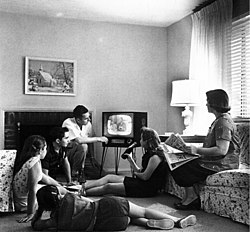
Following World War II, companies like RCA and DuMont began mass-producing television sets for American consumers. Prices gradually fell, and by the end of the decade television ownership was spreading rapidly through American households.
Image source: Television set
Dec 27, 1947 - Sep 24, 1960
% complete
The Howdy Doody Show premiered on NBC and became one of television's first hit programs, establishing the format of children's programming and demonstrating television's ability to build loyal young audiences.
Image source: Howdy Doody
Jan 25, 1949
% complete
The first Emmy Awards were presented by the Academy of Television Arts & Sciences in Los Angeles, honoring excellence in television programming and establishing a prestigious annual tradition that continues today.
Image source: Emmy Awards
Sep 4, 1951
% complete
President Harry Truman's speech at the Japanese Peace Treaty Conference in San Francisco was transmitted live across the United States via newly completed coaxial cable and microwave links, connecting East Coast and West Coast viewers for the first time.
Image source: Space Ghost Coast to Coast
Oct 15, 1951 - May 6, 1957
% complete
I Love Lucy premiered on CBS starring Lucille Ball and Desi Arnaz. The show pioneered the three-camera filming technique used before a live studio audience, revolutionizing sitcom production and becoming one of the most beloved shows in television history.
Image source: I Love Lucy
Jun 2, 1953
% complete
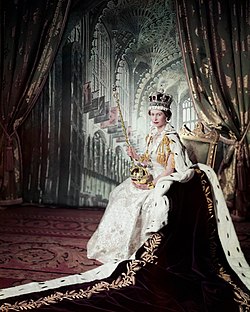
The coronation of Queen Elizabeth II was broadcast live on BBC Television and recorded for transmission around the world, drawing an estimated 20 million British viewers and dramatically accelerating television adoption in the UK.
Image source: Coronation of Elizabeth II
Feb 9, 1964
% complete
The Beatles made their historic American television debut on The Ed Sullivan Show, drawing a record audience of approximately 73 million viewers and demonstrating television's extraordinary cultural influence on popular music and youth culture.
Image source: The Beatles on The Ed Sullivan Show
Sep 8, 1966 - Jun 3, 1969
% complete
Star Trek premiered on NBC, presenting a diverse crew exploring the galaxy. Though initially modest in ratings, the series grew into one of the most influential franchises in television history, inspiring generations of fans and spin-offs.
Image source: Star Trek: The Original Series
Jul 20, 1969
% complete
An estimated 600 million people worldwide watched live television coverage of Apollo 11 astronauts Neil Armstrong and Buzz Aldrin walking on the Moon, making it one of the most-watched television events in history and showcasing TV's global reach.
Image source: Apollo 11
Dec 17, 1953
% complete
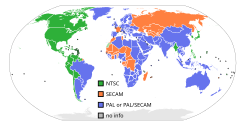
The National Television System Committee (NTSC) color standard was approved by the FCC, allowing compatible color broadcasting on existing black-and-white sets. CBS had earlier attempted an incompatible color system that failed commercially.
Image source: NTSC
Jan 1, 1954
% complete
NBC broadcast the Tournament of Roses Parade in color, the first major national color television broadcast in the United States, showcasing the new NTSC color standard to a nationwide audience.
Image source: Rose Parade
Jul 23, 1962
% complete
The Telstar communications satellite relayed the first live transatlantic television pictures, enabling viewers in Europe and North America to see each other's broadcasts in real time and ushering in the era of global satellite television.
Image source: Telstar
Apr 6, 1965
% complete
Intelsat I, nicknamed Early Bird, became the first commercial geostationary communications satellite, providing continuous transatlantic television transmission and transforming international news and entertainment distribution.
Image source: Intelsat I
Nov 8, 1972
% complete
Home Box Office (HBO) began transmitting movies and sports events over cable to subscribers in Pennsylvania and New York, launching the premium cable industry and changing how Americans paid for and consumed television content.
Image source: HBO
Jun 1, 1980
% complete
Ted Turner launched the Cable News Network (CNN), the first television channel dedicated to providing news coverage 24 hours a day, fundamentally changing the pace and nature of television journalism worldwide.
Image source: CNN
Aug 1, 1981
% complete
Music Television (MTV) went on the air with the words 'Ladies and gentlemen, rock and roll' and the video for Video Killed the Radio Star, creating an entirely new genre of television centered on music videos and profoundly shaping youth culture.
Image source: MTV
1987 - 1996
% complete
Engineers and regulators worked through the late 1980s and early 1990s to develop digital high-definition television standards, culminating in the FCC's approval of the ATSC digital television standard in the United States in 1996.
Image source: High-definition television
Mar 31, 1999
% complete
TiVo shipped its first digital video recorders, allowing viewers to pause, rewind, and record live television automatically. The device disrupted traditional viewing habits and advertising models, giving audiences unprecedented control over their schedules.
Image source: TiVo
2007
% complete
Netflix introduced streaming video over the internet, beginning a shift away from scheduled broadcasting toward on-demand viewing. Its subsequent investment in original programming like House of Cards in 2013 transformed television production and distribution globally.
Image source: Netflix
Jun 12, 2009
% complete
Full-power television stations in the United States ceased analog broadcasting and switched exclusively to digital signals, freeing spectrum for wireless services and completing a transition that improved picture quality and efficiency.
Image source: Digital television transition in the United States
Or browse the full history timeline directory, with more than 2,000 topics.
This History of Television timeline was generated with the help of AI, using information found on the internet.
We work hard to keep these timelines accurate, but mistakes do get through. If you spot one, email us at [email protected] and we'll fix it for future visitors.
Generate yours with AI or build it from scratch, for free.
Export your timeline, add your own events, edit or remove AI-generated events, and much more
No credit card required.
Cancel anytime.
Cancel anytime.
You can create an unlimited number of timelines with up to 10 events on each one, customize how they look, export them to PDF, PNG, PowerPoint, CSV, and Excel, and share them with a link. Paid plans raise the event limit and add features like spreadsheet imports and collaborators.
Yes. You can cancel your subscription from your account page at any time, and you will not be charged again. Your subscription stays active for the rest of the period you already paid for.
Yes. We will email you a reminder before the annual renewal, and we will also email you a receipt.
Yes. You can email us within 15 days of any payment, and we will issue you a full refund.
Check out our pricing docs or send us an email anytime: [email protected].