-
Use Cases
-
Resources
-
Pricing
The guitar is a fretted string instrument with roots tracing back over 4,000 years to ancient Mesopotamia. Evolving through medieval instruments like the oud and Renaissance-era vihuela and four-course guitars in Spain, the instrument took its modern shape with the six-string classical guitar developed by Antonio de Torres in the 19th century. The 20th century revolutionized the guitar through electrification, pioneered by George Beauchamp and refined by Les Paul and Leo Fender, transforming music genres from jazz and blues to rock and pop. More Less
Jan 1, 711
% complete
The four-string oud, an ancestor of the guitar, was brought to Iberia by the Moors in the 8th century. Along with its precursor, the European lute, it is commonly claimed as one of the influential predecessors of the earliest 'guitar', although the development of that instrument is lost to the history of medieval Spain.
Image source: Oud
Jan 1, 1100
% complete
Beginning in the 12th century, a number of chordophones that would come to be referred to by the term 'guitar' were developed and used across Europe, and later in the Americas. These instruments were defined as having a long, fretted neck, flat wooden soundboard, ribs, and a flat back, most often with incurved sides.
Jan 1, 1200
% complete
The European lute, a fretted plucked string instrument derived from the Arabic oud, became one of the two instruments most often cited as influential predecessors of the guitar, shaping the development of chordophones across medieval Europe.
Image source: Lute
Jan 1, 1200
% complete
At least two instruments called 'guitars' were in use in Spain by 1200: the guitarra latina (Latin guitar) and the so-called guitarra morisca (Moorish guitar). These instruments reflected the blending of Latin and Moorish musical traditions on the Iberian peninsula.
Jan 1, 1300
% complete
By the 14th century, the qualifiers 'moresca' or 'morisca' and 'latina' had been dropped, and the two Spanish chordophones were simply referred to as guitars, marking a consolidation of the instrument's identity.
Image source: Guitar
Jan 1, 1400 - Dec 31, 1599
% complete
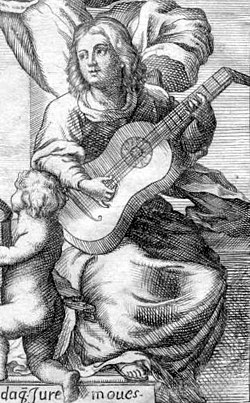
The Spanish vihuela, called in Italian the viola da mano, was a guitar-like instrument of the 15th and 16th centuries. It is widely considered to have been the single most important influence in the development of the baroque guitar.
Image source: Vihuela
Jan 1, 1500 - Dec 31, 1599
% complete
By the 16th century, most of the forms of the guitar had fallen out of use, never to be seen again, leaving only certain lineages such as the four-course and five-course guitars to continue developing.
Jan 1, 1500 - Dec 31, 1599
% complete
By the 16th century, the guitar tuning of ADGBE had already been adopted in Western culture; a lower E was later added on the bottom as a sixth string, giving rise to the standard tuning used today.
Image source: Guitar tunings
Jan 1, 1500 - Dec 31, 1599
% complete
By the 16th century, the vihuela's construction had more in common with the modern guitar, with its curved one-piece ribs, than with the viols, and was more like a larger version of the contemporary four-course guitars.
Jan 1, 1550
% complete
Espinel was born in 1550, a fact later cited by critics who argued it made it impossible for him to have been responsible for the tradition of adding a fifth string to the guitar, despite claims made on his behalf.
Image source: Vicente Espinel
Jul 1, 1550
% complete
Midway through the 16th century, the five-course guitar was established, becoming a durable design that would dominate European guitar playing for the next two centuries.
Image source: Baroque guitar
Jul 1, 1550
% complete
The five-course baroque guitar was documented in Spain from the middle of the 16th century, marking the emergence of the instrument that would flourish across Europe in the following centuries.
Jan 1, 1576
% complete
The vihuela enjoyed only a relatively short period of popularity in Spain and Italy during an era dominated elsewhere in Europe by the lute; the last surviving published music for the instrument appeared in 1576.
Jan 1, 1580 - Dec 31, 1750
% complete
The five-course baroque guitar enjoyed popularity, especially in Spain, Italy and France, from the late 16th century to the mid-18th century, becoming one of the most fashionable instruments of the era.
Jan 1, 1600 - Dec 31, 1750
% complete
Renaissance and Baroque guitars are easily distinguished: the Renaissance guitar is very plain, while the Baroque guitar is very ornate, with ivory or wood inlays all over the neck and body, and a paper-cutout inverted 'wedding cake' inside the sound hole.
Jan 1, 1640
% complete
In 1640, Nicolas Doizi de Velasco repeated the claim crediting Espinel with the addition of the guitar's fifth string; however, this claim has been contested by others who state that Espinel's birth year of 1550 make it impossible for him to be responsible for the tradition.
Jan 1, 1674
% complete
Gaspar Sanz's Instrucción de Música sobre la Guitarra Española of 1674 contains his whole output for the solo guitar, and remains one of the most important sources of Baroque guitar repertoire.
Image source: Gaspar Sanz
Jan 1, 1674
% complete
Writing in the 17th century, Gaspar Sanz noted that other nations such as Italy or France had added to the Spanish guitar, reflecting how the instrument evolved through cross-cultural exchange.
Image source: Gaspar Sanz
Jan 1, 1750
% complete
After the ADGBE tuning had been adopted in Western culture by the 16th century, a lower E was later added on the bottom as a sixth string, establishing the standard six-string EADGBE tuning of the modern guitar.
Jan 1, 1800 - Dec 31, 1899
% complete
Nineteenth-century guitars, now known as salon guitars, were smaller than modern instruments, reflecting the intimate parlor performance settings in which they were typically played.
Image source: Parlor guitar
Jan 1, 1850 - Dec 31, 1892
% complete
The Spaniard Antonio de Torres Jurado (1817–1892) established the modern dimensions of the classical instrument, increasing the size of the guitar body and altering its proportions in ways that defined the modern guitar.
Image source: Antonio de Torres Jurado
Jan 1, 1850
% complete
Around 1850, Spanish makers including Manuel de Soto y Solares and, perhaps most importantly, Antonio Torres Jurado developed the form and structure of the modern guitar, with Torres inventing the breakthrough fan-braced pattern that improved tone and projection.
Jan 1, 1880 - Dec 31, 1899
% complete
Steel guitar strings were introduced near the end of the nineteenth century in the United States, offering greater volume and brightness, though they would not become fully mainstream until decades later.
Image source: String (music)
Jan 1, 1900 - Dec 31, 1930
% complete
A slide or steel — a hard smooth object such as a steel bar, round metal or glass cylinder, or the neck of a bottle — came to be used to create glissando effects made popular in Hawaiian music at the beginning of the 20th century, and was widely adopted in country and blues music.
Image source: Slide guitar
Jan 1, 1926 - Dec 31, 1932
% complete
All three principal types of resonator guitars were invented by the Slovak-American John Dopyera (1893–1988) for the National and Dobro (Dopyera Brothers) companies, creating loud metal-bodied instruments designed to be heard before electric amplification.
Image source: Resonator guitar
Jan 1, 1931
% complete
The first successful magnetic pickup for a guitar was invented by George Beauchamp, and incorporated into the 1931 Ro-Pat-In (later Rickenbacker) 'Frying Pan' lap steel, launching the era of the electrified guitar.
Jan 1, 1932
% complete
Following Beauchamp's invention of the magnetic pickup, other manufacturers, notably Gibson, soon began to install pickups in their archtop models, bringing amplified guitars to jazz and popular musicians.
Image source: Archtop guitar
Jan 1, 1937
% complete
Electric guitars were first patented in 1937. Using a pickup and amplifier, they made the instrument loud enough to be heard, but also enabled manufacturing guitars with a solid block of wood, without needing a resonant chamber.
Image source: Electric guitar
Sep 2, 1945
% complete
Although steel guitar strings had been introduced near the end of the nineteenth century in the United States, nylon and steel strings became mainstream only following World War II, defining the standard string types for classical and steel-string guitars alike.
Jan 1, 1982
% complete
In 1982, Uli Jon Roth developed the 'Sky Guitar', featuring a vastly extended number of frets. It was the first guitar to venture into the upper registers of the violin, expanding the instrument's melodic range dramatically.
Image source: Uli Jon Roth
Or browse the full history timeline directory, with more than 2,000 topics.
This History of the Guitar timeline was generated with the help of AI, using information found on the internet.
We work hard to keep these timelines accurate, but mistakes do get through. If you spot one, email us at [email protected] and we'll fix it for future visitors.
Generate yours with AI or build it from scratch, for free.
Export your timeline, add your own events, edit or remove AI-generated events, and much more
No credit card required.
Cancel anytime.
Cancel anytime.
You can create an unlimited number of timelines with up to 10 events on each one, customize how they look, export them to PDF, PNG, PowerPoint, CSV, and Excel, and share them with a link. Paid plans raise the event limit and add features like spreadsheet imports and collaborators.
Yes. You can cancel your subscription from your account page at any time, and you will not be charged again. Your subscription stays active for the rest of the period you already paid for.
Yes. We will email you a reminder before the annual renewal, and we will also email you a receipt.
Yes. You can email us within 15 days of any payment, and we will issue you a full refund.
Check out our pricing docs or send us an email anytime: [email protected].