-
Use Cases
-
Resources
-
Pricing
The Mayflower was an English merchant ship that transported 102 passengers—Pilgrims seeking religious freedom and other settlers—from Plymouth, England, to North America in 1620. After a difficult 66-day Atlantic crossing, the ship landed at Cape Cod, leading to the founding of Plymouth Colony in present-day Massachusetts. The voyage resulted in the signing of the Mayflower Compact, one of America's first documents of self-governance. More Less
1608
% complete
Starting in 1608, a group of English families departed England for the Netherlands, where they could worship freely. Rather than work for change in England as other Puritans did, they chose to live as separatists in religiously tolerant Holland.
1609 - 1622
% complete
Mayflower was an English square-rigged merchant sailing ship, active from before 1609 until 1622. She was a typical vessel of her class, used for transporting cargo and passengers across European trade routes.
1609 - 1611
% complete
Mayflower was designated in the port books of 1609–11 as 'of Harwich' in the county of Essex, coincidentally the birthplace of her master Christopher Jones in about 1570. There were 26 vessels bearing the name Mayflower in the port books of England during the reign of King James I.
1609 - 1610
% complete
During the 1609–10 winter period known as the Starving Time in the Jamestown settlement of the Virginia Colony, 440 of the town's 500 settlers died of starvation. This grim episode foreshadowed the dangers awaiting future English colonists in America.
Aug 1609
% complete
Records dating from August 1609 note Christopher Jones as master and part owner of Mayflower when the ship was chartered for a voyage from London to Trondheim, Norway and back to London. Litigation resulting from this voyage went unresolved until at least 1612.
1613
% complete
According to records, Mayflower was twice on the Thames at London in 1613, once in July and again in October and November, continuing its work as a merchant trading vessel.
1616
% complete
In 1616 Mayflower was on the Thames carrying a cargo of wine, which suggests that the ship had recently been on a voyage to France, Spain, Portugal, the Canary Islands or some other wine-producing land. No further records relate to Jones's Mayflower from 1616 until 1624.
Image source: Mayflower
1620
% complete
By 1620, the Pilgrim community resolved to cross the Atlantic Ocean for America, which they considered a 'new Promised Land' where they would establish Plymouth Colony.
1620
% complete
Thomas Weston chartered Mayflower from owners Child and Short in the summer of 1620 to undertake the Pilgrims' voyage. Jones was one of the owners of the ship by 1620, along with Christopher Nichols, Robert Child and Thomas Short.
Jul 1620
% complete
Carrying about 65 passengers, Mayflower left London in mid-July 1620, beginning the journey that would become one of the most famous crossings in history.
Sep 6, 1620
% complete
On 6 September 1620, with what Bradford called 'a prosperous wind', Mayflower carried 102 passengers and a crew of 25 to 30 officers and men, bringing the total aboard to approximately 130 people bound for America.
Nov 9, 1620
% complete
On 9 November 1620, after a difficult Atlantic crossing hampered by the ship's high stern castle that was ill-suited for the North Atlantic's prevailing westerlies, the crew sighted present-day Cape Cod.
Dec 1620
% complete
The Pilgrim Fathers first set foot in December 1620 upon a bare rock on the bleak coast of Massachusetts Bay, while all around the earth was covered with deep snow. This landing became one of the most iconic moments in American history.
Apr 15, 1621
% complete
Mayflower set sail for England on 15 April [O.S.] 1621, arriving 6 May 1621 in less than half the time it had taken her to sail to America, with the strong winds now blowing in the direction of the voyage.
1620
% complete
No admiralty court documents have been found that mention the Pilgrims' voyage of 1620, making the details of this famous crossing surprisingly absent from official legal records of the period.
1622
% complete
Captain Christopher Jones, who had commanded the Mayflower on its historic 1620 voyage, died in 1622, ending the ship's long association with its most famous master.
Image source: Christopher Jones (Mayflower captain)
1624
% complete
She is believed to have been broken up and her timbers used for building construction. Historical records indicate that in 1624, Thomas Russell of Jordans, a village in Buckinghamshire, erected a barn with timbers purchased from a shipbreaker's yard in Rotherhithe, which many believe to have been those of the Mayflower.
May 4, 1624
% complete
Three of Mayflower's owners applied to the admiralty court for an appraisal of the ship on 4 May 1624, two years after Captain Jones's death in 1622. No record of the ship herself exists after 1624.
May 1629 - Aug 1629
% complete
Another ship called Mayflower voyaged from London to Plymouth Colony in May 1629, arriving in August with 35 passengers aboard, many of whom were from the Pilgrim congregation in Leiden that organized the first voyage.
1630
% complete
This ship also traveled from England to America in 1630 as part of the Winthrop Fleet, and made further crossings in 1633, 1634 and 1639.
Oct 1641
% complete
This ship attempted the trip again in October 1641, with 140 passengers bound for Virginia, but it was lost at sea.
1871
% complete
George Henry Boughton used the famous phrase associated with the Pilgrims for his 1871 painting, as did Bernard F., helping cement the cultural memory of the Mayflower voyage in art.
Image source: George Henry Boughton
1919
% complete
The SS Ruslan, a ship of the Third Aliyah from Odessa that docked in Jaffa in 1919, has been described as the 'Israeli Mayflower' for its cultural importance in the development of Israeli culture, since several pioneers of Israeli culture were on board.
Image source: Ruslan (ship)
Jan 1920 - Dec 1921
% complete
The 300th anniversary of Mayflower's landing was commemorated in 1920 and early 1921 by celebrations throughout the United States and Europe, with delegations from England, Holland and Canada meeting in New York. With 20 Mayflower historical societies throughout the country, the celebration was expected to last throughout 1920.
Jan 2020 - Dec 2020
% complete
For the 400th anniversary of Mayflower's landing in 2020, numerous organizations planned celebrations to mark the voyage, and festivities celebrating the anniversary took place in various New England locations.
Aug 28, 2021
% complete
In a charity event, a full-scale replica of Mayflower was burned in Great Torrington in Devon, England on 28 August 2021, a year later than originally planned due to delays.
Dec 1620 - Apr 15, 1621
% complete
Captain Jones had originally planned to return to England as soon as the Pilgrims found a settlement site, but his crew members were ravaged by the same diseases that were felling the Pilgrims, so he remained in Plymouth Harbor through the winter of 1620–21. The entire crew stayed with the ship, and about half of them died during that time.
1621
% complete
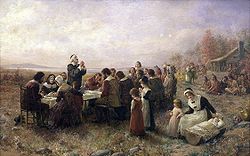
The following year, the survivors celebrated the colony's first fall harvest along with 90 Wampanoag people, an occasion declared in centuries later as the first American Thanksgiving. The American national holiday originated from this prayer event and dinner marking the first harvest of the Mayflower settlers.
Image source: Thanksgiving (United States)
Apr 1, 1621
% complete
The governor and his wife died in April 1621; and on the first of that month, forty-six of the one hundred emigrants were in their graves, nineteen of whom were signers of the Mayflower Compact.
Or browse the full history timeline directory, with more than 2,000 topics.
This History of the Mayflower timeline was generated with the help of AI, using information found on the internet.
We work hard to keep these timelines accurate, but mistakes do get through. If you spot one, email us at [email protected] and we'll fix it for future visitors.
Generate yours with AI or build it from scratch, for free.
Export your timeline, add your own events, edit or remove AI-generated events, and much more
No credit card required.
Cancel anytime.
Cancel anytime.
You can create an unlimited number of timelines with up to 10 events on each one, customize how they look, export them to PDF, PNG, PowerPoint, CSV, and Excel, and share them with a link. Paid plans raise the event limit and add features like spreadsheet imports and collaborators.
Yes. You can cancel your subscription from your account page at any time, and you will not be charged again. Your subscription stays active for the rest of the period you already paid for.
Yes. We will email you a reminder before the annual renewal, and we will also email you a receipt.
Yes. You can email us within 15 days of any payment, and we will issue you a full refund.
Check out our pricing docs or send us an email anytime: [email protected].