-
Use Cases
-
Resources
-
Pricing
The history of the novel traces the evolution of long-form fictional prose from ancient works like the Greek romances and Murasaki Shikibu's Tale of Genji through the rise of the modern novel in early modern Europe. Miguel de Cervantes' Don Quixote (1605) is often cited as the first modern novel, followed by the growth of realism in the 18th and 19th centuries with authors like Austen, Dickens, and Tolstoy, and later experimentation by modernists such as Joyce and Woolf. More Less
1010
% complete
Murasaki Shikibu's The Tale of Genji, written in early 11th-century Japan, is often considered the world's first great novel. Its psychological depth, complex characters, and depiction of court life at the Heian imperial court give it a sophistication unmatched by European prose fiction for centuries.
Image source: The Tale of Genji
1400
% complete
Attributed to Luo Guanzhong in the 14th century, Romance of the Three Kingdoms became one of the Four Great Classical Novels of Chinese literature. Blending history and legend across a century of warfare, it established enduring models of epic prose narrative in East Asia.
Image source: Romance of the Three Kingdoms
60
% complete
Petronius' Satyricon, written during the reign of Nero, is one of the earliest surviving works of extended prose fiction. Its picaresque narrative, including the famous Trimalchio's feast episode, features episodic adventures, satire of Roman society, and realistic detail that anticipate elements later central to the novel form.
Image source: Satyricon
1351 - 1353
% complete
Giovanni Boccaccio's Decameron, written after the Black Death swept Florence, is a frame story containing one hundred tales told by ten young people fleeing plague. Its realistic dialogue, varied social types, and secular outlook laid crucial groundwork for the development of European prose fiction.
Image source: The Decameron
1470
% complete
Sir Thomas Malory compiled Le Morte d'Arthur while imprisoned, drawing together Arthurian legends into a unified English prose work. Printed by William Caxton in 1485, it became one of the most influential books in English literature and demonstrated the power of sustained prose narrative.
Image source: Le Morte d'Arthur
1554
% complete
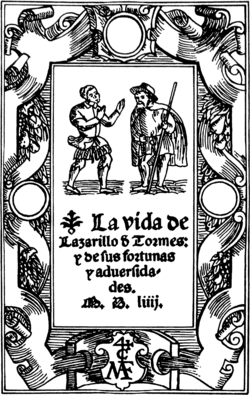
The anonymous Spanish novella Lazarillo de Tormes introduced the picaresque genre, following a roguish lower-class hero through episodic misadventures. Its realism, satire, and first-person narration established conventions that shaped novels from Cervantes to Defoe and beyond.
Image source: Lazarillo de Tormes
Jan 1605
% complete
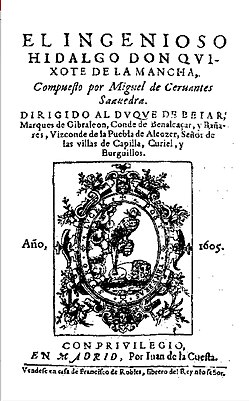
Miguel de Cervantes published the first part of Don Quixote in Madrid, widely regarded as the first modern European novel. Its parody of chivalric romances, psychological complexity, metafictional playfulness, and blend of comedy and tragedy set the template for the novel as an art form.
Image source: Don Quixote
1615
% complete
The second part of Don Quixote appeared in 1615, responding to an unauthorized sequel by Avellaneda. By having characters aware of the first book, Cervantes deepened the novel's self-reflexive innovation, cementing its status as a foundational masterpiece of world literature.
1678
% complete
John Bunyan's allegorical narrative of Christian's journey from the City of Destruction to the Celestial City became one of the most published books in English history. Though an allegory rather than a realist novel, its extended prose storytelling helped establish narrative habits for later fiction.
Image source: The Pilgrim's Progress
1688
% complete
Aphra Behn's Oroonoko, a short prose work about an enslaved African prince in Surinam, is often cited as an early precursor to the English novel. As one of the first English works by a professional female writer, it pioneered themes of slavery, colonialism, and tragic heroism.
Image source: Oroonoko
Apr 25, 1719
% complete
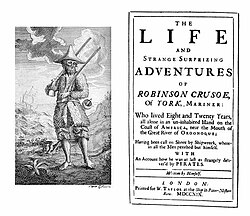
Daniel Defoe's Robinson Crusoe, presented as a fictional autobiography of a shipwrecked castaway, is frequently called the first major English novel. Its verisimilitude, individualism, and economic realism marked a decisive turn toward the realist mode that would dominate the genre.
Image source: Robinson Crusoe
1740
% complete
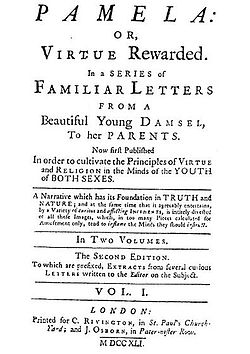
Samuel Richardson's epistolary novel Pamela caused a sensation with its psychological interiority told through letters. It sparked intense public debate, imitations, and parodies including Henry Fielding's Shamela, helping define the novel as a serious literary form focused on character and moral feeling.
Image source: Pamela; or, Virtue Rewarded
1749
% complete
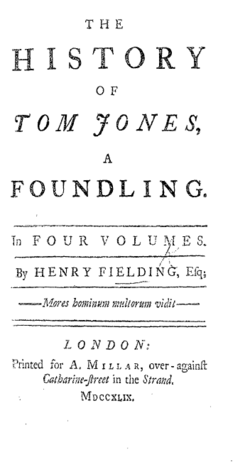
Henry Fielding's comic epic Tom Jones showcased panoramic plotting, robust humor, and ironic omniscient narration. Its sophisticated structure and self-aware narrator expanded the technical possibilities of the novel and influenced generations of writers from Austen to Dickens.
Image source: The History of Tom Jones, a Foundling
1759 - 1767
% complete
Laurence Sterne's Tristram Shandy, released in nine volumes over eight years, gleefully subverted novelistic convention with digressions, blank pages, typographical experiments, and endless deferral. It anticipated modernist and postmodernist experimentation by two centuries.
Image source: The Life and Opinions of Tristram Shandy, Gentleman
1774
% complete
Goethe's epistolary novel about a young man's doomed passion ignited the Sturm und Drang movement and a Europe-wide 'Werther fever.' It established the sentimental novel of sensibility and made the novel a vehicle for exploring extreme emotional experience.
Image source: The Sorrows of Young Werther
Jan 28, 1813
% complete
Jane Austen's second novel refined the novel of manners with its sparkling irony, free indirect discourse, and acute observation of domestic life. Her mastery of characterization and social comedy set new standards for psychological realism in English fiction.
Image source: Pride and Prejudice
1814
% complete
Walter Scott's Waverley, published anonymously, created the modern historical novel by dramatizing the Jacobite rising of 1745. Its fusion of individual destiny with sweeping historical change influenced Balzac, Tolstoy, Hugo, and countless successors across Europe.
Image source: Waverley (novel)
1818
% complete
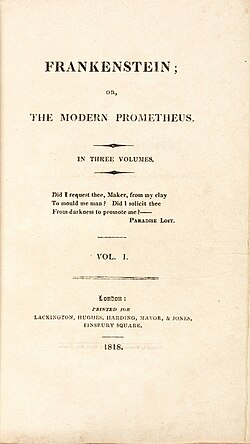
Written when she was just eighteen, Mary Shelley's Frankenstein blended Gothic horror with philosophical inquiry into science, creation, and responsibility. Often called the first science fiction novel, it expanded the genre's thematic range far beyond domestic realism.
Image source: Frankenstein
1830
% complete
Stendhal's The Red and the Black traced an ambitious young man's rise and fall in Restoration France with unprecedented psychological analysis. Its analytical realism and irony made it a cornerstone of French realism and a favorite of later modernists.
Image source: The Red and the Black
1837 - 1839
% complete
Charles Dickens' serialization of Oliver Twist demonstrated the power of the magazine installment format, which would dominate Victorian fiction. Dickens' vivid characters and social critique of poverty and crime made the novel a mass cultural phenomenon and instrument of reform.
Image source: Oliver Twist
1847
% complete
In a landmark year for women's writing, Charlotte Brontë's Jane Eyre and Emily Brontë's Wuthering Heights appeared under male pseudonyms. Their passionate intensity, Gothic atmosphere, and bold first-person voices expanded the emotional and moral territory of the English novel.
Image source: Jane Eyre
1851
% complete
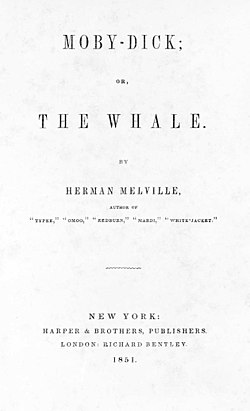
Herman Melville's Moby-Dick, initially a commercial failure, fused adventure narrative with encyclopedic digression, Shakespearean drama, and metaphysical meditation. Later recognized as America's greatest novel, it exemplified fiction's capacity for symbolic and philosophical ambition.
Image source: Moby-Dick
1856 - 1857
% complete
Flaubert's Madame Bovary, serialized in Revue de Paris and then prosecuted for obscenity, perfected literary realism through obsessive attention to style and impersonal narration. Its portrait of provincial boredom and romantic delusion defined the aesthetic of the modern novel.
Image source: Madame Bovary
1866
% complete
Dostoevsky's Crime and Punishment plunged readers into the tormented mind of murderer Raskolnikov, pioneering the psychological novel of guilt and redemption. His exploration of ideology, conscience, and suffering profoundly shaped existentialism and modern fiction worldwide.
Image source: Crime and Punishment
1869
% complete
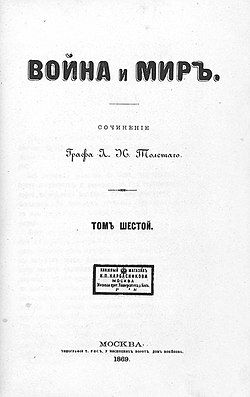
Tolstoy's monumental War and Peace interwove the lives of Russian aristocratic families with Napoleon's invasion of Russia. Its vast scope, hundreds of characters, and meditations on history and free will represented the apex of the nineteenth-century realist novel.
Image source: War and Peace
1871 - 1893
% complete
Émile Zola's twenty-novel cycle Les Rougon-Macquart applied scientific determinism to portray heredity and environment across Second Empire France. Works like Germinal and Nana established naturalism as an international movement influencing fiction on every continent.
Image source: Les Rougon-Macquart
1881
% complete
Henry James's The Portrait of a Lady exemplified his art of psychological nuance and international theme. His theories of point of view and the 'house of fiction' refined narrative technique, preparing the ground for the modernist revolution in the novel.
Image source: The Portrait of a Lady
1916
% complete
James Joyce's semi-autobiographical Künstlerroman traced Stephen Dedalus's growth through evolving prose styles, culminating in stream-of-consciousness diary entries. It announced the techniques Joyce would perfect in Ulysses and helped launch high modernism.
Image source: A Portrait of the Artist as a Young Man
Feb 2, 1922
% complete
Published complete in Paris by Sylvia Beach after censorship elsewhere, Ulysses compressed Homer's Odyssey into a single Dublin day using radical stream-of-consciousness and stylistic virtuosity. It redefined what the novel could be and remains modernism's towering achievement.
Image source: Ulysses (novel)
May 14, 1925
% complete
Virginia Woolf's Mrs Dalloway followed Clarissa Dalloway and shell-shocked veteran Septimus Smith through one London day, using interior time to dissolve conventional plot. Woolf's lyrical modernism opened the novel to consciousness, memory, and feminist perspective.
Image source: Mrs Dalloway
Oct 7, 1929
% complete
William Faulkner's fractured narrative of the Compson family, told partly through the mind of cognitively disabled Benjy, pushed stream-of-consciousness to its limits. His Yoknapatawpha saga made him a central figure of American modernism and Nobel laureate in 1949.
Image source: The Sound and the Fury
Apr 14, 1939
% complete
John Steinbeck's epic of Dust Bowl migrants, interweaving Joad family chapters with documentary interludes, won the Pulitzer Prize and galvanized national debate on poverty. It showed the novel's continuing power as social protest and collective narrative.
Image source: The Grapes of Wrath
Jun 8, 1949
% complete
George Orwell's dystopia of Big Brother, Newspeak, and thoughtcrime became one of the most influential novels of the twentieth century. Its concepts entered everyday political language, demonstrating the dystopian novel's role in critiquing totalitarianism and surveillance.
Image source: Nineteen Eighty-Four
1952
% complete
Ralph Ellison's Invisible Man, blending realism, expressionism, and blues aesthetics, chronicled a Black narrator's journey through American racism. Winner of the National Book Award, it transformed African American fiction and the American novel at large.
Image source: Invisible Man
1967
% complete
Gabriel García Márquez's saga of the Buendía family in Macondo catalyzed the global boom in Latin American literature. Its magical realism, treating the miraculous as ordinary fact, reshaped world fiction and earned him the Nobel Prize in 1982.
Image source: One Hundred Years of Solitude
1981
% complete
Salman Rushdie's Booker Prize-winning novel tied Saleem Sinai's life to India's independence through exuberant magical realism and unreliable narration. It revitalized postcolonial fiction and inaugurated a generation of globally minded Anglophone novels.
Image source: Midnight's Children
1985
% complete
Margaret Atwood's dystopian vision of Gilead, a theocratic regime enslaving fertile women, became a defining feminist novel. Its enduring cultural resonance, renewed by television adaptation and political debate, shows speculative fiction's power to interrogate contemporary society.
Image source: The Handmaid's Tale
1987
% complete
Toni Morrison's Beloved gave ghostly form to the trauma of slavery through Sethe, a formerly enslaved woman haunted by her dead daughter. Winner of the Pulitzer Prize, it secured Morrison's Nobel recognition in 1993 and stands among the greatest American novels.
Image source: Beloved (novel)
2007
% complete
The launch of Amazon's Kindle in November 2007 accelerated the shift to digital reading, alongside self-publishing platforms and online serialized fiction. These changes democratized novel production and distribution, reshaping how readers discover and consume long-form fiction worldwide.
Image source: Ebook
Or browse the full history timeline directory, with more than 2,000 topics.
This History of the Novel timeline was generated with the help of AI, using information found on the internet.
We work hard to keep these timelines accurate, but mistakes do get through. If you spot one, email us at [email protected] and we'll fix it for future visitors.
Generate yours with AI or build it from scratch, for free.
Export your timeline, add your own events, edit or remove AI-generated events, and much more
No credit card required.
Cancel anytime.
Cancel anytime.
You can create an unlimited number of timelines with up to 10 events on each one, customize how they look, export them to PDF, PNG, PowerPoint, CSV, and Excel, and share them with a link. Paid plans raise the event limit and add features like spreadsheet imports and collaborators.
Yes. You can cancel your subscription from your account page at any time, and you will not be charged again. Your subscription stays active for the rest of the period you already paid for.
Yes. We will email you a reminder before the annual renewal, and we will also email you a receipt.
Yes. You can email us within 15 days of any payment, and we will issue you a full refund.
Check out our pricing docs or send us an email anytime: [email protected].