-
Use Cases
-
Resources
-
Pricing
Women's soccer has a rich history dating back to the late 19th century, when matches in England drew large crowds. Despite being banned in several countries during much of the 20th century, the sport revived in the 1970s and grew rapidly after the first FIFA Women's World Cup in 1991. Today, women's soccer is one of the fastest-growing sports worldwide, with professional leagues and increasing global participation. More Less
May 7, 1881
% complete
One of the earliest recorded women's football matches took place at Easter Road in Edinburgh, Scotland, featuring two teams billed as playing under women's rules. The match drew large crowds and curiosity, marking the beginning of organized women's football in Britain despite widespread skepticism and ridicule from the press.
Image source: Women's association football
1895
% complete
The British Ladies' Football Club was founded in London by activist Nettie Honeyball (Lady Florence Dixie was involved as patron). The club staged a series of exhibition matches across England, drawing thousands of spectators and proving there was public appetite for women's football, even amid strong social opposition.
1917
% complete
Women working at the Dick, Kerr & Co. munitions factory in Preston, England formed a football team during World War I. They became one of the most successful and famous women's teams of the era, drawing record crowds and raising money for charity while men were away fighting.
Image source: Dick, Kerr Ladies F.C.
Dec 26, 1920
% complete
A Boxing Day match between Dick, Kerr Ladies and St Helens Ladies at Goodison Park in Liverpool attracted an estimated 53,000 spectators, with thousands more turned away. It remains one of the largest crowds ever for a women's match in England and demonstrated the enormous popularity of the women's game.
Dec 5, 1921
% complete
The English Football Association declared that football was 'quite unsuitable for females' and banned women's teams from using grounds affiliated with FA clubs. The ban devastated the growing women's game in England, stunting its development for nearly fifty years until it was lifted in 1971.
Image source: History of association football
1919
% complete
France launched an early organized women's football competition, with teams like Femina Sport gaining prominence. French pioneers such as Alice Milliat helped champion women's sport internationally, laying groundwork for later growth despite resistance from male-dominated sporting bodies.
Image source: Première Ligue
Jul 6, 1970 - Jul 15, 1970
% complete
An unofficial Women's World Cup was staged in Turin, Italy, with Denmark defeating hosts Italy in the final. Though not sanctioned by FIFA, the tournament demonstrated growing international interest in women's football and inspired further competitions in the following years.
Dec 1971
% complete
After fifty years, the Football Association finally rescinded its 1921 ban on women playing on affiliated grounds. The reversal allowed women's teams access to proper facilities, referees, and official recognition, catalyzing the modern revival of the women's game in England.
Image source: The Football Association
Feb 1972
% complete
UEFA passed a resolution encouraging its member associations to formally integrate women's football into their structures. This landmark decision gave official legitimacy to the women's game in Europe and prompted many countries to establish national leagues and governing programs.
Image source: UEFA Women's Championship
Jun 23, 1972
% complete
Title IX, a US federal civil rights law prohibiting sex-based discrimination in education programs receiving federal funding, transformed opportunities for girls and women in sports. Its enforcement dramatically expanded women's soccer participation in schools and colleges, fueling America's rise as a global soccer power.
Image source: Title IX
Nov 16, 1991 - Nov 30, 1991
% complete
FIFA staged the first official Women's World Cup in Guangdong Province, China. The United States won the inaugural title, defeating Norway 2-1 in the final. The tournament legitimized women's international soccer on the world stage and set the template for future editions.
Image source: 1991 FIFA Women's World Cup
Jul 24, 1996
% complete
Women's soccer became an Olympic sport at the Atlanta Games, with eight nations competing. Hosts United States won gold, defeating China 2-1 before a crowd of over 76,000, cementing the sport's place in global multi-sport competition.
Image source: Football at the 1996 Summer Olympics – Women's tournament
Jul 10, 1999
% complete
The United States defeated China on penalties before 90,185 fans at the Rose Bowl in Pasadena. Brandi Chastain's iconic celebration after scoring the winning penalty captivated American audiences and sparked a boom in youth soccer participation among girls nationwide.
Image source: 1999 FIFA Women's World Cup
2001
% complete
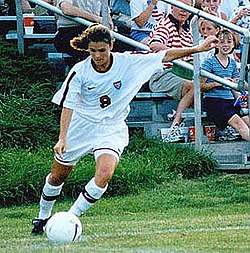
American forward Mia Hamm received the first-ever FIFA Women's World Player of the Year award. As the face of US soccer and one of the greatest players in history, Hamm inspired a generation of young athletes and helped popularize the women's game globally.
Image source: Mia Hamm
Sep 27, 2003 - Oct 12, 2003
% complete
Relocated to the United States due to SARS concerns, the 2003 World Cup saw Germany defeat Sweden 2-1 in extra time in the final. Germany's victory began an era of dominance that included back-to-back titles in 2003 and 2007.
Image source: 2003 FIFA Women's World Cup
Jun 7, 2019 - Jul 7, 2019
% complete
The United States captured its fourth Women's World Cup title, defeating the Netherlands 2-0 in Lyon. Megan Rapinoe won the Golden Boot and Golden Ball, while record audiences worldwide watched a tournament that showcased the rapid growth of the women's game.
Image source: 2019 FIFA Women's World Cup
Sep 2003
% complete
The WUSA, the first professional women's soccer league in the United States, ceased operations after three seasons due to financial losses. Despite featuring stars like Mia Hamm and Abby Wambach, its collapse highlighted the economic challenges facing professional women's soccer.
Image source: Women's United Soccer Association
Mar 29, 2009
% complete
Women's Professional Soccer debuted as a new top-tier professional league in the United States, featuring international stars including Marta and Hope Solo. Although the league folded after the 2011 season, it kept professional aspirations alive and paved the way for the NWSL.
Image source: Women's Professional Soccer
Apr 13, 2013
% complete
Backed by the US, Canadian, and Mexican federations, the National Women's Soccer League launched as a more sustainable professional league. It has grown into one of the world's premier women's competitions, attracting top international talent and expanding to numerous franchises.
Image source: National Women's Soccer League
2018
% complete
The FA Women's Super League transitioned to full professionalism, requiring clubs to offer minimum contracts to players. The move significantly raised standards in English women's soccer and contributed to the WSL becoming one of Europe's most competitive leagues.
Image source: Women's Super League
Mar 8, 2019
% complete
All 28 members of the USWNT filed a gender discrimination lawsuit against the US Soccer Federation, demanding pay equity with their male counterparts. The high-profile case galvanized a global conversation about unequal treatment of women athletes and eventually led to a landmark settlement.
Image source: United States women's national soccer team pay discrimination claim
May 2022
% complete
The US Soccer Federation agreed to landmark collective bargaining agreements guaranteeing equal pay between the men's and women's national teams, including equal World Cup prize money distribution. The deal was hailed as a watershed moment for gender equity in sports.
May 22, 2022
% complete
FC Barcelona defeated Wolfsburg 3-1 in the UEFA Women's Champions League final at Juventus' stadium in Turin. Barcelona's dominance, built around stars like Alexia Putellas, reflected the rising investment and quality of club football in Spain and across Europe.
Image source: 2022 UEFA Women's Champions League final
Jul 31, 2022
% complete
England defeated Germany 2-1 after extra time at Wembley Stadium to win its first major women's trophy. The tournament drew record-breaking attendance figures and television audiences, sparking unprecedented growth in girls' participation in football across England.
Image source: UEFA Women's Euro 2022
Aug 20, 2023
% complete
Spain defeated England 1-0 in Sydney to win its first Women's World Cup, becoming only the fifth nation to claim the title. The co-hosted Australia–New Zealand edition was the biggest ever, drawing nearly two million spectators and record global broadcast numbers.
Image source: 2023 FIFA Women's World Cup
Oct 30, 2023
% complete
Spanish midfielder Aitana Bonmatí won the Ballon d'Or Féminin after starring in Barcelona's treble-winning season and Spain's World Cup triumph. Her recognition underscored the growing prestige and visibility of individual honors in women's football.
Image source: Ballon d'Or Féminin
Or browse the full history timeline directory, with more than 2,000 topics.
This History of Women's Soccer timeline was generated with the help of AI, using information found on the internet.
We work hard to keep these timelines accurate, but mistakes do get through. If you spot one, email us at [email protected] and we'll fix it for future visitors.
Generate yours with AI or build it from scratch, for free.
Export your timeline, add your own events, edit or remove AI-generated events, and much more
No credit card required.
Cancel anytime.
Cancel anytime.
You can create an unlimited number of timelines with up to 10 events on each one, customize how they look, export them to PDF, PNG, PowerPoint, CSV, and Excel, and share them with a link. Paid plans raise the event limit and add features like spreadsheet imports and collaborators.
Yes. You can cancel your subscription from your account page at any time, and you will not be charged again. Your subscription stays active for the rest of the period you already paid for.
Yes. We will email you a reminder before the annual renewal, and we will also email you a receipt.
Yes. You can email us within 15 days of any payment, and we will issue you a full refund.
Check out our pricing docs or send us an email anytime: [email protected].