-
Use Cases
-
Resources
-
Pricing
The Women's Suffrage Movement was a decades-long political and social campaign in the United States and around the world aimed at securing voting rights for women. Beginning with the Seneca Falls Convention in 1848, activists like Susan B. Anthony, Elizabeth Cady Stanton, Alice Paul, and countless others organized, protested, and lobbied for over 70 years. Their efforts culminated in the passage and ratification of the 19th Amendment to the U.S. Constitution in 1920, guaranteeing women the right to vote. More Less
1654
% complete
Marie Guyart, a French nun who worked with the First Nations people of Canada, wrote in 1654 regarding the suffrage practices of Iroquois women, noting the role of female chieftains in their political life.
Image source: Marie of the Incarnation (Ursuline)
1718 - 1772
% complete
In Sweden, conditional women's suffrage was in effect during the Age of Liberty (1718–1772). Major single or widowed women who owned property, were subject to tax and members of guilds could participate in local and national elections. These rights were annulled in 1758 for local elections and in 1772 for national elections.
Image source: Age of Liberty
1755
% complete
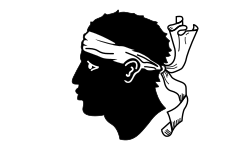
The Corsican Republic was one of the earliest instances of women's suffrage, though it operated only briefly as an independent state.
Image source: Corsican Republic
1756
% complete
In 1756, Lydia Taft became the first legal woman voter in colonial America, a notable early instance of a woman casting a ballot in the colonies.
Image source: Lydia Taft
Jul 2, 1776 - 1807
% complete
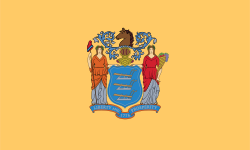
Under the July 2, 1776 declaration of its independence from English rule, unmarried white women who owned property could vote in New Jersey. This remained unchanged until 1807.
Image source: New Jersey
1791 - 1945
% complete
Following the elections to the Estates General of 1789, women were explicitly excluded from the electorate starting with the elections to the Legislative Assembly of 1791, an exclusion that lasted until 1945.
Image source: Legislative Assembly (France)
1792
% complete
In the 1792 elections in Sierra Leone, then a new British colony, all heads of household could vote, and one-third of these voters were ethnic African women.
Image source: Sierra Leone Colony and Protectorate
1838
% complete
The female descendants of the Bounty mutineers who lived on the Pitcairn Islands could vote from 1838. This right was transferred after they resettled in 1856 to Norfolk Island, now an Australian external territory.
Image source: Pitcairn Islands
1840
% complete
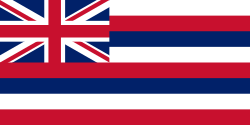
The emergence of modern democracy generally began with male citizens obtaining the right to vote before female citizens, except in the Kingdom of Hawai'i, where universal suffrage was introduced in 1840 without mention of sex. The 1840 constitution established a House of Representatives but did not specify voter eligibility.
Image source: Hawaiian Kingdom
1849
% complete
In 1849, the Grand Duchy of Tuscany, in Italy, became the first European state to have a law providing for the vote of women in administrative elections, taking up a tradition that was already informally sometimes present in Italy.
Image source: Grand Duchy of Tuscany
1852
% complete
A constitutional amendment in 1852 rescinded female voting in the Kingdom of Hawai'i and put property qualifications on male voting, specifying that suffrage was restricted to males over twenty years old.
1853 - 1856
% complete
The 1853 Constitution of the province of Vélez in the Republic of New Granada, modern day Colombia, allowed married women or women older than 21 to vote within the province. However, the law was annulled by the Supreme Court in 1856, eliminating female suffrage there.
Image source: Vélez, Santander
1840
% complete
The seed for the first Woman's Rights Convention in the United States at Seneca Falls, New York, was planted in 1840, when Elizabeth Cady Stanton met Lucretia Mott at the World Anti-Slavery Convention in London.
Image source: World Anti-Slavery Convention
Jul 1848
% complete
Elizabeth Cady Stanton and Lucretia Mott organized the first women's rights convention in America, held in July 1848 in Seneca Falls, New York, launching the organized movement for women's rights including suffrage.
Image source: Seneca Falls Convention
1851
% complete
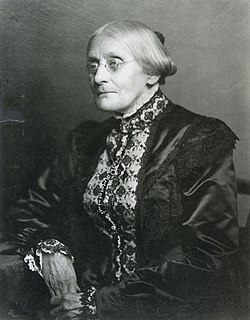
In 1851, Elizabeth Cady Stanton met temperance worker Susan B. Anthony, beginning a decades-long partnership that would shape the American women's suffrage movement.
Image source: Susan B. Anthony
1868
% complete
In 1868, Susan B. Anthony encouraged working women from the printing and sewing trades in New York, who were excluded from men's trade unions, to form Working Women's Associations. As a delegate to the National Labor Congress that year, she persuaded the committee on female labor to call for votes for women and equal pay for equal work.
May 1869
% complete
Susan B. Anthony helped form the National Woman Suffrage Association (NWSA) in May 1869, a key American organization campaigning for women's right to vote.
Image source: National Woman Suffrage Association
1873
% complete
Throughout the world, the Women's Christian Temperance Union (WCTU), established in the United States in 1873, campaigned for women's suffrage in addition to ameliorating the condition of prostitutes.
Image source: Woman's Christian Temperance Union
1903
% complete
One major division in the movement, especially in Britain, was between suffragists, who sought constitutional change, and suffragettes, led by English political activist Emmeline Pankhurst, who in 1903 formed the more militant Women's Social and Political Union.
Image source: Women's Social and Political Union
1904
% complete
National and international organizations formed to coordinate efforts towards women voting, most notably the International Woman Suffrage Alliance, founded in 1904 in Berlin, Germany.
1869
% complete
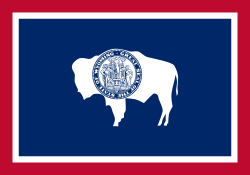
In 1869, women in the Wyoming Territory were permitted to both vote and stand for office, making it the first territory in the United States to grant women full political participation rights.
Image source: Wyoming
1870
% complete
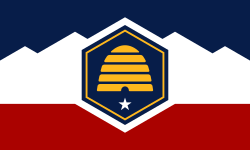
The territory of Utah granted women the right to vote in 1870, following Wyoming Territory's lead as one of the earliest instances of women's suffrage in the United States.
Image source: Utah
1881
% complete
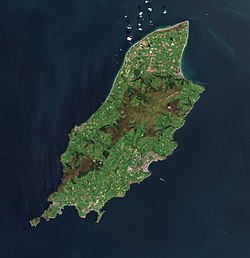
In 1881, the Isle of Man, an internally self-governing dependent territory of the British Crown, enfranchised women property owners, an early instance of women's suffrage in the British Isles.
Image source: Isle of Man
1889 - 1890
% complete
The Pacific commune of Franceville (now Port Vila, Vanuatu), maintained independence from 1889 to 1890, becoming the first self-governing nation to adopt universal suffrage without distinction of sex or color, although only white males were permitted to hold office.
Image source: Port Vila
1893
% complete
The first national granting of women's suffrage occurred in 1893 in New Zealand, then a self-governing British colony, largely due to a movement led by Kate Sheppard. The British protectorate of Cook Islands rendered the same right in 1893 as well.
Image source: Women's suffrage in New Zealand
1895
% complete
Another British colony, South Australia, followed in 1895, enacting laws which not only extended voting to women but also made women eligible to stand for election to its parliament — a first for the modern world. Suffragist Catherine Helen Spence stood for office in 1897.
Image source: Women's suffrage in Australia
1896
% complete
Utah, upon its admission to the Union, and Idaho both granted women the right to vote in 1896, extending women's suffrage among US states.
Image source: Idaho
1902
% complete
Following the federation of the British colonies in Australia in 1901, the new federal government enacted the Commonwealth Franchise Act 1902, which allowed female British subjects to vote and stand for election on the same terms as men. However, many indigenous Australians remained excluded from federal voting until 1962.
Image source: Commonwealth Franchise Act 1902
1906
% complete
The Grand Duchy of Finland in 1906 became the first place in Europe to introduce women's suffrage, and the first place in continental Europe to implement racially-equal suffrage for women. It was one of many self-governing actions in the Russian autonomous province leading to conflict with Russia and ultimately Finnish independence in 1917.
1907
% complete
As a result of the 1907 parliamentary elections, Finland's voters elected 19 women as the first female members of a representative parliament in the world.
1917
% complete
Canada gave the right to vote to some women in 1917; women got the vote on the same basis as men in 1920, though men and women of certain races or status were excluded from voting until 1960, when universal adult suffrage was achieved.
Image source: Women's suffrage in Canada
1917
% complete
Dutch women won the passive vote (the right to run for parliament) after a revision of the Dutch Constitution in 1917, followed by the active vote (electing representatives) in 1919.
1918
% complete
The Representation of the People Act 1918 saw British women over 30 gain the vote, a major milestone for the British suffrage movement after decades of activism by suffragists and suffragettes.
Image source: Representation of the People Act 1918
1918
% complete
Germany extended voting rights to women in 1918, during the interwar period when most major Western powers moved to enfranchise women.
1919
% complete
Austria and the Netherlands extended voting rights to women in 1919, part of the wave of interwar enfranchisement across major Western powers.
Image source: Women's suffrage in Austria
Aug 26, 1920
% complete
American women gained the right to vote on August 26, 1920, with the passage of the 19th Amendment. The Voting Rights Act of 1965 later secured voting rights for racial minorities.
Image source: Nineteenth Amendment to the United States Constitution
1922
% complete
Irish women won the same voting rights as men under the Irish Free State constitution of 1922.
Image source: Irish Free State
1928
% complete
In 1928, British women won suffrage on the same terms as men, meaning for ages 21 and older, completing the equalization of the franchise in the United Kingdom.
Image source: Representation of the People (Equal Franchise) Act 1928
1930 - 1934
% complete
The suffrage of Turkish women was introduced in 1930 for local elections and extended in 1934 for national elections.
Image source: Women's suffrage in Turkey
Jul 1944
% complete
By the time French women were granted the suffrage in July 1944 by Charles de Gaulle's government in exile, by a vote of 51 for and 16 against, France had been for about a decade the only Western country that did not even allow women's suffrage at municipal elections.
Image source: Women's suffrage
1971
% complete
Switzerland was a notable European exception: since 1971, women could vote at the federal level, and between 1959 and 1990, women gradually got the right to vote at the local canton level.
1948
% complete
In 1948 the United Nations adopted the Universal Declaration of Human Rights; Article 21 stated that everyone has the right to take part in the government of his country, directly or through freely chosen representatives.
Image source: Universal Declaration of Human Rights
1954
% complete
The United Nations General Assembly adopted the Convention on the Political Rights of Women, which went into force in 1954, enshrining the equal rights of women to vote, hold office, and access public services as set out by national laws.
Image source: Convention on the Political Rights of Women
1979
% complete
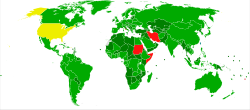
The United Nations encouraged women's suffrage in the years following World War II, and the Convention on the Elimination of All Forms of Discrimination Against Women (1979) identifies it as a basic right, with 189 countries currently being parties to this convention.
Image source: Convention on the Elimination of All Forms of Discrimination Against Women
2008
% complete
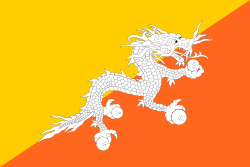
One of the most recent jurisdictions to acknowledge women's full right to vote was Bhutan in 2008, with its first national elections.
Image source: Bhutan
2015
% complete
Most recently, King Abdullah of Saudi Arabia, after both national and international condemnation and activism by feminist groups, granted Saudi women the vote and the right to run for office for the first time in the 2015 local elections.
Apr 26, 2023
% complete
On 26 April 2023, Pope Francis announced that women would be allowed to vote at the Sixteenth Ordinary General Assembly of the Synod of Bishops, marking the first time women were allowed to vote at any Synod of Bishops. Earlier, on 6 February 2021, he had appointed Nathalie Becquart an undersecretary of the Synod, making her the first woman with the right to vote there.
Image source: Synod of Bishops in the Catholic Church
Or browse the full history timeline directory, with more than 2,000 topics.
This Women's Suffrage Movement timeline was generated with the help of AI, using information found on the internet.
We work hard to keep these timelines accurate, but mistakes do get through. If you spot one, email us at [email protected] and we'll fix it for future visitors.
Generate yours with AI or build it from scratch, for free.
Export your timeline, add your own events, edit or remove AI-generated events, and much more
No credit card required.
Cancel anytime.
Cancel anytime.
You can create an unlimited number of timelines with up to 10 events on each one, customize how they look, export them to PDF, PNG, PowerPoint, CSV, and Excel, and share them with a link. Paid plans raise the event limit and add features like spreadsheet imports and collaborators.
Yes. You can cancel your subscription from your account page at any time, and you will not be charged again. Your subscription stays active for the rest of the period you already paid for.
Yes. We will email you a reminder before the annual renewal, and we will also email you a receipt.
Yes. You can email us within 15 days of any payment, and we will issue you a full refund.
Check out our pricing docs or send us an email anytime: [email protected].