-
Use Cases
-
Resources
-
Pricing
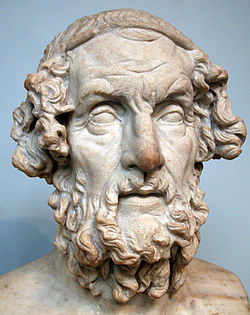
Homer is the semi-legendary ancient Greek poet traditionally credited with composing the Iliad and the Odyssey, the two foundational epic poems of Western literature. Believed to have lived around the 8th century BCE, possibly in Ionia (modern-day Turkey), Homer's identity remains a mystery, with seven cities claiming to be his birthplace. His works shaped Greek education, culture, and mythology, and continue to influence literature and storytelling to this day. More Less
1600 BC - 1150 BC
% complete
Certain helmets described in the Homeric poems were not worn in Homer's own time but were commonly worn by aristocratic warriors between 1600 and 1150 BC, suggesting preservation of very old details in the tradition.
Image source: Homer
1220 BC
% complete
The year 1220 BC is sometimes cited as the origin of the myth of the Trojan War, while others hold that the poem was inspired by multiple similar sieges that took place over the centuries.
Image source: Trojan War
1184 BC
% complete
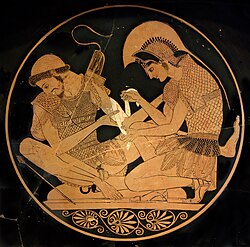
In ancient Greek chronology, the sack of Troy, the central event celebrated in Homer's Iliad, was dated to 1184 BC.
800 BC - 750 BC
% complete
Scholar Powell dates the composition of the Iliad and the Odyssey to sometime between 800 and 750 BC, based on Herodotus' statement that Homer lived four hundred years before his own time 'and not more', and on the fact that the poems do not mention hoplite battle tactics, inhumation, or literacy. Richard Janko has similarly proposed an eighth-century date based on linguistic analysis and statistics.
Image source: Homeric Question
799 BC
% complete
Homer (Ancient Greek: Ὅμηρος) was an ancient Greek poet traditionally credited as the author of the Iliad and the Odyssey, two epic poems that are foundational works of ancient Greek literature. He was possibly born around the 8th century BC.
1873
% complete
By the nineteenth century there was widespread scholarly skepticism that the Trojan War had ever happened and that Troy had even existed, but in 1873 Heinrich Schliemann announced to the world that he had discovered the ruins of Homer's Troy at Hisarlik in modern Turkey.
Image source: Heinrich Schliemann
800 BC - 600 BC
% complete
The orally transmitted Homeric poems were put into written form at some point between the eighth and sixth centuries BC. Other scholars hold that after their creation in the eighth century, they continued to be orally transmitted with considerable revision until being written down in the sixth century.
699 BC
% complete
The first early implicit references to Homer in the 7th century BC appear in works by Archilochus, Alcman, Tyrtaeus, and Callinus.
663 BC
% complete
Some scholars interpret passages in the Iliad as showing knowledge of historical events in the ancient Near East during the middle of the seventh century BC, including the destruction of Babylon by Sennacherib in 689 BC and the Sack of Thebes by Ashurbanipal in 664/663 BC.
550 BC - 528 BC
% complete
In antiquity it was widely held that the Homeric poems were collected and organised in Athens in the late sixth century BC by Pisistratus (died 528/527 BC), in what subsequent scholars have dubbed the 'Peisistratean recension'. This idea is referenced by Cicero and in several other surviving sources, including two ancient Lives of Homer.
Image source: Homer
500 BC
% complete
The poet Pindar is credited with saying that Homer originated from Chios and Smyrna, claims also mentioned by other fifth-century writers.
150 BC
% complete
At one extreme, American scholars such as Gregory Nagy see 'Homer' as a continually evolving tradition, which grew more stable as it progressed but did not fully cease changing and evolving until as late as the middle of the second century BC.
1664
% complete
In 1664, contradicting widespread praise of Homer as the epitome of wisdom, François Hédelin, abbé d'Aubignac wrote a scathing attack declaring the Homeric poems incoherent, immoral, tasteless, and without style, that Homer never existed, and that the poems were hastily cobbled together by incompetent editors from unrelated oral songs.
Image source: François Hédelin, abbé d'Aubignac
1744
% complete
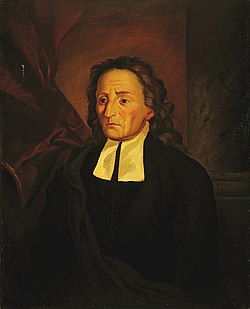
Giambattista Vico analysed Homer and other ancient writings in his philological treatise The New Science (1744) and concluded that Homer was not one man, but many, or an amalgam of other writers.
Image source: Giambattista Vico
1795
% complete
Friedrich August Wolf's Prolegomena ad Homerum argued that much of the material later incorporated into the Iliad and Odyssey was originally composed in the tenth century BC as short, separate oral songs, passed through oral tradition for roughly four hundred years before being assembled into prototypical versions in the sixth century BC by literate authors.
1800 - 1899
% complete
Wolf and the 'Analyst' school, which led the field in the nineteenth century, sought to recover the original, authentic poems thought to be concealed by later excrescences. By around 1830 these scholarly preoccupations had been dubbed 'the Homeric Question'.
1928
% complete
Starting around 1928, Milman Parry and Albert Lord, after studying folk bards in the Balkans, developed the 'Oral-Formulaic Theory': that the Homeric poems were originally composed through improvised oral performances relying on traditional epithets and poetic formulas.
Image source: Milman Parry
1933
% complete
The so-called 'type scenes' (typische Szenen), recurring narrative patterns in the Homeric epics, were named by Walter Arend in 1933.
1979
% complete
Gregory Nagy published influential scholarship in 1979 that shaped modern understanding of Homer as an evolving oral tradition, followed by further work in 2010.
Image source: Gregory Nagy
1982
% complete
Richard Janko's 1982 work proposed a date for both the Iliad and the Odyssey in the eighth century BC based on linguistic analysis and statistics.
1100 - 1199
% complete
Byzantine scholars such as Eustathius of Thessalonica and John Tzetzes produced commentaries, extensions and scholia to Homer, especially in the twelfth century. Eustathius's commentary on the Iliad alone sprawls over nearly 4,000 oversized pages in a 21st-century printed version, with nearly 2,000 additional pages on the Odyssey.
1488
% complete
In 1488, the Greek scholar Demetrios Chalkokondyles published the editio princeps of the Homeric poems in Florence; this was the first printed edition of Homer.
1535 - 1551
% complete
Editions of Homer with comments were produced by Micyllus and Camerarius at Basel in 1535, with an improved text in 1541, and a further edition including commentary in 1551.
1572 - 1592
% complete
Further printed editions of the Homeric poems appeared in 1572, 1588, and 1592.
1886 - 1888
% complete
Walter Leaf published his edition of the Iliad in London between 1886 and 1888, followed by a second edition.
Image source: Walter Leaf
1911
% complete
David Binning Monro, a noted Homeric scholar, contributed important work on Homer published in 1911.
Image source: David Monro (scholar)
1991 - 1996
% complete
Van Thiel's editions of the Homeric poems (1991, 1996) follow the medieval vulgate, whereas the nineteenth-century edition of Arthur Ludwich mainly follows Aristarchus's work.
1998 - 2000
% complete
Martin West produced major critical scholarship on the Homeric poems published across 1998–2000, contributing to modern textual and analytical study of Homer.
Image source: Martin Litchfield West
Or browse the full history timeline directory, with more than 2,000 topics.
This Homer timeline was generated with the help of AI, using information found on the internet.
We work hard to keep these timelines accurate, but mistakes do get through. If you spot one, email us at [email protected] and we'll fix it for future visitors.
Generate yours with AI or build it from scratch, for free.
Export your timeline, add your own events, edit or remove AI-generated events, and much more
No credit card required.
Cancel anytime.
Cancel anytime.
You can create an unlimited number of timelines with up to 10 events on each one, customize how they look, export them to PDF, PNG, PowerPoint, CSV, and Excel, and share them with a link. Paid plans raise the event limit and add features like spreadsheet imports and collaborators.
Yes. You can cancel your subscription from your account page at any time, and you will not be charged again. Your subscription stays active for the rest of the period you already paid for.
Yes. We will email you a reminder before the annual renewal, and we will also email you a receipt.
Yes. You can email us within 15 days of any payment, and we will issue you a full refund.
Check out our pricing docs or send us an email anytime: [email protected].