-
Use Cases
-
Resources
-
Pricing
Pericles (c. 495–429 BCE) was an influential Athenian statesman, orator, and general who led Athens during its Golden Age. Under his leadership, Athens experienced unprecedented cultural, political, and economic growth, including the construction of the Parthenon and the flourishing of democracy, philosophy, and the arts. More Less
495 BC
% complete
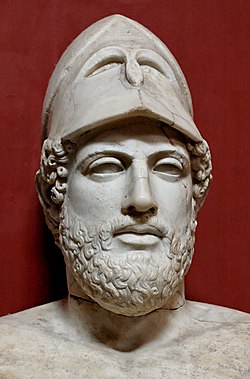
Pericles was born in Athens around 495 BC into the influential Alcmaeonid family. His father, Xanthippus, was a prominent politician and general, while his mother, Agariste, came from the powerful Alcmaeonid clan, giving Pericles a strong foundation for a future in Athenian politics.
Image source: Pericles
485 BC
% complete
Pericles' father Xanthippus was ostracized from Athens in 485 BC, a common political practice used to exile citizens deemed too powerful. His exile exposed the young Pericles to the volatile nature of Athenian politics and the dangers of political rivalry in the democracy.
479 BC
% complete
Xanthippus returned from exile and commanded the Athenian contingent at the Battle of Mycale in 479 BC, a decisive Greek victory over the Persians. This family legacy of military and political service greatly influenced Pericles' own ambitions and career.
Image source: Battle of Mycale
470 BC - 460 BC
% complete
As a young man, Pericles studied under the philosopher Anaxagoras, who taught him rational inquiry and calm reasoning. Anaxagoras' influence shaped Pericles' famously composed demeanor, eloquent speaking style, and intellectual approach to politics and leadership.
Image source: Anaxagoras
430 BC - 429 BC
% complete
Pericles suffered the devastating loss of his two legitimate sons, Paralus and Xanthippus, to the plague in 430-429 BC. The deaths shattered him personally; Athens, moved by his suffering, allowed his son by Aspasia, Pericles the Younger, to be legitimized and made a citizen.
472 BC
% complete
Around 472 BC, Pericles served as choregos, financing the production of Aeschylus' tragedy The Persians, which celebrated the Greek victory over Persia. The production won first prize and marked Pericles' early engagement with Athenian cultural life and public visibility.
Image source: The Persians
456 BC
% complete
The colossal bronze statue of Athena Promachos, sculpted by Phidias with Pericles' encouragement, was dedicated on the Acropolis around 456 BC. Standing nearly nine meters tall, it symbolized Athens' military prowess and the city's cultural ambition under Periclean leadership.
Image source: Athena Promachos
447 BC - 432 BC
% complete
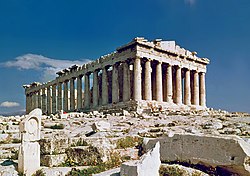
Under Pericles' direction, construction of the Parthenon began in 447 BC on the Acropolis. Designed by architects Ictinus and Callicrates and adorned with sculptures by Phidias, the temple to Athena Parthenos became the supreme symbol of Athenian glory and the Periclean building program.
Image source: Parthenon
439 BC
% complete
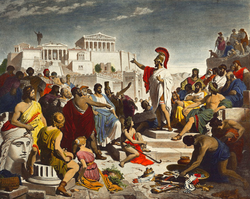
Pericles delivered his famous Funeral Oration at the public burial of the first Athenian soldiers killed in the Peloponnesian War. Recorded by Thucydides, the speech praised Athenian democracy, freedom, and civic devotion, becoming one of the most celebrated speeches in history.
Image source: Pericles's Funeral Oration
437 BC - 432 BC
% complete
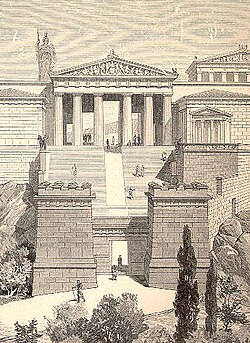
Pericles commissioned the monumental Propylaea, the grand gateway to the Acropolis, designed by the architect Mnesicles. Construction began in 437 BC, and though halted by the war's outbreak, the structure became another masterpiece of the Periclean building program.
Image source: Propylaea
429 BC
% complete
Pericles died in 429 BC, likely of the plague, after more than three decades as Athens' leading statesman. His death removed the steady hand guiding Athenian strategy, and Thucydides later judged that under his successors the city's leaders pursued reckless policies that led to defeat.
400 BC
% complete
In the generations after his death, the era of Periclean leadership came to be known as the Golden Age of Athens. His patronage produced the Parthenon, the tragedies of Sophocles and Euripides, the philosophy of Socrates, and a legacy that defined Western civilization's ideals of democracy and culture.
Image source: Fifth-century Athens
463 BC
% complete
Pericles, alongside Ephialtes, prosecuted the influential general Cimon on charges of bribery after his failed expedition against Thasos. Although Cimon was acquitted, the prosecution demonstrated Pericles' willingness to challenge the aristocratic establishment and assert democratic leadership.
Image source: Cimon
462 BC - 461 BC
% complete
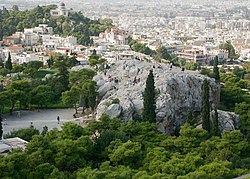
Ephialtes, with the support of Pericles, pushed through sweeping democratic reforms that stripped the aristocratic Areopagus council of most of its powers, transferring authority to the popular assemblies, the Council of 500, and the law courts, deepening Athenian democracy.
Image source: Ephialtes
461 BC
% complete
Ephialtes was assassinated in 461 BC, likely by political enemies angered by his democratic reforms. His death left Pericles as the leading figure of the democratic faction in Athens, paving the way for Pericles' rise to unchallenged political dominance.
461 BC
% complete
Following a dispute over whether to assist Sparta during the helot revolt, Cimon was ostracized in 461 BC. With his chief rival removed, Pericles consolidated power and Athens shifted toward a more democratic and anti-Spartan foreign policy.
454 BC
% complete
Pericles was first elected strategos, one of Athens' ten annually chosen generals, around 454 BC. He would be elected to this position repeatedly for the rest of his life, becoming the most influential statesman of democratic Athens.
454 BC
% complete
In 454 BC, after the disastrous Egyptian expedition, the treasury of the Delian League was moved from the island of Delos to Athens, officially for safekeeping. This gave Pericles and Athens direct control of allied funds, which he later used to finance grand building programs and the Athenian navy.
Image source: Delian League
451 BC
% complete
Pericles proposed a law restricting Athenian citizenship to those with two Athenian parents, both mother and father. The law reduced the citizen body's growth and reinforced the privileges of citizenship, though it later caused personal difficulty when his own sons were affected.
Image source: Pericles
430 BC
% complete
Blamed for the war's hardships and the plague, Pericles was fined and removed from office in 430 BC. However, the Athenians soon recognized his irreplaceable leadership, reinstated him as strategos, and he resumed command of the city's war effort.
460 BC
% complete
The First Peloponnesian War broke out in 460 BC between Athens and Sparta's allies, including Corinth and Aegina. During this conflict Pericles began his military career, serving as a strategos and gaining experience that would shape his later generalship.
Image source: First Peloponnesian War
454 BC
% complete
Pericles led a naval expedition into the Gulf of Corinth around 454 BC, defeating the Acarnanians. He then supported Athenian efforts in Oeniadae, demonstrating his growing competence as a military commander during the First Peloponnesian War.
447 BC
% complete
Pericles led a campaign to the Thracian Chersonese around 447 BC, subduing revolts in the region and re-establishing Athenian control over this strategically vital area guarding grain shipments from the Black Sea to Athens.
Image source: Gallipoli
447 BC
% complete
Athens suffered a defeat at the Battle of Coronea in 447 BC, losing control of Boeotia. The setback forced Pericles and Athens to adopt a more defensive posture on the Greek mainland, concentrating instead on naval power and the empire abroad.
446 BC
% complete
When Euboea revolted against Athenian rule in 446 BC, Pericles personally led forces to suppress the rebellion. He crossed back to Euboea despite threats to Athens itself and subdued the island, imposing harsh terms and securing this critical source of Athenian food and resources.
446 BC
% complete
In 446 BC, Athens and Sparta concluded the Thirty Years' Peace, ending the First Peloponnesian War. The treaty recognized Athenian dominance at sea and Spartan dominance on land, ushering in an era of stability that allowed Pericles to pursue his cultural and building programs.
Image source: Thirty Years' Peace
440 BC - 439 BC
% complete
Pericles led the Athenian fleet against Samos when the island revolted from the Delian League. After a hard-fought nine-month siege, Samos surrendered, dismantled its walls, and paid indemnities, reaffirming Athenian imperial authority in the Aegean.
Image source: Samos
431 BC
% complete
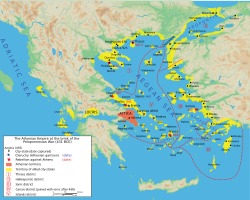
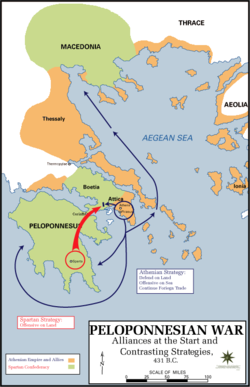
The Second Peloponnesian War erupted in 431 BC when Spartan forces invaded Attica. Pericles' strategy of avoiding land battles, sheltering the population behind Athens' walls, and relying on naval supremacy and the empire's resources defined the war's early years.
Image source: Peloponnesian War
431 BC - 425 BC
% complete
Pericles persuaded Athenians not to fight the Spartan army in open battle, instead enduring annual invasions of Attica while the navy raided the Peloponnesian coast. His cautious grand strategy aimed to outlast Sparta, though it was controversial among Athenians who lost their farms and homes.
430 BC - 426 BC
% complete
A devastating plague broke out in Athens in 430 BC, likely worsened by the crowding of refugees within the city walls. It killed perhaps a third of the population, including Pericles himself, and dealt a catastrophic blow to Athenian manpower, morale, and the war effort.
Image source: Plague of Athens
Or browse the full history timeline directory, with more than 2,000 topics.
This Pericles timeline was generated with the help of AI, using information found on the internet.
We work hard to keep these timelines accurate, but mistakes do get through. If you spot one, email us at [email protected] and we'll fix it for future visitors.
Generate yours with AI or build it from scratch, for free.
Export your timeline, add your own events, edit or remove AI-generated events, and much more
No credit card required.
Cancel anytime.
Cancel anytime.
You can create an unlimited number of timelines with up to 10 events on each one, customize how they look, export them to PDF, PNG, PowerPoint, CSV, and Excel, and share them with a link. Paid plans raise the event limit and add features like spreadsheet imports and collaborators.
Yes. You can cancel your subscription from your account page at any time, and you will not be charged again. Your subscription stays active for the rest of the period you already paid for.
Yes. We will email you a reminder before the annual renewal, and we will also email you a receipt.
Yes. You can email us within 15 days of any payment, and we will issue you a full refund.
Check out our pricing docs or send us an email anytime: [email protected].