-
Use Cases
-
Resources
-
Pricing
500 BCE
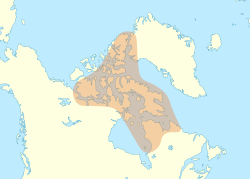
The Dorset culture developed across much of the eastern Arctic. Dorset communities relied on marine hunting and developed distinctive tools, art, and settlements before the arrival of the Thule people.
Image source: Dorset culture
1000
The Thule people emerged around the Bering Strait and western Alaska. Anthropologists identify them as the direct ancestors of modern Inuit, with a highly developed whale-hunting technology and extensive maritime mobility.
1000 - 1300
Thule migrants moved eastward from Alaska through the Canadian Arctic. Their expansion introduced technologies such as large skin boats, dog sleds, and specialized whaling equipment.
Image source: Thule people
1100
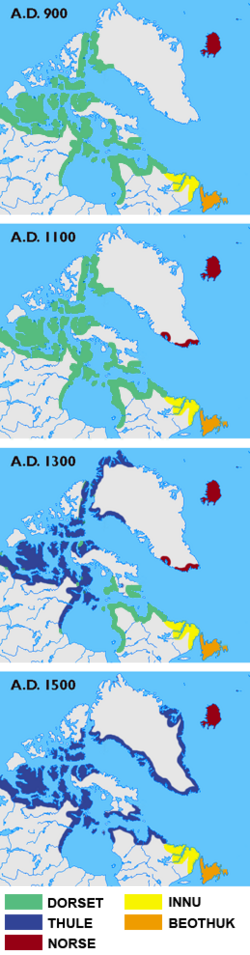
By about 1100, Thule-related Inuit migrants had reached western Greenland. Their arrival established the ancestral population of Greenlandic Inuit, or Kalaallit.
Image source: History of Greenland
1100 - 1200
During the 12th century, Inuit communities expanded into eastern Greenland. There they encountered Norse settlements that had been established centuries earlier.
1200 - 1300
The Thule expansion into Greenland was completed during the 13th century. Genetic and archaeological evidence indicates that these migrants largely replaced or absorbed earlier Dorset populations.
1300 - 1400
After the Thule expansion, Dorset communities disappeared as a distinct people in Greenland and much of the eastern Arctic. Archaeological and genetic research generally supports substantial Thule replacement of Dorset populations after 1300.
1350 - 1850
From about 1350, colder conditions associated with the Little Ice Age altered sea ice, animal migrations, and settlement patterns. Inuit communities adapted through changes in mobility, hunting strategies, and seasonal organization.
Image source: Little Ice Age
1400 - 1500
The Tuniit, the Inuit name commonly associated with Dorset peoples, are thought to have become extinct as a distinct population by about 1400 or 1500. Their disappearance remains an important subject in Arctic archaeology and oral history.
1902 - 1903
The Sadlermiut, an isolated Inuit population in the central Canadian Arctic, survived until the winter of 1902–1903. Exposure to infectious diseases following European contact caused the population to die out as a distinct people.
1982 - 1994
Storm-driven coastal erosion near Utqiaġvik, Alaska, exposed a remarkably preserved human burial. Radiocarbon dating of grave goods and hair placed the woman in about 1200, providing evidence about ancestral Inuit life.
2012
A 2012 genetic analysis reported no genetic link between the Sadlermiut and the Dorset or Tuniit peoples. The finding challenged earlier mitochondrial-DNA interpretations that had suggested continuity between these populations.
1200 - 1400
In Greenland, Thule Inuit encountered Norse settlers whose colonies had existed since the late tenth century. The two societies occupied overlapping regions and participated in limited contact and exchange.
Image source: Norse colonization of North America
1400 - 1500
The Norse colonies in Greenland disappeared by the late medieval period. Afterward, Inuit communities in the region had no sustained European contact for at least a century.
1550 - 1600
By the mid-16th century, Basque whalers and fishermen were active along the Labrador coast. They established shore stations, including the later archaeological site at Red Bay, and encountered local Inuit communities.
Image source: History of Basque whaling
1576
Martin Frobisher's 1576 expedition in search of the Northwest Passage produced the first well-documented European contact with Inuit. The encounter initiated a more sustained period of exploration, trade, conflict, and captivity.
Image source: Martin Frobisher
1771 - 1900
The Moravian Church began missionary work among Labrador Inuit in the late 18th century. Missionaries promoted Christianity and introduced new institutions, while Inuit communities selectively adopted and adapted religious practices.
Image source: Moravian Church
1800 - 1950
During the 19th and 20th centuries, missionaries and colonial authorities converted many Inuit to Christianity. Conversion campaigns often suppressed Indigenous languages, dances, tattoos, spiritual practices, and other cultural traditions.
1820
The Hudson's Bay Company opened a trading post at Great Whale River in 1820. The post became a center for processing whale products and trading furs and later developed into the communities of Whapmagoostui and Kuujjuarapik.
1821 - 1823
Commander William Edward Parry's Northwest Passage expedition twice overwintered in Foxe Basin. Parry and George Francis Lyon recorded extensive observations of Inuit life, which were published and widely read in 1824.
Image source: Edward Parry (Royal Navy officer, born 1790)
1904 - 1910
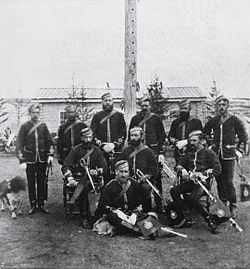
After 1904, North-West Mounted Police officers began accompanying the small number of traders and missionaries operating among more accessible Inuit communities. Their presence strengthened Canadian administrative and legal authority.
Image source: North-West Mounted Police
1800 - 1900
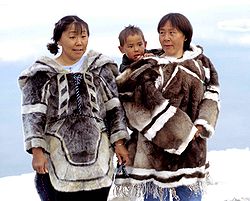
The Western Arctic suffered a population decline approaching 90 percent during the 19th century. Tuberculosis, measles, influenza, smallpox, and other diseases introduced through outside contact caused devastating mortality.
Image source: Inuit
1997 - 2021
Tuberculosis rates among Canadian Inuit rose sharply from the late 1990s and remained far higher than among non-Indigenous southern Canadians. Overcrowded housing, poverty, remoteness, and unequal access to health services contributed to the continuing crisis.
2002
Atanarjuat: The Fast Runner, the first feature film in Inuktitut, was released internationally in 2002. Directed by Zacharias Kunuk, it received widespread critical acclaim and brought Inuit storytelling and language to global audiences.
2003 - 2004
Jordin Tootoo became the first Inuk to play in the National Hockey League during the 2003–2004 season with the Nashville Predators. His career became a prominent example of Inuit visibility in professional sport.
2010
Inuit cultural symbols became increasingly visible in Canadian public life, including the use of the inuksuk as a prominent symbol during the 2010 Vancouver Winter Olympics. Such uses also prompted discussion about cultural ownership and representation.
2021
The 2021 Canadian census recorded 70,540 people identifying as Inuit, an increase of 8.5 percent from 2016. Nunavut had the largest Inuit population, while substantial communities also lived in Quebec, Newfoundland and Labrador, the Northwest Territories, and outside Inuit Nunangat.
1939
In 1939, the Supreme Court of Canada ruled in Re Eskimos that Inuit were legally considered Indians under section 91(24) of the British North America Act. The decision placed Inuit affairs under federal jurisdiction.
Image source: Reference Re Eskimos
1953
Denmark ended Greenland's colonial status in 1953 and incorporated it into the Danish realm. The change granted formal equality with Denmark but did not end Inuit demands for greater autonomy.
Image source: Greenland
1953 - 1955
In 1953, Canada relocated 17 Inuit families from Inukjuak, Quebec, to Resolute and Grise Fiord. The forced relocation caused severe hardship and family disruption; the government formally acknowledged abuses associated with the policy in 2005.
1953 - 1960
In response to growing recognition of northern neglect, the Canadian government began establishing roughly forty permanent administrative centers. These centers provided education, health care, government services, and economic development while also expanding state control.
1971
Inuit Tapirisat of Canada, now Inuit Tapiriit Kanatami, was founded in 1971. It became a national political organization advocating for Inuit rights, representation, language, culture, and land claims.
Image source: Inuit Tapiriit Kanatami
1975
The 1975 James Bay and Northern Quebec Agreement was a landmark modern treaty involving Inuit and Cree communities, Quebec, and Canada. It created compensation, governance, economic, and land-management arrangements and helped reshape Inuit political activism.
Image source: James Bay and Northern Quebec Agreement
1977
Northern Labrador Inuit submitted a comprehensive land claim in 1977. Negotiations ultimately produced the Labrador Inuit Land Claims Agreement and the self-governing Inuit region of Nunatsiavut.
1979
Greenland obtained home rule from Denmark in 1979. The arrangement transferred substantial domestic authority to Greenlandic institutions and marked a major step toward Inuit political self-determination.
1982
Sections 25 and 35 of Canada's Constitution Act, 1982 recognized Inuit as one of the Aboriginal peoples of Canada. Inuit were constitutionally distinguished from First Nations and Métis peoples while receiving recognition of Aboriginal rights.
1984
The Inuvialuit Final Agreement was signed in 1984, becoming the first comprehensive land claims settlement in northern Canada. It established rights, compensation, wildlife-management institutions, and regional governance for western Arctic Inuit.
1992
In November 1992, nearly 85 percent of Inuit voters in the future Nunavut region approved the Nunavut Final Agreement. The vote cleared the way for a major land claim and the creation of a new territory.
May 25, 1993
Prime Minister Brian Mulroney and Paul Quassa signed the Nunavut Land Claims Agreement in Iqaluit on May 25, 1993. The agreement transferred land, financial compensation, wildlife-management authority, and institutions of public government to the Nunavut region.
1996
In 1996, Dene and Inuit representatives held a healing ceremony at the site of the 1771 Bloody Falls massacre. The event addressed longstanding grievances and sought reconciliation between the two Indigenous peoples.
Apr 1, 1999
Nunavut became a distinct Canadian territory on April 1, 1999, following legislation implementing the Nunavut land claim. Its creation represented one of the most significant modern achievements of Inuit political organization and self-government.
Image source: Nunavut
2005
After decades of negotiations following the 1977 claim, the Labrador Inuit Land Claims Agreement established Nunatsiavut in 2005. The agreement provided regional Inuit self-government and recognized land and resource rights.
Oct 30, 2008
On October 30, 2008, Leona Aglukkaq became the first Inuk to hold a senior Canadian cabinet position when she was appointed Minister of Health. She later served as minister responsible for northern economic development and environment.
Image source: Leona Aglukkaq
Jun 21, 2009
Greenland's self-government arrangement came into force on June 21, 2009, following a 2008 referendum that received about 75 percent approval. It transferred additional powers from Denmark and recognized Greenlanders' right to self-determination.
May 12, 2011
Greenlandic Prime Minister Kuupik Kleist hosted the Arctic Council ministerial meeting in Nuuk on May 12, 2011. The meeting highlighted Inuit participation in international Arctic governance and brought senior officials from several Arctic states to Greenland.
Image source: Arctic Council
Or browse the full history timeline directory, with more than 2,500 topics.
This Inuit History timeline was generated with the help of AI, using information found on the internet.
We work hard to keep these timelines accurate, but mistakes do get through. If you spot one, email us at [email protected] and we'll fix it for future visitors.
Generate yours with AI or build it from scratch, for free.
Export your timeline, add your own events, edit or remove AI-generated events, and much more
No credit card required.
Cancel anytime.
Cancel anytime.
You can create an unlimited number of timelines with up to 10 events on each one, customize how they look, export them to PDF, PNG, PowerPoint, CSV, and Excel, and share them with a link. Paid plans raise the event limit and add features like spreadsheet imports and collaborators.
Yes. You can cancel your subscription from your account page at any time, and you will not be charged again. Your subscription stays active for the rest of the period you already paid for.
Yes. We will email you a reminder before the annual renewal, and we will also email you a receipt.
Yes. You can email us within 15 days of any payment, and we will issue you a full refund.
Check out our pricing docs or send us an email anytime: [email protected].