-
Use Cases
-
Resources
-
Pricing
1142
According to Haudenosaunee oral tradition and later reconstructions, the Mohawk, Oneida, Onondaga, Cayuga, and Seneca formed the Iroquois Confederacy, also called the Haudenosaunee Confederacy. The Peacemaker and Hiawatha are traditionally credited with establishing its principles of peace, unity, and collective decision-making.
Image source: Iroquois
1713 - 1722
Following defeat in the Tuscarora War, many Tuscarora migrated from the Carolinas toward Haudenosaunee territory. Their resettlement led to admission as the Confederacy's sixth nation in 1722.
1722
After migrating north from the Carolinas, the Tuscarora were admitted as the sixth nation of the Confederacy. They joined the existing Mohawk, Oneida, Onondaga, Cayuga, and Seneca nations, although they did not receive the same number of Grand Council offices.
1534
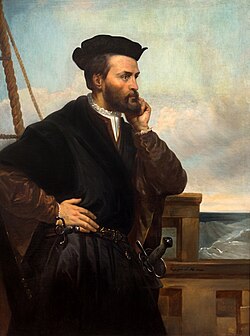
During Jacques Cartier's voyages in the St. Lawrence region, Europeans recorded encounters with Indigenous communities connected to the broader political and cultural world of the northeastern woodlands. These early contacts preceded the later diplomatic and military struggles involving the Haudenosaunee.
Image source: Jacques Cartier
1614
The Dutch established Fort Nassau near present-day Albany, New York, creating an important center for trade with the Mohawk and other Indigenous peoples. Access to European firearms and goods strengthened Haudenosaunee diplomacy and military power while intensifying regional competition.
Image source: Fort Nassau (North River)
1624
The Dutch built Fort Orange on the Hudson River, replacing Fort Nassau as a major commercial post. The settlement became central to the alliance and exchange relationship between the Dutch and the Haudenosaunee, especially the Mohawk.
1630 - 1640
During the early seventeenth century, Dutch trade supplied the Haudenosaunee with firearms and other manufactured goods. These weapons contributed to the Confederacy's ability to compete in the fur trade and conduct campaigns during the Beaver Wars.
Image source: Beaver Wars
1640 - 1701
The Haudenosaunee fought a series of campaigns against neighboring Indigenous nations and French allies over access to beaver territories, trade routes, and political influence. The conflicts dramatically reshaped the Indigenous map of the Great Lakes and northeastern North America.
1640 - 1660
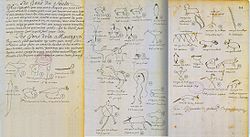
French Jesuit missionaries produced detailed reports about the Haudenosaunee, their towns, diplomacy, warfare, social organization, and religious life. These accounts are important historical sources, though they reflect European assumptions and missionary objectives.
Image source: The Jesuit Relations
1664
After the English takeover of New Netherland, the Haudenosaunee negotiated with the new colonial authorities at Fort Albany. The agreement helped preserve the longstanding diplomatic and commercial relationship between the Haudenosaunee and the English.
1666
French forces under the Marquis de Tracy and Daniel de Rémy de Courcelle invaded Mohawk country in 1666. The campaign destroyed villages and food stores, but the French did not permanently conquer the Mohawk or end Haudenosaunee resistance.
Image source: Mohawk people
1677
The Covenant Chain became a diplomatic framework linking the Haudenosaunee, the English colony of New York, and other Indigenous nations. Its symbolism of maintaining and polishing a chain represented continuing alliance, negotiation, and mutual obligations.
Image source: Covenant Chain
1678
The Treaty of Casco Bay ended major fighting in northern New England after King Philip's War. Haudenosaunee diplomacy contributed to the wider political environment in which Indigenous nations and English colonies negotiated new relationships.
Image source: King Philip's War
Aug 5, 1689
Haudenosaunee warriors attacked the French settlement of Lachine near Montreal during a period of escalating conflict. The raid exposed the vulnerability of New France and helped trigger a major French military response.
Image source: Lachine massacre
1693 - 1696
Governor Frontenac led French campaigns against Haudenosaunee communities, destroying crops and villages in an effort to force peace. The attacks placed severe pressure on the Confederacy but did not eliminate its political independence.
Sep 20, 1697
The Treaty of Ryswick ended the European war that had intensified conflict in North America. Its aftermath encouraged renewed negotiations among the Haudenosaunee, New France, and English colonies.
Image source: Peace of Ryswick
Aug 4, 1701
The Great Peace of Montreal brought together representatives of New France, the Haudenosaunee Confederacy, and numerous Indigenous nations. It ended the Beaver Wars, confirmed broad territorial understandings, and established a period of relative peace in the Great Lakes region.
Image source: Great Peace of Montreal
Apr 11, 1713
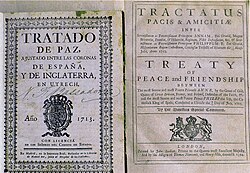
The Treaty of Utrecht ended the War of the Spanish Succession and transferred Acadia, Hudson Bay, and Newfoundland to Britain. Its provisions affected Indigenous homelands and diplomacy, while the Haudenosaunee continued asserting their own political authority.
Image source: Peace of Utrecht
1754 - 1763
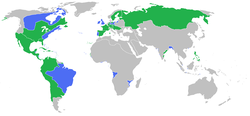
The French and Indian War brought intense competition among Britain, France, and Indigenous nations across northeastern North America. Haudenosaunee nations pursued their own strategic interests, with participation and alliances varying among communities.
Image source: French and Indian War
Jun 19, 1754
At the Albany Congress, British colonial delegates sought a unified defense plan and negotiated with Haudenosaunee representatives. The meeting produced the Albany Plan of Union and renewed diplomatic discussions, though the Confederacy did not accept the proposed colonial union.
Image source: Albany Congress
Oct 26, 1758
The Treaty of Easton ended a major phase of conflict between Pennsylvania, New Jersey, and Indigenous nations. It included territorial discussions and helped reduce Indigenous opposition to British operations against the French during the Seven Years' War.
Image source: Treaty of Easton
Feb 10, 1763
The Treaty of Paris ended the French and Indian War and transferred most French possessions in North America to Britain. The resulting British dominance altered the diplomatic balance on which the Haudenosaunee had long relied.
Image source: Treaty of Paris (1763)
Oct 7, 1763
Britain's Royal Proclamation reserved lands west of the Appalachian Mountains for Indigenous peoples and required Crown negotiation for valid land cessions. Although frequently violated, it became an important reference point in later Haudenosaunee land and sovereignty claims.
Image source: Royal Proclamation of 1763
Nov 5, 1768
Haudenosaunee representatives signed the Treaty of Fort Stanwix with the British Crown, establishing a boundary between Indigenous country and colonial settlement. The agreement ceded extensive territory south of the Ohio River, though its legitimacy and interpretation remained contested.
Image source: Treaty of Fort Stanwix (1768)
Apr 19, 1775 - Sep 3, 1783
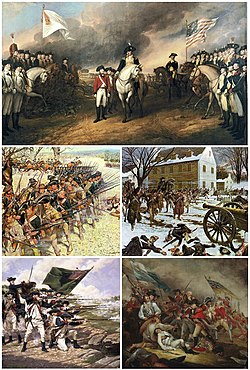
The American Revolution divided the Haudenosaunee Confederacy. The Oneida and Tuscarora generally supported the American cause, while the Mohawk, Onondaga, Cayuga, and Seneca largely supported Britain, although individual allegiances varied.
Image source: American Revolutionary War
Aug 6, 1777
At Oriskany in New York, Patriot militia and a Haudenosaunee force aligned with Britain fought a bloody engagement during the Saratoga campaign. The battle caused severe losses and deepened the Confederacy's internal divisions.
Image source: Battle of Oriskany
Jun 18, 1779 - Sep 30, 1779
The Continental Army's Sullivan–Clinton campaign destroyed Haudenosaunee towns, crops, orchards, and food stores across present-day New York. The campaign sought to end Haudenosaunee support for Britain and created widespread displacement and famine.
Image source: Sullivan Expedition
Sep 3, 1783
The Treaty of Paris recognized United States independence but did not include the Haudenosaunee as a negotiating party. Britain ceded territory that included Haudenosaunee homelands, leaving allied nations to face American expansion with limited British protection.
Image source: Treaty of Paris (1783)
Oct 22, 1784
The United States negotiated the Treaty of Fort Stanwix with Haudenosaunee representatives after the Revolution. It confined the Oneida, Onondaga, Cayuga, and Seneca to defined territories and confirmed major American claims to Indigenous land.
Nov 11, 1794
The Treaty of Canandaigua established peace between the United States and the Haudenosaunee after the Revolution. It recognized reservation boundaries, affirmed federal obligations, and remains a central treaty in contemporary Haudenosaunee sovereignty claims.
Image source: Treaty of Canandaigua
1796
Many Haudenosaunee people who had supported Britain resettled in British North America, particularly along the Grand River in present-day Ontario. The Six Nations of the Grand River became a major Haudenosaunee political community outside the United States.
Jan 15, 1838
The Treaty of Buffalo Creek attempted to transfer several Haudenosaunee reservations in western New York and promote removal to lands west of the Mississippi. It was later modified after opposition, but it accelerated land loss and pressure on Haudenosaunee communities.
1842
The Seneca Nation and its allies resisted provisions of the Treaty of Buffalo Creek that would have required removal from western New York. Their resistance helped preserve the Allegany, Cattaraugus, and Oil Spring reservations.
1799 - 1800
Seneca religious leader Handsome Lake began receiving visions that became the Code of Handsome Lake. The teachings combined Haudenosaunee spiritual traditions with moral reforms and helped support cultural renewal after war, displacement, and social crisis.
1800 - 1999
Colonial and United States policies challenged Haudenosaunee matrilineal governance, clan authority, and the political roles of women. Despite these pressures, Clan Mothers and other community leaders continued to maintain traditional systems of accountability and leadership.
Image source: Dawes Act
1887 - 1934
The Dawes Act promoted allotment of collectively held Indigenous lands into individual parcels and opened remaining lands to non-Indigenous settlement. Although not uniformly applied to every Haudenosaunee nation, allotment policies contributed to land loss and legal pressure on Indigenous governments.
1911
The Society of American Indians brought together Indigenous activists, professionals, and reformers, including people connected to Haudenosaunee communities. It helped advance national discussions about citizenship, education, land rights, and Indigenous political status.
1923
Levi General, known as Deskaheh, represented the Six Nations of the Grand River in an effort to obtain international recognition of Haudenosaunee sovereignty. Although the League of Nations did not hear the petition, the campaign established an enduring model of Indigenous international diplomacy.
Jun 2, 1924
The United States granted citizenship to all Native Americans born in the country through the Indian Citizenship Act. Haudenosaunee nations continued to assert that federal citizenship did not erase their preexisting national identities and treaty rights.
Jun 18, 1934
The Indian Reorganization Act ended the general allotment policy and encouraged federally recognized tribes to adopt written constitutions. Haudenosaunee nations debated and responded to the law according to their own political traditions and views of inherent sovereignty.
1960 - 1965
Construction of Kinzua Dam on the Allegheny River flooded a substantial portion of the Allegany Reservation and displaced Seneca families. The project became a major symbol of the conflict between federal development policy and Haudenosaunee treaty rights.
1968 - 1978
Haudenosaunee activists participated in the wider Indigenous rights movement, emphasizing treaty enforcement, land recovery, traditional governance, and cultural revitalization. Their activism helped bring Indigenous sovereignty issues to national and international attention.
Image source: American Indian Movement
1974
Mohawk activists occupied the Moss Lake area near the Six Nations of the Grand River in a protest over land rights and unrecognized Haudenosaunee claims. The action reflected growing use of direct protest to challenge Canadian land policies.
1977
The Haudenosaunee Confederacy developed its own passport to express its status as a sovereign Indigenous polity. Its use has periodically created disputes over international travel and recognition, while symbolizing continuing diplomatic independence.
1977
Haudenosaunee representatives participated in United Nations discussions during the first International NGO Conference on Discrimination Against Indigenous Populations in the Americas. Their international advocacy linked treaty rights and self-determination to global Indigenous rights.
1983
The Haudenosaunee Nationals, formerly known as the Iroquois Nationals, began competing internationally in men's lacrosse. Their participation presents lacrosse as a Haudenosaunee cultural gift and asserts the Confederacy's identity as an international sporting nation.
Sep 13, 2007
The United Nations adopted the Declaration on the Rights of Indigenous Peoples after decades of Indigenous advocacy, including participation by Haudenosaunee representatives. The declaration recognizes self-determination, cultural rights, lands, resources, and free, prior, and informed consent.
Image source: Declaration on the Rights of Indigenous Peoples
2013
New York State transferred a small parcel to the Onondaga Nation in a settlement connected to historic land and environmental issues. The action was significant as a limited recognition of Haudenosaunee land claims amid continuing disputes.
Or browse the full history timeline directory, with more than 2,500 topics.
This Iroquois Confederacy timeline was generated with the help of AI, using information found on the internet.
We work hard to keep these timelines accurate, but mistakes do get through. If you spot one, email us at [email protected] and we'll fix it for future visitors.
Generate yours with AI or build it from scratch, for free.
Export your timeline, add your own events, edit or remove AI-generated events, and much more
No credit card required.
Cancel anytime.
Cancel anytime.
You can create an unlimited number of timelines with up to 10 events on each one, customize how they look, export them to PDF, PNG, PowerPoint, CSV, and Excel, and share them with a link. Paid plans raise the event limit and add features like spreadsheet imports and collaborators.
Yes. You can cancel your subscription from your account page at any time, and you will not be charged again. Your subscription stays active for the rest of the period you already paid for.
Yes. We will email you a reminder before the annual renewal, and we will also email you a receipt.
Yes. You can email us within 15 days of any payment, and we will issue you a full refund.
Check out our pricing docs or send us an email anytime: [email protected].