-
Use Cases
-
Resources
-
Pricing
May 29, 1917
% complete
John Fitzgerald Kennedy was born on May 29, 1917, in Brookline, Massachusetts, the second of nine children of Joseph P. Kennedy Sr. and Rose Fitzgerald Kennedy. His father was a prominent businessman and later ambassador, and his mother was the daughter of Boston political figure John F. Fitzgerald, giving JFK deep roots in Irish-American Catholic politics.
Image source: John F. Kennedy
Sep 1, 1931 - Jun 1, 1935
% complete
Kennedy attended the Choate School in Wallingford, Connecticut, from 1931 to 1935. A bright but often mischievous student, he struggled with health problems but developed his social skills and charisma, graduating in June 1935 before heading to college.
Image source: Choate Rosemary Hall
Jun 1, 1940
% complete
Kennedy graduated cum laude from Harvard College in June 1940 with a degree in international affairs. His senior thesis, analyzing British appeasement policies toward Nazi Germany, was published in July 1940 as the book 'Why England Slept' and became a bestseller.
Image source: Harvard University
Jul 1, 1940
% complete
Based on his Harvard thesis, 'Why England Slept' examined why Britain failed to rearm against Nazi Germany in the 1930s. The book was well received and sold tens of thousands of copies, establishing Kennedy as a serious young thinker on foreign policy.
Image source: Why England Slept
Oct 1, 1954 - Feb 1, 1955
% complete
Kennedy underwent two major spinal operations in 1954 and 1955 to address chronic back pain worsened by war injuries. During his long recovery he wrote 'Profiles in Courage,' which won the Pulitzer Prize for Biography in 1957.
Image source: John F. Kennedy Jr.
Sep 1, 1941
% complete
After initially failing the Army's physical due to back problems, Kennedy used family connections to enter the U.S. Naval Reserve in September 1941. He completed training and was commissioned an ensign, eventually volunteering for Motor Torpedo Boat (PT boat) duty in the Pacific.
Image source: John F. Kennedy
Apr 1, 1943 - Aug 2, 1943
% complete
Lieutenant Kennedy took command of PT-109, a patrol torpedo boat operating in the Solomon Islands. On the night of August 2, 1943, the boat was rammed and sunk by the Japanese destroyer Amagiri, killing two crew members.
Image source: Patrol torpedo boat PT-109
Aug 2, 1943 - Aug 8, 1943
% complete
After PT-109 was destroyed, Kennedy led his surviving crew to swim to a nearby island, towing a badly burned crewman by clenching the man's life vest strap in his teeth. Over several days he arranged their rescue by Allied coastwatchers, earning the Navy and Marine Corps Medal for heroism and a Purple Heart for his injuries.
Mar 1, 1945
% complete
Suffering from recurring back problems aggravated by his wartime service, Kennedy was medically retired with the rank of lieutenant in early 1945. His war record became a central part of his public image in his subsequent political career.
Nov 5, 1946
% complete
At age 29, Kennedy won the Democratic primary and then the general election for Massachusetts' 11th congressional district, defeating Republican James Curley. He served three terms in the House of Representatives from 1947 to 1953.
Image source: United States House of Representatives
Nov 4, 1952
% complete
Kennedy defeated incumbent Republican Henry Cabot Lodge Jr. in a hard-fought Senate race, aided by tireless campaigning and the organizational efforts of his brother Robert. He served as senator from Massachusetts from 1953 until 1960.
Image source: United States Senate
Sep 12, 1953
% complete
Kennedy married Jacqueline Lee Bouvier, a Washington journalist twelve years his junior, at St. Mary's Church in Newport, Rhode Island. The glamorous couple became icons of American style, and they had four children, two of whom survived infancy: Caroline and John Jr.
Image source: Jacqueline Kennedy Onassis
May 6, 1957
% complete
Kennedy's book profiling eight U.S. senators who showed political courage, written largely with help from aide Ted Sorensen, was awarded the Pulitzer Prize for Biography or Autobiography in May 1957, boosting his national profile.
Image source: Profiles in Courage
Jan 2, 1960
% complete
On January 2, 1960, Kennedy formally announced his campaign for the Democratic presidential nomination. At 43, he overcame concerns about his youth and Catholic faith, defeating rivals including Hubert Humphrey and Lyndon B. Johnson for the nomination.
Image source: 1960 United States presidential election
Sep 26, 1960
% complete
The first of four televised debates between Kennedy and Republican nominee Richard Nixon drew about 70 million viewers. Kennedy's poised, telegenic performance contrasted with Nixon's haggard appearance, and many observers credit the debates with helping swing the close election.
Nov 8, 1960
% complete
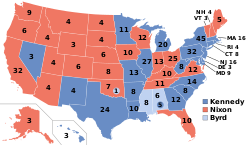
Kennedy narrowly defeated Richard Nixon in one of the closest elections in American history, winning 303 electoral votes and about 49.7% of the popular vote. He became the youngest person elected to the presidency and the first Roman Catholic to hold the office.
Jan 20, 1961
% complete
Kennedy was sworn in as the 35th president, delivering an inaugural address that urged Americans to 'ask not what your country can do for you—ask what you can do for your country.' The speech became one of the most celebrated in American history.
Image source: Inauguration of John F. Kennedy
Mar 1, 1961
% complete
By executive order, Kennedy established the Peace Corps, sending American volunteers abroad to assist in education, health, and community development in developing nations. The program embodied his call to public service and remains active today.
Image source: Peace Corps
Apr 17, 1961 - Apr 19, 1961
% complete
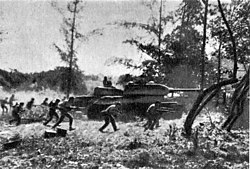
A CIA-planned invasion of Cuba by Cuban exiles seeking to overthrow Fidel Castro ended in humiliating failure within days. Kennedy assumed responsibility for the debacle, which damaged U.S. credibility and pushed Castro closer to the Soviet Union.
Image source: Bay of Pigs Invasion
May 25, 1961
% complete
In a speech to Congress, Kennedy declared that America should commit itself to landing a man on the Moon and returning him safely before the decade was out. This bold goal launched the Apollo program and defined the Space Race with the Soviet Union.
Image source: Apollo program
Jun 4, 1961 - Jun 5, 1961
% complete
Kennedy met Soviet leader Nikita Khrushchev in Vienna for talks on Berlin, disarmament, and Laos. Khrushchev's aggressive posture, particularly over Berlin, left Kennedy shaken and heightened Cold War tensions that soon led to the Berlin Wall's construction.
Image source: Vienna Summit
Aug 13, 1961
% complete
East Germany sealed off West Berlin overnight, erecting barbed wire barriers that became the Berlin Wall. Kennedy responded by reinforcing the Western garrison in Berlin, accepting the wall rather than risk nuclear confrontation while reaffirming U.S. commitments to West Berlin.
Image source: Berlin Wall
Oct 16, 1962 - Oct 28, 1962
% complete
After U.S. spy planes discovered Soviet nuclear missiles under construction in Cuba, Kennedy imposed a naval 'quarantine' of the island and negotiated privately with Khrushchev. After thirteen tense days, the Soviets agreed to withdraw the missiles in exchange for a U.S. pledge not to invade Cuba and a secret agreement to remove Jupiter missiles from Turkey.
Image source: Cuban Missile Crisis
Jun 11, 1963
% complete
On the night Alabama Governor George Wallace blocked Black students from enrolling at the University of Alabama, Kennedy delivered a historic televised address calling civil rights a moral issue and proposing legislation guaranteeing equal treatment, which became the Civil Rights Act of 1964.
Image source: Civil rights movement
Jun 26, 1963
% complete
Before a crowd of hundreds of thousands in West Berlin, Kennedy proclaimed solidarity with free people everywhere by declaring 'Ich bin ein Berliner.' The speech was a powerful rebuke of communism and one of the defining moments of the Cold War.
Image source: Ich bin ein Berliner
Oct 7, 1963
% complete
Following the near-catastrophe of the missile crisis, Kennedy signed the Partial Test Ban Treaty prohibiting nuclear tests in the atmosphere, outer space, and underwater. It marked the first significant arms control agreement between the superpowers.
Image source: Partial Nuclear Test Ban Treaty
Nov 22, 1963
% complete
While riding in a motorcade through Dealey Plaza in Dallas, Kennedy was shot and fatally wounded by sniper fire. Arrested suspect Lee Harvey Oswald was himself shot dead two days later by Jack Ruby. The assassination shocked the nation and spawned decades of investigation and conspiracy theories.
Image source: Assassination of John F. Kennedy
Nov 22, 1963
% complete
Hours after Kennedy's death, Vice President Lyndon B. Johnson was administered the oath of office aboard Air Force One at Dallas Love Field, with a grief-stricken Jacqueline Kennedy standing beside him, still wearing her bloodstained pink suit.
Image source: Lyndon B. Johnson
Nov 22, 1963
% complete
Kennedy was buried at Arlington National Cemetery on November 25, 1963, beneath an eternal flame lit at Jacqueline Kennedy's request. The gravesite, redesigned and rededicated in 1967, remains one of the most visited memorials in the United States.
Image source: John F. Kennedy Eternal Flame
Sep 24, 1964
% complete
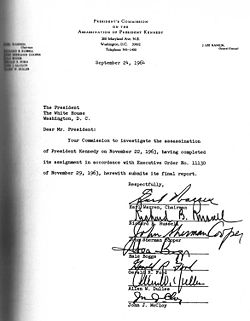
The Warren Commission, chaired by Chief Justice Earl Warren, issued its report concluding that Lee Harvey Oswald acted alone in assassinating Kennedy. Its findings were widely accepted at first but remained controversial amid persistent conspiracy theories.
Image source: Warren Commission
Or browse the full history timeline directory, with more than 2,000 topics.
This John F. Kennedy timeline was generated with the help of AI, using information found on the internet.
We work hard to keep these timelines accurate, but mistakes do get through. If you spot one, email us at [email protected] and we'll fix it for future visitors.
Generate yours with AI or build it from scratch, for free.
Export your timeline, add your own events, edit or remove AI-generated events, and much more
No credit card required.
Cancel anytime.
Cancel anytime.
You can create an unlimited number of timelines with up to 10 events on each one, customize how they look, export them to PDF, PNG, PowerPoint, CSV, and Excel, and share them with a link. Paid plans raise the event limit and add features like spreadsheet imports and collaborators.
Yes. You can cancel your subscription from your account page at any time, and you will not be charged again. Your subscription stays active for the rest of the period you already paid for.
Yes. We will email you a reminder before the annual renewal, and we will also email you a receipt.
Yes. You can email us within 15 days of any payment, and we will issue you a full refund.
Check out our pricing docs or send us an email anytime: [email protected].