-
Use Cases
-
Resources
-
Pricing
John Tyler (1790–1862) was the 10th President of the United States and the first vice president to succeed to the presidency upon the death of a sitting president. Known as 'His Accidency,' he served from 1841 to 1845 after William Henry Harrison's death, championed the annexation of Texas, and later sided with the Confederacy. More Less
Mar 29, 1790
% complete
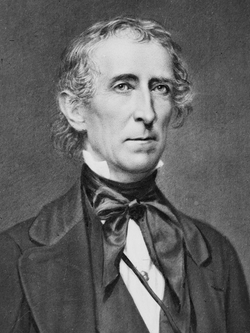
John Tyler was born at Greenway Plantation in Charles City County, Virginia, into a prominent planter family. His father, John Tyler Sr., was a judge and later governor of Virginia, giving young John access to elite education and political connections.
Image source: John Tyler
1807
% complete
Tyler graduated from the College of William & Mary at age seventeen, studying law under his father and preparing for admission to the Virginia bar, where he was admitted in 1809.
Dec 17, 1816 - Mar 4, 1821
% complete
At age twenty-six, Tyler won election to the U.S. House of Representatives as a Democratic-Republican. He served two terms, opposing federalist programs like the Second Bank of the United States and supporting states' rights.
Image source: United States House of Representatives
1823 - 1825
% complete
After leaving Congress, Tyler returned to Virginia politics, serving in the House of Delegates, where he continued to champion strict constructionist principles and limited federal power.
Image source: Virginia House of Delegates
Dec 10, 1825 - Mar 4, 1827
% complete
Tyler was elected governor of Virginia by the state legislature. During his tenure he advocated for internal improvements and public education while defending states' rights against federal overreach.
Image source: Governor of Virginia

Mar 4, 1827 - Feb 29, 1836
% complete
Tyler entered the U.S. Senate, where he initially supported Andrew Jackson but broke with him over the Force Bill during the Nullification Crisis, voting to censure Jackson in 1834.
Image source: United States Senate
1836
% complete
The Whigs nominated Tyler for vice president in 1836 as part of a strategy of running regional candidates against Martin Van Buren; Tyler finished third in electoral votes despite losing.
Image source: 1836 United States presidential election
Feb 29, 1836
% complete
When the Virginia legislature instructed its senators to vote for expunging Jackson's censure from the Senate record, Tyler refused and resigned his seat rather than betray his conscience.
Dec 4, 1839
% complete
The Whig convention nominated William Henry Harrison for president with John Tyler of Virginia for vice president to balance the ticket geographically and ideologically under the slogan 'Tippecanoe and Tyler Too.'
Image source: 1840 United States presidential election
Nov 3, 1840
% complete
Harrison and Tyler defeated incumbent Martin Van Buren in a landslide, winning 234 electoral votes. Tyler became vice president-elect of the United States.
Mar 4, 1841
% complete
Tyler took the oath of office as vice president in Washington, D.C., just weeks before President Harrison would fall gravely ill, setting up an unprecedented constitutional crisis.
Image source: Vice President of the United States
Apr 4, 1841
% complete
President Harrison died of what was diagnosed as pneumonia just thirty-one days into his term, making him the first U.S. president to die in office and creating uncertainty about presidential succession.
Image source: William Henry Harrison
Apr 6, 1841 - Mar 4, 1845
% complete
Despite objections from some cabinet members who argued he should merely act as president, Tyler insisted on assuming the full title and powers of the presidency. This precedent eventually became codified in law and later constitutional amendment.
Aug 6, 1841
% complete
During the special session called after Tyler's accession, Congress debated fiscal policy. Tyler vetoed bills to reestablish a national bank twice, alienating his own party, while the independent treasury system remained a key issue.
Image source: Independent Treasury
Sep 11, 1841
% complete
After Tyler vetoed the second bill establishing a national bank, furious Whig leaders expelled him from the party and his cabinet resigned in protest, with Secretary of State Daniel Webster remaining to complete negotiations with Britain.
May 18, 1842
% complete
A short-lived armed uprising against Rhode Island's restrictive voting requirements prompted calls for federal intervention; Tyler chose a cautious approach, urging compromise rather than sending troops.
Image source: Dorr Rebellion
Sep 10, 1842
% complete
Tyler's first wife died in the White House after suffering a paralytic stroke earlier that year, becoming the first First Lady to die while her husband held the presidency.
Image source: Letitia Christian Tyler
Feb 28, 1844
% complete
During a demonstration cruise of the new warship USS Princeton on the Potomac, a gun exploded, killing Secretary of State Abel Upshur, Secretary of the Navy Thomas Gilmer, and others. Tyler, below decks, survived unharmed.
Image source: USS Princeton (1843)
Jun 26, 1844
% complete
Widowed less than two years, the president married Julia Gardiner, a wealthy New Yorker more than thirty years his junior, in a private ceremony. She became a vibrant First Lady for the rest of his term.
Image source: Julia Gardiner Tyler
Nov 5, 1844
% complete
Tyler briefly sought a third-party candidacy to promote annexation but withdrew when Democrat James K. Polk, an expansionist, secured the nomination. Polk narrowly defeated Whig Henry Clay.
Image source: 1844 United States presidential election
Mar 1, 1845
% complete
On his final full day in office, Tyler signed the congressional joint resolution offering statehood to Texas, achieving his top foreign policy goal through a simple majority rather than treaty ratification.
Image source: Texas annexation
Mar 3, 1845
% complete
On his last day in office, Tyler signed the legislation admitting Florida into the Union as a slave state, balancing Iowa's anticipated entry as a free state.
Image source: Florida
Aug 9, 1842
% complete
Secretary of State Daniel Webster and British diplomat Lord Ashburton signed a treaty settling the disputed Maine–New Brunswick border and resolving other issues between the United States and British North America.
Image source: Webster–Ashburton Treaty
Jun 8, 1844
% complete
The Senate rejected Tyler's proposed treaty to annex the Republic of Texas by a vote of 35 to 16, largely due to opposition over slavery expansion, forcing Tyler to pursue a joint resolution instead.
Jul 3, 1844
% complete
Negotiated by Commissioner Caleb Cushing, the Treaty of Wanghia opened Chinese ports to American trade and granted the United States most-favored-nation status, the first treaty between the two countries.
Image source: Treaty of Wanghia
1861
% complete
Tyler was elected to the Provisional Confederate Congress and then to the permanent Confederate House of Representatives, though he died before taking his seat.
Image source: Confederate States Congress
Feb 4, 1861 - Feb 27, 1861
% complete
Former president Tyler chaired the Washington Peace Conference convened to prevent Southern secession, but he ultimately opposed the conference's proposed constitutional amendments and sided with secessionists.
Image source: Peace Conference of 1861
Apr 17, 1861
% complete
Tyler, a delegate to the Virginia Secession Convention, voted in favor of Virginia's ordinance of secession following the attack on Fort Sumter, breaking definitively with the Union he had once led.
Image source: Virginia in the American Civil War
Jan 18, 1862
% complete
Tyler died in Richmond after suffering a stroke, likely brought on by illness. He was buried in Hollywood Cemetery, and his death went officially unremarked in Washington because he had joined the Confederacy.
Image source: John Tyler
Or browse the full history timeline directory, with more than 2,000 topics.
This John Tyler timeline was generated with the help of AI, using information found on the internet.
We work hard to keep these timelines accurate, but mistakes do get through. If you spot one, email us at [email protected] and we'll fix it for future visitors.
Generate yours with AI or build it from scratch, for free.

Export your timeline, add your own events, edit or remove AI-generated events, and much more
No credit card required.
Cancel anytime.
Cancel anytime.
You can create an unlimited number of timelines with up to 10 events on each one, customize how they look, export them to PDF, PNG, PowerPoint, CSV, and Excel, and share them with a link. Paid plans raise the event limit and add features like spreadsheet imports and collaborators.
Yes. You can cancel your subscription from your account page at any time, and you will not be charged again. Your subscription stays active for the rest of the period you already paid for.
Yes. We will email you a reminder before the annual renewal, and we will also email you a receipt.
Yes. You can email us within 15 days of any payment, and we will issue you a full refund.
Check out our pricing docs or send us an email anytime: [email protected].