-
Use Cases
-
Resources
-
Pricing
The Kingdom of Kush was an ancient African civilization centered in Nubia (modern-day Sudan), which flourished along the Nile River. It rose as a major power after gaining independence from Egypt, conquered Egypt during its Napatan period to form the 25th Dynasty, and later thrived at Meroë, becoming renowned for its iron production, pyramids, and distinct culture before declining around 350 CE. More Less
4000 BC - 2900 BC
% complete
The A-Group was a civilization in Nubia that lasted from the 4th millennium BC, reached its climax at around 3100 BC, and fell about 200 years later, c. 2900 BC.
Image source: A-Group culture
3700 BC - 3250 BC
% complete
During the Bronze Age, Nubian ancestors of the Kingdom of Kush built speoi, temples or tombs cut into rock faces, between 3700 and 3250 BC.
Image source: Speos Artemidos
2450 BC - 1450 BC
% complete
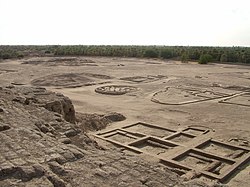
The city-state of Kerma emerged as the dominant political force between 2450 and 1450 BC, controlling the Nile Valley between the first and fourth cataracts, an area as large as Egypt.
Image source: Kerma culture
2450 BC
% complete
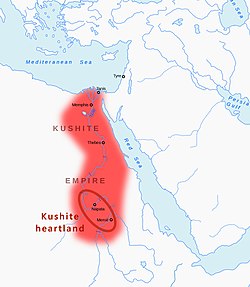
The Egyptians were the first to identify Kerma as 'Kush', probably from the indigenous ethnonym 'Kasu'. Over the next several centuries the two civilizations engaged in intermittent warfare, trade, and cultural exchange.
Image source: Kingdom of Kush
1800 BC - 400 AD
% complete
Doukki Gel was a settlement near Kerma, inhabited from 1800 BC to 400 AD. It was occupied by a coalition of African rulers from the south around 1700 BC during the Classical Kerma period, and later by Ancient Egyptian and Nubian officials during the New Kingdom period.
1700 BC - 1500 BC
% complete
In the Kingdom of Kerma's latest phase, lasting from about 1700–1500 BC, it absorbed the Sudanese kingdom of Saï and became a sizable, populous empire rivaling Egypt. The Kerma culture flourished from around 2500 BC to 1500 BC in ancient Nubia.
2000 BC
% complete
Mentuhotep II, the 21st century BC founder of the Middle Kingdom, is recorded to have undertaken campaigns against Kush in the 29th and 31st years of his reign.
Image source: Mentuhotep II
1650 BC
% complete
At the end of the Second Intermediate Period (mid-sixteenth century BC), Egypt faced twin existential threats—the Hyksos in the North and the Kushites in the South.
Image source: Second Intermediate Period of Egypt
1539 BC
% complete
Resistance to early Eighteenth Dynasty Egyptian rule by neighboring Kush is evidenced in the writings of Ahmose, son of Ebana, an Egyptian warrior who served under Nebpehtrya Ahmose (1539–1514 BC).
Image source: Ahmose I
1514 BC - 1493 BC
% complete
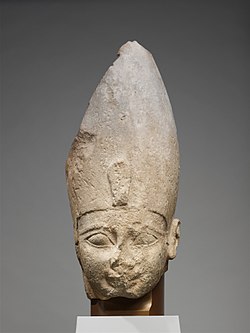
Taken from the autobiographical inscriptions on the walls of his tomb-chapel, the Egyptians undertook campaigns to defeat Kush and conquer Nubia under the rule of Amenhotep I (1514–1493 BC).
Image source: Amenhotep I
1504 BC
% complete
Under Thutmose I (1493–1481 BC), Egyptian campaigns eventually resulted in their annexation of Nubia c. 1504 BC.
Image source: Thutmose I
1500 BC
% complete
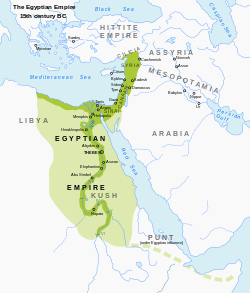
Around 1500 BC, Nubia was absorbed into the New Kingdom of Egypt, but rebellions continued for centuries. Much of Nubia came under Egyptian rule during the New Kingdom period (1550–1070 BC).
Image source: New Kingdom of Egypt
1500 BC - 1070 BC
% complete
As an Egyptian colony from the 16th century BC, Nubia ('Kush') was governed by an Egyptian Viceroy of Kush.
Image source: Viceroy of Kush
1500 BC - 1300 BC
% complete
After the conquest, Kerma culture was increasingly Egyptianized, yet rebellions continued for 220 years until c. 1300 BC.
1200 BC
% complete
1070 BC
% complete
With the disintegration of the New Kingdom around 1070 BC, Kush became an independent kingdom centered at Napata in modern northern Sudan.
Image source: Napata
935 BC - 605 BC
% complete
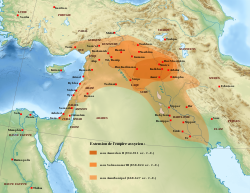
The Assyrians expanded from northern Mesopotamia and conquered a vast empire including the whole of the Near East, much of Anatolia, the eastern Mediterranean, the Caucasus and early Iron Age Iran. Kush's historical allies, the inhabitants of Canaan, had fallen first to the Middle Assyrian Empire (1365–1020 BC) and then to the resurgent Neo-Assyrian Empire (935–605 BC).
Image source: Neo-Assyrian Empire
780 BC - 760 BC
% complete
An inscription of the 5th century king Amanineteyerike remembered Alara's reign as long and successful. A 7th century inscription claimed that his sister was the grandmother of king Taharqo.
Image source: Alara of Kush
750 BC
% complete
In the 8th century BC, King Kashta ('the Kushite') peacefully became king of Upper Egypt, while his daughter, Amenirdis, was appointed as divine adoratrice of Amun in Thebes.
Image source: Kashta
747 BC - 656 BC
% complete
Because the 25th dynasty ruled over both states in the eighth century BC, from the Rift Valley to the Taurus mountains, historians have closely associated the study of Kush with Egyptology. The monarchs of Kush ruled Egypt for over a century until the Assyrian conquest.
Image source: Twenty-fifth Dynasty of Egypt
730 BC
% complete
During the siege of Hermopolis in the eighth century BC, siege towers were built for the Kushite army led by Piye, in order to enhance the efficiency of Kushite archers and slingers.
Image source: Piye
700 BC - 500 BC
% complete
Early records of bloomery furnaces dated at least to the seventh and sixth centuries BC have been discovered in Kush, showing advanced ironworking technology.
Image source: Bloomery
671 BC - 663 BC
% complete
The monarchs of Kush were dethroned by the Assyrian kings Esarhaddon and Ashurbanipal in the mid-7th century BC, ending Kushite rule over Egypt.
Image source: Assyrian conquest of Egypt
300 BC
% complete
From the second century BC, there was a separate Meroitic writing system. The latter was widely used; so far some 1,278 texts using this version are known (Leclant 2000).
Image source: Meroitic script
300 BC - 300 AD
% complete
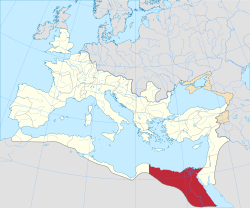
The northernmost part of Nubia was occupied from the 3rd century BC to the 3rd century AD, first by the Ptolemaic Kingdom and then by the Roman Empire.
Image source: Roman Egypt
100 BC - 1 BC
% complete
Strabo describes a war with the Romans in the first century BC. Kush began to fade as a power by the first or second century AD, sapped by the war with the Roman province of Egypt and the decline of its traditional industries.
Image source: Kingdom of Kush
100 BC
% complete
Meroitic texts from as early as the 1st century BC hint at conflicts with the Noba, who lived west of the Nile and were governed by their own chiefs and kings. Perhaps it was the increasingly arid climate that forced them to attack the Nile Valley, although they would not manage to break through until the 4th century.
200 AD - 300 AD
% complete
There is evidence of third century AD Kushite Kings at Philae in demotic inscriptions, and Kushite activities led others to note 'a de facto Kushite control of that area (as far north as Philae) for part of the third century AD.'
Image source: Philae temple complex
350 AD
% complete
A bowl from a 4th-century elite burial in el-Hobagi features a Meroitic-Nubian inscription mentioning a 'king', but identifying the interred individual and the polity he ruled over remains problematic.
350 AD - 400 AD
% complete
At Meroe, the last pyramids as well as non-royal burials are dated to the mid-4th century, conventionally thought to be when the kingdom of Kush came to an end. It weakened and disintegrated amid worsening climatic conditions, internal rebellions, and foreign invasions—notably by the Noba people, who introduced the Nubian languages and gave their name to Nubia itself.
500 AD - 600 AD
% complete
Nobatia, Makuria and Alodia eventually converted to Christianity in the 6th century, marking the beginning of medieval Nubia. Kushite civilization had continued for several centuries after the fall of Meroe.
Image source: Nobatia
1980 AD
% complete
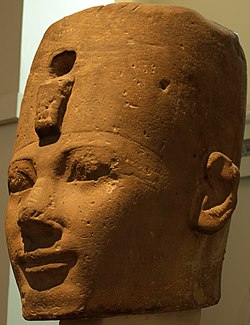
Long overshadowed by Egypt, archaeological discoveries since the late 20th century have revealed Kush to be an advanced civilization.
Or browse the full history timeline directory, with more than 2,000 topics.
This Kingdom of Kush timeline was generated with the help of AI, using information found on the internet.
We work hard to keep these timelines accurate, but mistakes do get through. If you spot one, email us at [email protected] and we'll fix it for future visitors.
Generate yours with AI or build it from scratch, for free.
Export your timeline, add your own events, edit or remove AI-generated events, and much more
No credit card required.
Cancel anytime.
Cancel anytime.
You can create an unlimited number of timelines with up to 10 events on each one, customize how they look, export them to PDF, PNG, PowerPoint, CSV, and Excel, and share them with a link. Paid plans raise the event limit and add features like spreadsheet imports and collaborators.
Yes. You can cancel your subscription from your account page at any time, and you will not be charged again. Your subscription stays active for the rest of the period you already paid for.
Yes. We will email you a reminder before the annual renewal, and we will also email you a receipt.
Yes. You can email us within 15 days of any payment, and we will issue you a full refund.
Check out our pricing docs or send us an email anytime: [email protected].