-
Use Cases
-
Resources
-
Pricing
1524
Lenape people in canoes met Giovanni da Verrazzano, the first European explorer known to enter New York Harbor.
Image source: Giovanni da Verrazzano
1600 - 1699
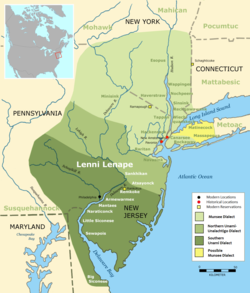
European settlers and traders from New Netherland and New Sweden exchanged iron tools for Lenape agricultural products, especially maize.
Image source: Lenape
1624
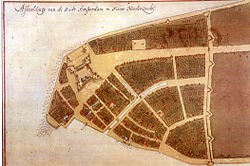
Dutch settlers founded New Amsterdam in 1624 at the site that later became New York City, creating a major center of colonial expansion near Lenape homelands.
Image source: New Amsterdam
Jun 3, 1631
Dutch settlers founded a colony at present-day Lewes, Delaware, naming it Zwaanendael, or Swan Valley.
Image source: Zwaanendael Colony
1632
A local Lenape band killed the 32 Dutch settlers at Zwaanendael after a misunderstanding escalated over the defacement of the Dutch West India Company's insignia.
1643 - 1645
Kieft's War brought recurrent violent conflict between Europeans and Indigenous communities, contributing to severe devastation among Lenape populations.
Image source: Kieft's War
1650 - 1699
Mid-seventeenth-century records suggest that most Lenape polities consisted of several hundred people, although warfare with the Susquehannock and Haudenosaunee likely reduced populations and altered political organization.
1676
The Haudenosaunee Confederacy added the Lenape to the Covenant Chain. The Lenape remained tributary to the Confederacy until 1753.
Image source: Covenant Chain
1676 - 1753
Following their admission to the Covenant Chain, the Lenape remained tributary to the Haudenosaunee Confederacy until 1753, shortly before the French and Indian War.
1682
William Penn and Quaker colonists created the English colony of Pennsylvania beginning at the lower Delaware River, intensifying colonial pressure on Lenape lands.
Image source: Province of Pennsylvania
1682
William Penn first met the Lenape in 1682 and recorded Unami words including anna for mother, isseemus for brother, and netap for friend.
Image source: William Penn
1718
William Penn died in 1718. His death marked the end of the life of the founder of Pennsylvania, whose colony had been established along the lower Delaware River.
1761
In 1761, the Lenape leader Killbuck led a British supply train from Fort Pitt to Fort Sandusky.
1763
In 1763, Bill Hickman, a Lenape, warned English colonists in the Juniata River region of an impending attack.
Apr 1763
Teedyuscung was killed in April 1763 during the burning of his home, removing an important Lenape leader during a period of intense colonial conflict.
1778
White Eyes, the Lenape chief who negotiated the Treaty of Fort Pitt, died in 1778.
1778
Killbuck permitted American soldiers to cross Lenape territory so they could attack British-held Fort Detroit.
1779
The British planned to attack Fort Laurens in early 1779 and demanded that neutral Lenape communities formally side with them. American forces later abandoned the fort in August.
Image source: Fort Laurens
1524
The first recorded European contact with people presumed to have been Lenape occurred in 1524, establishing the beginning of sustained historical documentation of Lenape-European relations.
1600 - 1900
During the seventeenth through nineteenth centuries, the Lenape were a powerful Native American nation inhabiting the mid-Atlantic coast from southern Massachusetts to the southern extent of Delaware, within the Northeastern Woodlands.
1600 - 1699
In the seventeenth century, Lenape communities practiced slash-and-burn agriculture as part of their food-production system.
1628
Dutch settler Isaac de Rasieres observed that the Lenape planted maize, their primary crop, in March.
1634 - 1644
David de Vries described a Lenape communal hunt in the Hackensack River valley. One hundred or more men formed a line, drove animals toward the river, and killed them there.
1648
In 1648, the Axion band of Lenape was recorded as the largest tribe on the Delaware River, with approximately 200 warriors.
1699
At the end of the seventeenth century, the Lenape had three clans, each of which historically contained twelve sub-clans.
1820
In the early nineteenth century, amateur anthropologist Silas Wood published a book claiming that several distinct American Indian tribes had inhabited Long Island, New York.
1700 - 1799
Beginning in the eighteenth century, the Moravian Church established missions in Lenape settlements, creating new religious communities and written records.
Image source: Moravian Church
1700 - 1799
Through the eighteenth century, many Lenape moved west into the relatively depopulated upper Ohio River basin, while some communities also launched raids on distant settler communities.
1757
The New Jersey Association for Helping the Indians wrote a constitution intended to expel native Munsee Lenape from settlements around present-day Washington Valley in Morris County.
1758
The Treaty of Easton was signed in 1758 between the Lenape and European colonists, addressing territorial and political relations during the colonial wars.
Image source: Treaty of Easton
1763
The Lenape believed the Royal Proclamation of 1763, which restricted Anglo-American settlement west of the Appalachian Mountains, might help preserve an Indigenous territory.
Image source: Royal Proclamation of 1763
1775 - 1783
During the American Revolutionary War and its aftermath, European settlers and military pressures displaced most Lenape from their eastern homelands and pushed them north and west.
1777
Reverend John Brainerd abandoned the reservation in 1777, reflecting the disruption of Lenape communities and missionary settlements during the Revolutionary era.
Image source: David Brainerd
1778
Lenape leaders sympathetic to the United States signed the Treaty of Fort Pitt with American officials. The agreement allowed American forces to traverse Lenape territory and contemplated an alliance.
1780
Munsee-speaking Lenape leaders displaced from Washington Valley to Brotherton wrote a community treaty opposing the renting, leasing, or sale of additional Indian lands without collective consent.
1792
Following the war, the Turtle Phratry settled at Moraviantown in 1792. The community later became the site of the largest Lenape reserve.
1795
The 1795 Treaty of Greenville resulted in the cession of additional Indigenous lands to the United States government.
Image source: Treaty of Greenville
1796
In 1796, the Oneidas of New Stockbridge invited the Munsee Lenape to join their reservation.
1798
Lenape leaders Bartholomew Calvin, Jason Skekit, and eighteen others publicly refused the invitation to leave their homeland, declaring their attachment to their fine place in Jersey.
1802
By 1802, the Brotherton Indians of New Jersey and the Stockbridge-Munsee had migrated to Oneida County, New York.
Oct 3, 1818
Under the Treaty of St. Mary's, signed in Ohio, the Lenape ceded their Indiana lands in exchange for territory west of the Mississippi and an annuity of $4,000.
1820
Elements of the Lenape migrated from Missouri into Texas around 1820, settling near the Red River and Sabine River.
1821 - 1835
After Mexico won independence from Spain in 1821, peaceful relations continued and Lenape communities remained in eastern Mexican Texas.
1822
Munsee Lenape from Washington Valley who had moved to Stockbridge were forcibly displaced again in 1822, traveling more than 900 miles to Green Bay, Wisconsin.
1828
Mexican General Manuel de Mier y Terán estimated that eastern Mexican Texas contained between 150 and 200 Lenape families.
Sep 24, 1829
The Treaty of the James Fork, signed on September 24, 1829, and ratified in 1830, forced the Lenape to move farther west.
1835
The Texas Revolution began in 1835 and changed the relatively peaceful relationship between the Lenape and authorities in Texas.
Image source: Texas Revolution
Feb 1836
A treaty agreed upon in February 1836 mapped the boundaries of Indian lands, but the Texas government never officially ratified it.
Image source: Republic of Texas
1837
Sam Houston sought the services of friendly Lenape and, in 1837, enlisted several to protect the Texas frontier from hostile western tribes.
1841
After Sam Houston was reelected president of the Republic of Texas in 1841, his peaceful Indian policy was reinstated.
Image source: Sam Houston
1843
A treaty with the remaining Lenape and other tribes was negotiated at Fort Bird in 1843. The Lenape were enlisted to help establish peace with the Comanche.
1844
The peace initiative succeeded, and Lenape representatives helped bring the Comanche to a treaty council in 1844.
Image source: Comanche
1845
In 1845, the Republic of Texas agreed to annexation by the United States and became an American state, changing the political setting for Lenape communities in Texas.
Image source: Texas annexation
1847
Jim Shaw, a Lenape, assisted John Meusebach in settling German communities in the Texas Hill Country.
1848
John Conner, a Lenape guide, led the Chihuahua-El Paso Expedition in 1848. A special act of the Texas legislature later granted him a league of land in 1853.
1849 - 1854
Lenape guide Black Beaver accompanied map maker Randolph B. Marcy on expeditions through West Texas in 1849, 1852, and 1854.
Image source: Black Beaver
1854
The Kansas–Nebraska Act created the Territory of Kansas and opened it to white settlement, increasing pressure on Lenape lands.
Image source: Kansas–Nebraska Act
1854
Despite a history of peaceful relations, the last Texas Lenape were moved by the United States government to the Brazos Indian Reservation near Graham, Texas.
1855
Indian Agent Major B. F. Robinson could not control the hundreds of white trespassers who stole stock, cut timber, built houses, and squatted on Lenape lands.
1859
In 1859, the United States forced the remaining Lenape in Texas to move to the Washita River area near present-day Anadarko, Oklahoma.
1860
By 1860, Lenape communities had reached a consensus to leave Kansas, aligning with the United States government's broader Indian removal policy.
1898
The Curtis Act of 1898 dissolved tribal governments and ordered the allotment of communal tribal lands to individual households.
Image source: Curtis Act of 1898
1907
After Lenape lands were allotted in 160-acre lots to tribal members in 1907, the government sold surplus land to non-Indians.
1979
In 1979, the United States Bureau of Indian Affairs revoked the tribal status of Lenape living among the Cherokee in Oklahoma.
1996
The Lenape overturned the 1979 decision in 1996, when the federal government recognized them as a separate tribal nation.
Sep 2000
In September 2000, the Delaware Nation of Oklahoma received 11.5 acres in Thornbury Township, Delaware County, Pennsylvania.
2002
The Delaware Tribe of Indians received grant money in 2002 to fund the Lenape Talking Dictionary, preserving and digitizing the Southern Unami dialect.
2004
The Delaware Nation filed suit against Pennsylvania in federal court in 2004, seeking to reclaim 315 acres included in the 1737 Walking Purchase for a proposed casino.
Image source: Walking Purchase
2004
A 2004 court ruling in favor of the Cherokee Nation caused the tribe to lose federal recognition.
May 26, 2009
Members approved a constitution and bylaws in a May 26, 2009, vote, establishing a governing framework for the tribe.
Jul 28, 2009
The Delaware Tribe regained federal recognition on July 28, 2009, after losing it in the 2004 court ruling.
Image source: Delaware Tribe of Indians
2023
As of 2023, only a few Delaware First Nation elders in Moraviantown, Ontario, fluently spoke Munsee, highlighting the language's endangered status.
Or browse the full history timeline directory, with more than 2,500 topics.
This Lenape History timeline was generated with the help of AI, using information found on the internet.
We work hard to keep these timelines accurate, but mistakes do get through. If you spot one, email us at [email protected] and we'll fix it for future visitors.
Generate yours with AI or build it from scratch, for free.
Export your timeline, add your own events, edit or remove AI-generated events, and much more
No credit card required.
Cancel anytime.
Cancel anytime.
You can create an unlimited number of timelines with up to 10 events on each one, customize how they look, export them to PDF, PNG, PowerPoint, CSV, and Excel, and share them with a link. Paid plans raise the event limit and add features like spreadsheet imports and collaborators.
Yes. You can cancel your subscription from your account page at any time, and you will not be charged again. Your subscription stays active for the rest of the period you already paid for.
Yes. We will email you a reminder before the annual renewal, and we will also email you a receipt.
Yes. You can email us within 15 days of any payment, and we will issue you a full refund.
Check out our pricing docs or send us an email anytime: [email protected].