-
Use Cases
-
Resources
-
Pricing
Shawnee history traces the experiences of an Indigenous people whose homelands centered in the Ohio Valley and extended across parts of the eastern and central United States. It includes migration, diplomacy, warfare, forced removal, cultural survival, and the continuing life of Shawnee communities. More Less
1000 CE - 1650 CE
Fort Ancient culture developed primarily from the earlier Hopewell culture among populations inhabiting areas corresponding to southern Ohio, northern Kentucky, and western West Virginia.
Image source: Fort Ancient
1500 CE
Successive waves of epidemic disease introduced through early contact with Spanish explorers are widely thought to have profoundly disrupted Shawnee-related societies and other Mississippian cultures.
1525 CE
Archaeological evidence from the Madisonville site after 1525 indicates that village houses became smaller and less numerous.
1600 CE - 1699 CE
During the 17th century, Shawnee communities dispersed throughout Ohio, Illinois, Maryland, Delaware, and Pennsylvania.
1700 - 1799
In the early 18th century, Shawnee were concentrated primarily in eastern Pennsylvania, but later dispersed across Pennsylvania, West Virginia, Kentucky, Ohio, Indiana, and Illinois; a small group joined the Muscogee in Alabama.
1614
A 1614 Dutch map contains one of the earliest possible references to the Shawnee, identifying a group called Sawwanew just east of the Delaware River.
1618 - 1650
English colonial legend claimed that some Shawnee descended from a group sent by Powhatan leader Opechancanough to settle in the Shenandoah Valley.
1640 - 1699
Historian Alan Gallay suggested that Shawnee migrations during the mid-to-late 17th century were likely driven by the Beaver Wars, which began in the 1640s.
Image source: Beaver Wars
1650 - 1699
French explorers more commonly encountered or situated Shawnee communities along the Ohio River during expeditions from eastern Canada and the Illinois Country.
1650
Edward Bland wrote that during Opechancanough's lifetime a Chawan chief had been involved in a conflict with a Powhatan weroance related to Opechancanough's family.
1650 - 1699
Later 17th-century Dutch sources also placed the Shawnee in the general region east of the Delaware River.
1660 - 1670
Sometime before 1670, a group of Shawnee migrated to the Savannah River region.
1671
Colonists Batts and Fallam reported that the Shawnee were contesting control of the Shenandoah Valley with the Haudenosaunee Confederacy and were losing the contest.
1674
The Savannah River Shawnee made contact with English colonists based in Charles Town, South Carolina, and formed a long-lasting alliance.
1714
Having long lacked a recognized chief, the Shawnee requested that Oneida war chief Carondawana represent them before Pennsylvania's provincial council.
1722
Most Tuscarora completed their migration to New York near the Oneida and became the sixth nation of the Iroquois Confederacy.
1727
Around 1727, Carondawana and his wife, the interpreter Madame Montour, settled at Otstonwakin at the confluence of Loyalsock Creek and the West Branch Susquehanna River.
1730
By 1730, European American settlers had begun arriving in Virginia's Shenandoah Valley, where Shawnee predominated in the northern portion.
Image source: Shenandoah Valley
1745
Approximately 400 Shawnee migrated from Pennsylvania to Ohio, Kentucky, Alabama, and Illinois to escape the influence of traders.
1750
The Ohio River settlement known as Shannoah, or Lower Shawneetown, grew to approximately 1,200 inhabitants by 1750.
1753
Before 1754, the Shawnee maintained a headquarters at Shawnee Springs in present-day Cross Junction, Virginia.
1753 - 1754
In 1753, Shawnee along the Scioto River urged those remaining in the Shenandoah Valley to join western communities; the valley Shawnee crossed the Alleghenies the following year.
1754 - 1763
The Shawnee initially participated in the opening phase of the French and Indian War as allies of the French.
Image source: French and Indian War
1758
In 1758, the Shawnee shifted their alliance and made formal peace with the British colonies through the Treaty of Easton.
Image source: Treaty of Easton
1763
After Britain's defeat of France and assumption of French territories east of the Mississippi, Pontiac's War erupted in 1763.
Image source: Pontiac's War
1763
The Crown's Proclamation of 1763 reaffirmed the 1758 boundary as the western limit of British settlement and reserved lands beyond it for Native Americans.
Image source: Royal Proclamation of 1763
1774
Rising violence between settlers and Native Americans culminated in Lord Dunmore's War in 1774.
1774
The treaty ending Lord Dunmore's War compelled Cornstalk and the Shawnee to recognize the Ohio River as their southern boundary.
1776 - 1783
When the United States declared independence in 1776, Shawnee communities were divided in their responses during the American Revolutionary War.
1786 - 1795
The Shawnee fought the United States in the Northwest Indian War in an effort to retain their ancestral homelands.
Image source: Northwest Indian War
1794
U.S. forces defeated the Shawnee and other Native forces at the Battle of Fallen Timbers in 1794.
Image source: Battle of Fallen Timbers
1795
Most Shawnee bands signed the Treaty of Greenville the year after Fallen Timbers, although Tecumseh did not sign it.
Image source: Treaty of Greenville
1800 - 1810
In the early 19th century, Tecumseh gained prominence by organizing an intertribal alliance opposing American expansion into Native American lands.
Image source: Tecumseh's confederacy
Sep 30, 1809
Representatives of the Potawatomi, Lenape, Eel River people, and Miami signed the Treaty of Fort Wayne, ceding more than 3,000,000 acres to the United States.
Image source: Treaty of Fort Wayne (1809)
Aug 1810
Tecumseh led approximately 400 armed warriors to confront Indiana Territory governor William Henry Harrison at Vincennes.
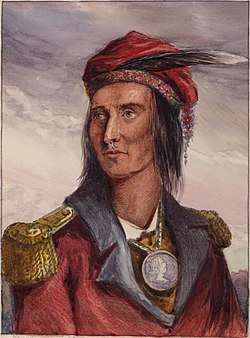
Image source: Tecumseh
Mar 1811
The Great Comet of 1811 appeared in March. Tecumseh later told several Native nations that the comet signaled his coming.
Aug 1811
Tecumseh met Harrison in August 1811 and assured him that the Shawnee intended to remain at peace with the United States.
Nov 6, 1811
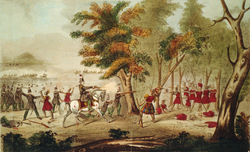
Harrison led approximately 1,000 men toward Prophetstown, Indiana, intending to disperse Tecumseh's confederacy.
Image source: Battle of Tippecanoe
Dec 11, 1811
The New Madrid earthquake shook Muscogee lands and much of the Midwestern United States.
Image source: 1811–1812 New Madrid earthquakes
1812 - 1815
The Shawnee conflict became part of the broader War of 1812 when open fighting broke out between American forces and the Red Stick faction of the Creek.
Image source: War of 1812
1813 - 1815
After Tecumseh's death and the end of the War of 1812, the Shawnee signed several treaties ceding land to the U.S. federal government.
Jan 22, 1813
A substantial detachment of Harrison's army was defeated by British and Native forces at Frenchtown along the River Raisin.
Image source: Battle of Frenchtown
May 1813
Procter and Tecumseh besieged Fort Meigs in northern Ohio during the War of 1812.
Image source: Siege of Fort Meigs
Sep 10, 1813
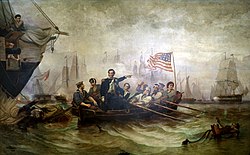
Master Commandant Oliver Hazard Perry defeated a British squadron at the Battle of Lake Erie.
Image source: Battle of Lake Erie
Oct 5, 1813
Harrison's invasion of Upper Canada culminated in an American victory at the Battle of the Thames.
Image source: Battle of the Thames
1817
The Ohio Shawnee ceded their remaining lands in exchange for reservations at Wapaughkonetta, Hog Creek, and Lewistown.
1825
After Missouri joined the Union, a treaty led to the forced relocation of approximately 1,400 Missouri Shawnee from Cape Girardeau to southeastern Kansas near the Neosho River.
1825
Through the Treaty of Lewistown, the Shawnee and Seneca agreed to exchange western Ohio lands for territory west of the Mississippi River in what later became Indian Territory.
1826
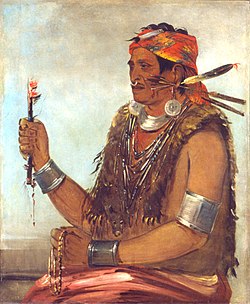
Around 200 Ohio Shawnee who followed the prophet Tenskwatawa joined their Kansas relatives in the area that later became Indian Territory.
Image source: Tenskwatawa
1830 - 1900
Under the 1830 Indian Removal Act, the United States removed the Shawnee to lands west of the Mississippi River, later associated with Missouri, Kansas, and Texas.
Image source: Indian Removal Act
Jul 1831
The Lewistown group of Seneca–Shawnee departed for Indian Territory, in present-day Kansas and Oklahoma, under terms negotiated largely by interpreter Joseph Parks.
1833
By 1833, only Black Bob's band of Shawnee continued to resist removal.
1839
Although allied with the Cherokee led by The Bowl, Shawnee chief John Linney remained neutral during the 1839 Cherokee War.
1850
Historian Henry Harvey described the Shawnee as ruled by kings or sachems who succeeded to office through a matrilineal line.
1853
The Indian Appropriations Bill allocated $64,366 for Shawnee treaty obligations, including annuities, education, and other services.
1935
A 1935 study reported that the Shawnee consisted of five septs and six clans or name groups based on kinship.
1970 - 1999
In the late 20th century, the Loyal or Cherokee Shawnee began a movement seeking federal recognition as a tribe independent of the Cherokee Nation.
1979 - 1980
The Ohio legislature held hearings in 1979 and 1980 regarding state recognition of the United Remnant Band.
1980
The 113th Ohio General Assembly adopted a joint resolution recognizing the Shawnee Nation United Remnant Band.
2002
In 2002, Shawnee, an Algonquian language, was in decline but was still spoken by approximately 200 people.
2008
In 2008, there were 7,584 enrolled Shawnee, with the majority living in Oklahoma.
2017
Shawnee language advocates, including tribal member George Blanchard, estimated that fewer than 100 people spoke the language.
Jun 7, 2024
Great Council State Park opened at the former Shawnee town of Old Chillicothe in Greene County, Ohio, with participation from the three federally recognized Shawnee tribes.
Or browse the full history timeline directory, with more than 2,500 topics.
This Shawnee History timeline was generated with the help of AI, using information found on the internet.
We work hard to keep these timelines accurate, but mistakes do get through. If you spot one, email us at [email protected] and we'll fix it for future visitors.
Generate yours with AI or build it from scratch, for free.
Export your timeline, add your own events, edit or remove AI-generated events, and much more
No credit card required.
Cancel anytime.
Cancel anytime.
You can create an unlimited number of timelines with up to 10 events on each one, customize how they look, export them to PDF, PNG, PowerPoint, CSV, and Excel, and share them with a link. Paid plans raise the event limit and add features like spreadsheet imports and collaborators.
Yes. You can cancel your subscription from your account page at any time, and you will not be charged again. Your subscription stays active for the rest of the period you already paid for.
Yes. We will email you a reminder before the annual renewal, and we will also email you a receipt.
Yes. You can email us within 15 days of any payment, and we will issue you a full refund.
Check out our pricing docs or send us an email anytime: [email protected].