
-
Use Cases
-
Resources
-
Pricing
The Neolithic Revolution, also known as the Agricultural Revolution, was the widespread transition of human societies from nomadic hunting and gathering to agriculture and settlement. Beginning around 10,000 BCE in the Fertile Crescent, it led to the domestication of plants and animals, permanent villages, population growth, social stratification, and ultimately the rise of civilizations. More Less
10000 BCE - 8000 BCE
% complete
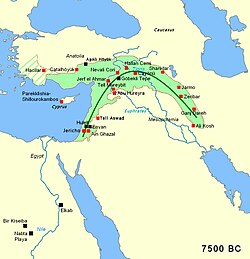
The beginning of the Neolithic transition in different regions has been dated from 10,000 to 8,000 BCE in the Fertile Crescent, where hunter-gatherer communities first began cultivating plants and domesticating animals, marking one of the earliest shifts from foraging to farming anywhere in the world.
Image source: Neolithic Revolution
10000 BCE
% complete
Domestication was a slow process that unfolded across multiple regions, and it was preceded by centuries if not millennia of pre-domestication cultivation, during which communities managed wild plants long before fully domesticated varieties emerged.
Image source: Domestication
9400 BCE
% complete
Selectively propagated figs, wild barley and wild oats were cultivated at the early Neolithic site of Gilgal I, where in 2006 archaeologists found caches of seeds of each in quantities too large to be accounted for even by intensive gathering.
Image source: Gilgal
7000 BCE
% complete
Once agriculture started gaining momentum, around 9000 BP, human activity resulted in the selective breeding of cereal grasses, beginning with emmer, einkorn and barley, favouring plants that offered greater caloric returns through larger seeds.
7000 BCE
% complete
Among the first cereal grasses subject to selective breeding around 9000 BP was emmer wheat, as farmers favoured plants with larger seeds and greater caloric returns, gradually transforming wild grasses into productive domesticated crops.
Image source: Emmer
7000 BCE
% complete
Einkorn wheat was among the earliest cereals selectively propagated by Neolithic farmers around 9000 BP, part of a broader process in which human activity reshaped wild grasses into high-yield domesticated staples.
Image source: Einkorn
7000 BCE
% complete
Barley was one of the founding crops of selective cereal breeding around 9000 BP, cultivated alongside emmer and einkorn as early agriculturalists selected for larger seeds and greater caloric returns.
Image source: Barley
8500 BCE
% complete
The prehistoric site of Mehrgarh in Baluchistan (modern Pakistan) is the earliest Neolithic site in the north-west Indian subcontinent, dated as early as 8500 BCE, representing an early centre of farming in South Asia.
Image source: Mehrgarh
8000 BCE
% complete
The beginning of agricultural practices has been dated to perhaps 8000 BCE at the Kuk Early Agricultural Site of Papua New Guinea in Melanesia, demonstrating that plant cultivation arose independently outside the Fertile Crescent.
Image source: Kuk Swamp
7000 BCE
% complete
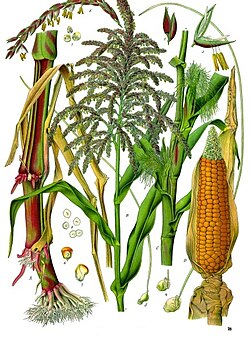
Maize (corn) was among the earliest crops domesticated in Mesoamerica, with its domestication beginning about 7000 BCE, laying the foundation for one of the world's great independent centres of agricultural origin.
Image source: Maize
6500 BCE - 5500 BCE
% complete
The earliest Neolithic site in South Asia is Mehrgarh, dated to between 6500 and 5500 BCE in the Kachi plain of Balochistan, Pakistan; the site has evidence of farming (wheat and barley) and herding (cattle, sheep and goats).
6000 BCE
% complete
Squash was among the earliest crops domesticated in Mesoamerica, cultivated as early as 6000 BCE alongside maize and beans in a trio of staples that would sustain complex Mesoamerican societies.
Image source: Cucurbita
5500 BCE
% complete
The earliest evidence of cheese-making dates to 5500 BCE in Kujawy, Poland, showing that dairying technology had developed among Europe's early farming communities.
Image source: History of cheese
4000 BCE
% complete
Beans were among the earliest crops domesticated in Mesoamerica, domesticated no later than 4000 BCE, completing the classic maize-beans-squash cropping system of the region.
Image source: Bean
2500 BCE
% complete
In what is now the eastern United States, Native Americans domesticated sunflower, sumpweed and goosefoot c. 2500 BCE, establishing an independent centre of plant domestication in North America.
Image source: Eastern Agricultural Complex
8000 BCE - 1900 CE
% complete
Average height for Europeans went down from 178 centimetres for men and 168 centimetres for women to 165 and 155 centimetres respectively, and it took until the twentieth century for average height to return to pre-Neolithic Revolution levels.
2000 BCE - 500 CE
% complete
According to bioarchaeological research, the effects of agriculture on dental health in Southeast Asian rice farming societies from 4000 to 1500 BP were not detrimental to the same extent as in other world regions.
6500 BCE - 4000 BCE
% complete
The diffusion of the Neolithic across Europe, from the Aegean to Britain, took about 2,500 years (8500–6000 BP), as farming gradually replaced hunting and gathering across the continent.
6500 BCE
% complete
Remains of food-producing societies in the Aegean have been carbon-dated to c. 6500 BCE at Knossos, Franchthi Cave, and a number of mainland sites in Thessaly, marking the arrival of farming in Europe.
Image source: Aegean Sea
3500 BCE
% complete
The Baltic region was penetrated a bit later than most of Europe, around 5500 BP, reflecting the uneven pace at which the Neolithic way of life spread into northern Europe.
3500 BCE
% complete
Alongside the later penetration of the Baltic, there was also a delay in settling the Pannonian plain, illustrating how geography shaped the variable pace of the Neolithic expansion across Europe.
Image source: Pannonian Basin
3000 BCE
% complete
Bellwood (2011) proposes that population pressure from agriculture may have been the impetus of the Austronesian expansion, which started with the migration of Austronesian-speakers from Taiwan to the Philippines at around 5,000 BP.
Image source: Austronesian peoples
1908
% complete
The Oasis Theory, originally proposed by Raphael Pumpelly in 1908, suggested that desiccation forced humans and animals together around oases, prompting the close association that led to domestication.
Image source: Neolithic Revolution
1928
% complete
V. Gordon Childe popularized the Oasis Theory in 1928, arguing that climate change drew humans, plants and animals together at water sources, catalysing the origins of agriculture in the Near East.
1936
% complete
Gordon Childe's book Man Makes Himself (1936) summarized his thinking on the Neolithic Revolution, framing the shift to farming as a fundamental transformation in human history and cementing the term's place in archaeology.
Image source: David Makes Man
1948
% complete
The Hilly Flanks hypothesis, proposed by Robert John Braidwood in 1948, suggests that agriculture began in the hilly flanks of the Taurus and Zagros Mountains, where fertile land supported a variety of plants and animals amenable to domestication, contrary to Childe's drier-climate scenario.
Image source: Fertile Crescent
1952
% complete
In 'Agricultural Origins and Dispersals', Carl Sauer suggested as early as 1952 that Southeast Asia was a centre of early agriculture, a view later supported by archaeological discoveries in the region.
1973
% complete
In 1973, Ammerman and Cavalli-Sforza discovered a linear relationship between the age of an Early Neolithic site and its distance from the conventional source in the Near East (Jericho), demonstrating that the Neolithic spread at an average speed of about 1 km/yr.
Image source: Great tit
2003
% complete
Archaeological research in 2003 suggested that in some regions, such as the Southeast Asian peninsula, the transition from hunter-gatherer to agriculturalist was not linear, but region-specific, complicating simple models of the Neolithic Revolution.
2005
% complete
More recent studies in 2005 confirmed Ammerman and Cavalli-Sforza's results, yielding a spread speed of 0.6–1.3 km per year at a 95% confidence level for the Neolithic expansion out of the Near East.
Or browse the full history timeline directory, with more than 2,000 topics.
This Neolithic Revolution timeline was generated with the help of AI, using information found on the internet.
We work hard to keep these timelines accurate, but mistakes do get through. If you spot one, email us at [email protected] and we'll fix it for future visitors.
Generate yours with AI or build it from scratch, for free.
Export your timeline, add your own events, edit or remove AI-generated events, and much more
No credit card required.
Cancel anytime.
Cancel anytime.
You can create an unlimited number of timelines with up to 10 events on each one, customize how they look, export them to PDF, PNG, PowerPoint, CSV, and Excel, and share them with a link. Paid plans raise the event limit and add features like spreadsheet imports and collaborators.
Yes. You can cancel your subscription from your account page at any time, and you will not be charged again. Your subscription stays active for the rest of the period you already paid for.
Yes. We will email you a reminder before the annual renewal, and we will also email you a receipt.
Yes. You can email us within 15 days of any payment, and we will issue you a full refund.
Check out our pricing docs or send us an email anytime: [email protected].