-
Use Cases
-
Resources
-
Pricing
Operation Market Garden was a bold Allied military operation conducted in the Netherlands during World War II. Launched on 17 September 1944, it combined a massive airborne assault (Market) with an armored ground offensive (Garden) to secure key bridges over the Rhine, allowing Allied forces to bypass German defenses and advance into Germany's Ruhr industrial region. Despite initial successes, the operation failed to capture the final bridge at Arnhem and was halted on 25 September 1944. More Less
Nov 1943
% complete
After the war it was found that the Royal Corps of Signals was either unaware or failed to tell divisional signals of the communication problems identified in November 1943 due to sun spots by the Scientific Advisor's Office to the 21st Army Group, contributing to radio failures at Arnhem.
1944
% complete
The planned route crossed the Waal river by a new bridge to Lent, and traversed the open cultivated plain to the lower Rhine through flat open fields lined with deep ditches and small scattered orchards near the villages.
1944
% complete
Urquhart's claim that the terrain difficulties were known ahead of time was corroborated by the 21st Army Group report written in 1944, which noted that the old road via Elst varied from 20 ft to 40 ft in width.
Apr 1944
% complete
There was a reason for this caution: Britain's spy network in the Netherlands had been thoroughly compromised — the so-called Englandspiel, which had only been discovered in April 1944; therefore British intelligence took pains to minimise all civilian contact with the resistance.
Aug 1944
% complete
In August 1944, following the Allied breakout from Normandy and the closure of the Falaise Pocket, the Allied armies pursued the retreating German army, expelling it from nearly all of France and Belgium, setting the stage for an ambitious advance into the Netherlands.
Sep 1944
% complete
General Gavin gave his division's most important tasks (Groesbeek ridge and Nijmegen) to the 508th PIR rather than his best regiment, Tucker's 504th PIR. In 1975, O'Connor also admitted that Adair 'was not really a flyer,' reflecting doubts about some command decisions.
Sep 1944
% complete
They gathered 9,000 engineers, the bridging assets of 21st Army Group and XXX Corps and its three divisions, and an additional 2,000 truckloads of equipment from elsewhere in the theatre to support the ground advance.
Sep 1944
% complete
At I Airborne Corps HQ, intelligence officer Major Brian Urquhart unsuccessfully argued against the 'unbelievable notion that once the bridges were captured, XXX Corps's tanks could drive up this abominably narrow corridor—which was little more than a causeway—and then walk into Germany like a bride into a church.'
Sep 1944
% complete
During the battle, the Army Group B war diary recorded larger numbers than Schwalbe's account: 82,000 troops, 530 guns, 4,600 vehicles, and over 4,000 horses evacuated across the Scheldt.
Image source: Operation Market Garden
Sep 2, 1944
% complete
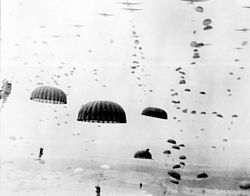
Field Marshal Montgomery initially suggested Operation Comet, a limited airborne coup de main operation that was to be launched on 2 September 1944, which later evolved into the much larger Operation Market Garden.
Sep 3, 1944
% complete
A more recent accounting found that the 9th SS Panzer Division had 6,380 men on 3 September and the 10th SS Panzer Division had 7,142 men in early September — forces that would oppose the Allies at Arnhem.
Sep 4, 1944 - Sep 23, 1944
% complete
A third accounting, based on the records of Sonderstab Knuth, the evacuation's naval command, claims that between 4 and 23 September, 89,707 troops, 645 guns, and 6,625 vehicles escaped across the Scheldt Estuary.
Sep 5, 1944 - Sep 21, 1944
% complete
Between 5 and 21 September, some 65,000 troops of the German Fifteenth Army with 225 guns, 750 trucks, and 1,000 horses escaped north across the Scheldt Estuary using a flotilla of commandeered freighters, barges, and small boats, strengthening German defenses in the Netherlands.
1946
% complete
These numbers of escaped German troops had been provided in 1946 by General Eugen-Felix Schwalbe, who had directed the army side of the evacuation across the Scheldt Estuary.
Sep 1944
% complete
During resupply flights over Arnhem, Flight Lieutenant David Lord continued flying his burning Dakota to deliver supplies to the surrounded paratroopers; he was killed when his aircraft crashed. Following the release of King from prison camp, full details became known.
Sep 1944
% complete
According to historian Rick Atkinson, this German bombing raid was 'the only large, long-range air strike by German bombers during the fall of 1944', targeting Allied positions during the battle.
Sep 1944
% complete
A squadron of Cromwells and two battalions of the 327th Glider Infantry Regiment reinforced the 502nd Parachute Infantry Regiment and defeated the Germans defending the Best bridge site and the Zonsche Forest, taking 1,100–1,400 prisoners and counting 300–600 German dead.
Sep 17, 1944
% complete
Operation Market Garden, an Allied military operation fought in the German-occupied Netherlands, began on 17 September 1944, combining a massive airborne landing ('Market') with a ground offensive by XXX Corps ('Garden').
Sep 17, 1944
% complete
At one drop zone, 1,003 men arrived and casualties during the drop and later that day amounted to five killed and 25 wounded, illustrating the relatively light losses suffered during the initial landings.
Sep 20, 1944
% complete
On September 20, 1944, the 504th Parachute Infantry Regiment of the 82nd Airborne Division famously crossed the river Waal at Nijmegen in canvas boats under heavy fire as part of Market Garden, securing the bridge.
Sep 25, 1944
% complete
Operation Market Garden ended on 25 September 1944 without achieving all its objectives; the Allies failed to secure the final bridge over the Rhine at Arnhem, and the remnants of the British 1st Airborne Division were withdrawn.
Sep 26, 1944 - Oct 21, 1944
% complete
The Germans rounded up most of those left behind after the withdrawal, but some British and Polish paratroopers managed to avoid capture and were sheltered by the Dutch underground until they could be rescued.
Oct 1944
% complete
Lindemans (known as 'King Kong'), suspected of betraying the operation's plans to the Germans, was arrested in October 1944 but committed suicide in his cell in 1946 while awaiting trial.
Image source: Christiaan Lindemans
Oct 22, 1944
% complete
On 22 October 1944, Operation Pegasus rescued the British and Polish paratroopers who had been sheltered by the Dutch underground, bringing them back across the Rhine to Allied lines.
Image source: Operation Pegasus
Nov 1944 - May 1945
% complete
A consequence of the operation's failure was the Dutch famine of 1944–45, also known as the 'Hunger Winter', which caused great suffering among the civilian population of the occupied western Netherlands.
Image source: Dutch famine of 1944–1945
Feb 1945
% complete
In February 1945, Allied forces in Operation Veritable advanced from the Groesbeek heights which had been taken during Market Garden, and into Germany, crossing the Rhine in March during Operation Plunder.
Image source: Operation Veritable
Apr 12, 1945 - Apr 14, 1945
% complete
As a result of Operation Plunder, the city of Arnhem was finally liberated by I Canadian Corps on 14 April 1945 after two days of fighting, nearly seven months after the failure of Market Garden.
1948
% complete
In 1948, Eisenhower wrote that 'The attack began well and unquestionably would have been successful except for the intervention of bad weather.' He had been isolated at SHAEF HQ at Granville, which lacked radio or telephone links, so his staff were largely ignorant of details of the operation.
1969
% complete
In 1969, the French journalist and historian Anne Laurens concluded that Lindemans had been a double agent, adding weight to the theory that intelligence leaks contributed to the failure at Arnhem.
Oct 8, 1945
% complete
On 8 October 1945, the US 82nd Airborne Division was awarded the Knights 4th class honour by HM Queen Wilhelmina of the Netherlands, and the division was also allowed to add 'Nijmegen 1944' to her battle honors.
Image source: 82nd Airborne Division
Nov 13, 1945
% complete
Following the release of King from prison camp, full details of the action became known and David Lord received a posthumous Victoria Cross on 13 November 1945, the only VC awarded to any member of Transport Command during the Second World War.
1946
% complete
The first film about the battle, Theirs Is the Glory, was made in 1946, and mixed original footage from the battle with reenactments shot on location in Arnhem, using many veterans of the actual battle.
1948 - Dec 17, 1977
% complete
The original Arnhem road bridge was destroyed in the battle and replaced with a bridge of similar appearance in 1948; it was renamed John Frost Bridge (John Frostbrug) on 17 December 1977, honoring the commander of the defenders at the bridge.
Image source: John Frost Bridge
May 1949
% complete
In May 1949, the Dutch Government awarded Harry King, who survived Lord's crash and captivity, the Netherlands Bronze Cross for his part in the resupply actions over Arnhem.
1977
% complete
The second major film about the operation, A Bridge Too Far, was released in 1977 based on the 1974 book of the same name by Cornelius Ryan, bringing the story of Operation Market Garden to a worldwide audience.
Image source: A Bridge Too Far (film)
Sep 16, 1994
% complete
On 16 September 1994, 101st Airborne veterans unveiled a 'Monument for the Dutch' in Sint-Oedenrode, honoring the Dutch civilians who supported the American paratroopers.
Sep 2004
% complete
It was officially opened in September 2004, during the festivities marking the 60th anniversary of the Liberation, serving as a memorial to the Battle of Arnhem.
Image source: Airborne Museum 'Hartenstein'
May 31, 2006
% complete
On 31 May 2006, HM Queen Beatrix awarded the Knights 4th class honour to the Polish 1st Independent Parachute Brigade, recognizing the brigade's sacrifice at Driel and Oosterbeek during the battle.
Image source: 1st Independent Parachute Brigade
Jun 23, 2009
% complete
A Commemorative Project plaque was unveiled on 23 June 2009, to commemorate the unique military and historical ties between Canada and the Netherlands forged during the liberation of the country.
Image source: Canada–Netherlands relations
2010
% complete
A hole, a par five, on the south course (Hylands Golf Course Uplands) in Ottawa, Ontario was named 'Arnhem', in honour of the Royal Canadian Artillery squadrons that took part in the allied airborne operation from 17 to 25 September 1944.
2013
% complete
In 2013 the city of Nijmegen completed construction of a city bridge exactly where the 82nd Division crossed the river Waal on September 20, 1944. The bridge and road bear the name 'De Oversteek' (The Crossing), in memory of the 504th Parachute Infantry Regiment's crossing.
Image source: De Oversteek
Oct 19, 2014
% complete
Each day since October 19, 2014, as a daily tribute, a veteran walks the so-called Sunset March across the bridge at sunset while the 48 lights are lit one by one, commemorating the crossing of the Waal.
Or browse the full history timeline directory, with more than 2,000 topics.
This Operation Market Garden timeline was generated with the help of AI, using information found on the internet.
We work hard to keep these timelines accurate, but mistakes do get through. If you spot one, email us at [email protected] and we'll fix it for future visitors.
Generate yours with AI or build it from scratch, for free.
Export your timeline, add your own events, edit or remove AI-generated events, and much more
No credit card required.
Cancel anytime.
Cancel anytime.
You can create an unlimited number of timelines with up to 10 events on each one, customize how they look, export them to PDF, PNG, PowerPoint, CSV, and Excel, and share them with a link. Paid plans raise the event limit and add features like spreadsheet imports and collaborators.
Yes. You can cancel your subscription from your account page at any time, and you will not be charged again. Your subscription stays active for the rest of the period you already paid for.
Yes. We will email you a reminder before the annual renewal, and we will also email you a receipt.
Yes. You can email us within 15 days of any payment, and we will issue you a full refund.
Check out our pricing docs or send us an email anytime: [email protected].