
-
Use Cases
-
Resources
-
Pricing
The Pax Romana, meaning 'Roman Peace,' was a long period of relative stability, minimal expansionist warfare, and flourishing trade, culture, and infrastructure throughout the Roman Empire. Initiated by Emperor Augustus after decades of civil war, it lasted roughly two centuries and allowed Rome's population to grow, its cities to prosper, and its laws and roads to knit the Mediterranean world together. More Less
Jan 1, 180 - Dec 31, 192
According to Cassius Dio, the dictatorial reign of Commodus marked the turning point after which Rome descended 'from a kingdom of gold to one of iron and rust,' ending the long era of stability that had defined the Pax Romana.
Image source: Commodus

Dec 31, 192
The assassination of Commodus ended the Nerva-Antonine dynasty and plunged Rome into succession chaos. Cassius Dio regarded Commodus's dictatorial reign as the pivotal moment when Rome descended from a kingdom of gold to one of iron and rust.
Jan 1, 193 - Dec 31, 193
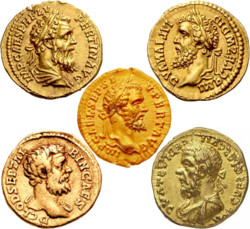
Following Commodus's assassination, five different men claimed imperial power in a single year, triggering civil war. Cassius Dio cited this turmoil, following the dictatorial rule of Commodus, as evidence of Rome's descent from gold to iron and rust.
Image source: Year of the Five Emperors
Jan 1, 235
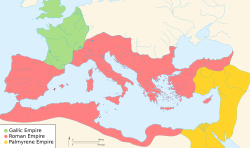
The Crisis of the Third Century brought near-collapse to the Roman Empire through civil war, invasion, plague, and economic instability. Cassius Dio's metaphor of Rome's descent 'from a kingdom of gold to one of iron and rust' encompassed this catastrophic era.
Image source: Crisis of the Third Century
Jan 1, 284
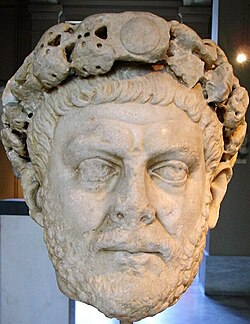
Diocletian's accession and reforms brought the Crisis of the Third Century to a close, ending the half-century of turmoil that Cassius Dio's 'iron and rust' metaphor came to symbolize as the aftermath of the Pax Romana.
Image source: Diocletian
Jan 1, 1300 - Dec 31, 1321
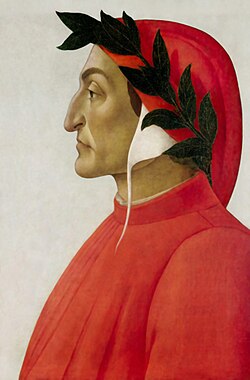
Dante wrote on the ideal of universal peace under a single monarch, an idea rooted in the memory of the Pax Romana. His works on the topic were later analyzed at the beginning of the twentieth century by William Mitchell Ramsay.
Image source: Dante Alighieri
Jan 18, 1871
As an example of internal imperial peace, the German Empire's imperial peace of 1871 over its internal components such as Saxony slowly evolved into the later unified German state, paralleling how Rome imposed internal peace on conquered peoples.
Jan 1, 1913
At the beginning of the twentieth century, William Mitchell Ramsay analyzed Dante's works on the theme of universal peace in his book The Imperial Peace: An Ideal in European History (1913), tracing the ideal of the Pax Romana through European intellectual history.
Image source: William Mitchell Ramsay

Jan 1, 1949
Inez Scott Ryberg published her influential 1949 study persuasively dating the third, undocumented closure of the Gates of Janus to 13 BC, linking it to the commissioning of the Ara Pacis under Augustus.
Image source: Inez Scott Ryberg

Jan 1, 2006
Gaius Stern, building on the work of Inez Scott Ryberg, published research in 2006 that persuasively dated the third closure of the Gates of Janus to 13 BC, reinforcing the connection between that event and the Ara Pacis.
This Pax Romana timeline was generated with the help of AI, using information found on the internet.
We work hard to keep these timelines accurate, but mistakes do get through. If you spot one, email us at [email protected] and we'll fix it for future visitors.
Generate yours with AI or build it from scratch, for free.
