-
Use Cases
-
Resources
-
Pricing
Jan 12, 1848
% complete
A popular uprising began in Palermo against Bourbon rule in the Kingdom of the Two Sicilies. The revolt demanded a constitution and restored the separate political identity of Sicily, helping ignite the wider European revolutionary wave.
Image source: Sicilian revolution of 1848
Jan 12, 1848 - Jan 30, 1848
% complete
Palermo insurgents fought Neapolitan forces and forced the Bourbon government to withdraw from much of the city. The success encouraged constitutional and national movements elsewhere in Italy.
Feb 14, 1848
% complete
Pope Pius IX promulgated a constitution for the Papal States, creating representative institutions while retaining papal sovereignty. The concession reflected mounting liberal pressure across the Italian peninsula.
Image source: Papal States
Mar 4, 1848
% complete
King Charles Albert granted the Statuto Albertino, a constitutional charter for Piedmont-Sardinia. It became the constitutional foundation of the Kingdom of Italy after unification.
Mar 18, 1848 - Mar 22, 1848
% complete
Milanese citizens erected barricades and fought Austrian forces during a five-day insurrection. Field Marshal Radetzky withdrew from the city, allowing a provisional government to form.
Image source: Five Days of Milan
Mar 22, 1848
% complete
Daniele Manin proclaimed the Republic of San Marco in Venice after the Austrian garrison surrendered. The new republic became a major center of Italian resistance to Habsburg rule.
Mar 23, 1848 - Aug 22, 1848
% complete
Piedmont-Sardinia declared war on Austria, seeking to expel Habsburg forces from northern Italy. Initial enthusiasm and volunteer support gave way to Austrian victories and the restoration of imperial control.
Image source: First Italian War of Independence
Jul 22, 1848 - Jul 25, 1848
% complete
Austrian forces under Radetzky defeated the Piedmontese army at Custoza. The defeat forced Charles Albert to abandon Milan and retreat, weakening the first major military attempt to unify northern Italy.
Image source: Battle of Custoza (1848)
Nov 9, 1848
% complete
A constituent assembly was summoned in Rome amid conflict between Pope Pius IX and liberal nationalists. The political crisis initiated the process that would culminate in the proclamation of the Roman Republic in February 1849.
Nov 24, 1848
% complete
Pope Pius IX fled Rome for the Neapolitan fortress of Gaeta after the assassination of his prime minister and the collapse of papal authority in the capital. His departure accelerated the republican movement in the Papal States.
Feb 22, 1848 - Feb 24, 1848
% complete
Demonstrations and clashes erupted in Paris after the government banned a reform banquet. The crisis quickly became a republican insurrection against the July Monarchy.
Image source: French Revolution of 1848
Feb 24, 1848
% complete
King Louis Philippe I abdicated after losing political and military support during the Paris uprising. He fled to Britain, ending the July Monarchy and opening the way for a republic.
Image source: Louis Philippe I
Feb 24, 1848
% complete
A provisional government proclaimed the French Second Republic in Paris. It introduced universal male suffrage, abolished hereditary privilege, and promised political and social reform.
Image source: French Second Republic
Feb 25, 1848
% complete
Under pressure from workers, the provisional government created national workshops to provide employment for the unemployed. The program became a central symbol of the republic's effort to address the social question.
Apr 23, 1848
% complete
France held elections by universal male suffrage for a Constituent Assembly. Conservative and moderate republican forces won a strong position, disappointing socialist and radical activists.
Apr 27, 1848
% complete
The provisional government abolished slavery throughout French territories. The decree, associated with Victor Schœlcher, ended a colonial institution restored under Napoleon in 1802.
Jun 22, 1848 - Jun 26, 1848
% complete
Parisian workers revolted after the government closed the national workshops. General Louis-Eugène Cavaignac suppressed the insurrection in intense street fighting, marking a decisive rupture between social republicans and the conservative republic.
Nov 4, 1848
% complete
The Constituent Assembly adopted a republican constitution establishing a powerful elected presidency, a single legislative assembly, and universal male suffrage. Its structure shaped the subsequent presidential election and the Second Republic.
Mar 1, 1848 - Mar 10, 1848
% complete
Petitions, demonstrations, and assemblies across the German Confederation demanded constitutions, civil liberties, press freedom, and national unity. The movement transformed local unrest into a coordinated German political crisis.
Image source: German revolutions of 1848–1849
Mar 1, 1848 - Apr 1848
% complete
Radical opposition in the Grand Duchy of Baden mobilized around democratic and national demands. The state became one of the most important centers of revolutionary agitation in southwestern Germany.
Mar 5, 1848 - Mar 6, 1848
% complete
Liberal and democratic representatives met at Heidelberg to coordinate German constitutional politics. They selected a committee that proposed convening a nationwide representative body.
Mar 6, 1848 - Mar 19, 1848
% complete
Mass demonstrations in Berlin forced King Frederick William IV of Prussia to promise reforms and support German unification. Fighting between troops and protesters nevertheless produced hundreds of deaths.
Mar 9, 1848
% complete
The German Confederation responded to revolutionary pressure by promising reforms, including civil liberties and a national representative body. These concessions represented the first formal institutional response to the German March movement.
Image source: German Confederation
Mar 10, 1848
% complete
Liberal German politicians met at Heppenheim and discussed creating a national parliament through the German Confederation. Their plans helped prepare the institutional path toward the Frankfurt Parliament.
Mar 18, 1848 - Mar 19, 1848
% complete
Berlin insurgents built barricades and fought Prussian troops after a disputed royal announcement. The king withdrew the army from the city and publicly honored the dead, temporarily conceding to the revolution.
Mar 19, 1848
% complete
Frederick William IV appointed a liberal ministry led by Ludolf Camphausen. The government attempted to manage the revolutionary crisis through constitutional reform while preserving the monarchy.
Mar 20, 1848 - May 9, 1848
% complete
Polish national activists in the Prussian Grand Duchy of Posen organized for autonomy and national rights after the March Revolution. Prussian authorities initially negotiated but later crushed the movement.
Mar 31, 1848 - Apr 3, 1848
% complete
The preliminary parliament met at Frankfurt's St. Paul's Church to discuss German representation and national unity. It called for elections to a constituent national assembly, though disputes divided moderates and radicals.
May 18, 1848
% complete
The elected Frankfurt Parliament convened in St. Paul's Church as the first all-German national assembly. It sought to draft a constitution and determine the boundaries and political form of a unified Germany.
Image source: Frankfurt Parliament
Mar 13, 1848 - Mar 15, 1848
% complete
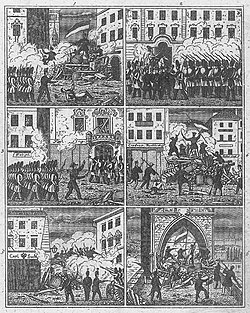
Students and citizens demonstrated in Vienna demanding constitutional government, press freedom, and ministerial reform. The uprising forced the resignation and flight of the influential conservative statesman Klemens von Metternich.
Image source: Revolutions of 1848 in the Austrian Empire
Mar 13, 1848
% complete
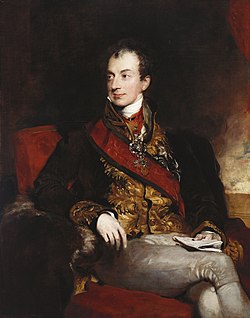
Klemens von Metternich resigned and fled to Britain after the Vienna uprising. His fall symbolized the collapse of the conservative European order established after the Congress of Vienna.
Image source: Klemens von Metternich
Mar 15, 1848 - Aug 13, 1849
% complete
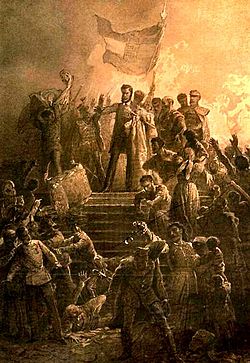
A mass movement in Pest, led politically by Lajos Kossuth and symbolically by Sándor Petőfi, demanded national autonomy, civil equality, and a responsible government. The movement developed into a war for Hungarian independence from the Habsburg monarchy.
Image source: Hungarian Revolution of 1848
Apr 11, 1848
% complete
Emperor Ferdinand I sanctioned the April Laws, which created a responsible Hungarian ministry, expanded political rights, ended feudal privileges, and established equality before the law. The legislation gave Hungary broad constitutional autonomy within the Habsburg lands.
Jun 2, 1848 - Jun 12, 1848
% complete
Representatives from Slavic communities met in Prague to debate cultural rights, federal reform, and relations with the Habsburg monarchy. The congress was cut short when violence erupted in the city.
Image source: Prague Slavic Congress, 1848
Jun 12, 1848 - Jun 17, 1848
% complete
Czech nationalists and radical democrats rose in Prague during the Pan-Slavic Congress. Austrian troops under Prince Alfred Windisch-Grätz bombarded the city and suppressed the uprising.
Oct 6, 1848 - Oct 31, 1848
% complete
Viennese revolutionaries resisted the dispatch of Austrian troops against Hungary and seized control of parts of the capital. Imperial forces recaptured Vienna after heavy fighting, ending the city's revolutionary phase.
Oct 31, 1848
% complete
Imperial troops under Alfred Windisch-Grätz entered Vienna and defeated the October insurgents. The victory restored Habsburg control and enabled a more forceful campaign against revolutionary movements in the empire.
Dec 2, 1848
% complete
Ferdinand I abdicated during the continuing revolutionary crisis and was succeeded by his eighteen-year-old nephew, Franz Joseph I. The change strengthened the dynasty's ability to pursue centralization and military repression.
Image source: Ferdinand I of Austria
Or browse the full history timeline directory, with more than 2,000 topics.
This Revolutions of 1848 timeline was generated with the help of AI, using information found on the internet.
We work hard to keep these timelines accurate, but mistakes do get through. If you spot one, email us at [email protected] and we'll fix it for future visitors.
Generate yours with AI or build it from scratch, for free.
Export your timeline, add your own events, edit or remove AI-generated events, and much more
No credit card required.
Cancel anytime.
Cancel anytime.
You can create an unlimited number of timelines with up to 10 events on each one, customize how they look, export them to PDF, PNG, PowerPoint, CSV, and Excel, and share them with a link. Paid plans raise the event limit and add features like spreadsheet imports and collaborators.
Yes. You can cancel your subscription from your account page at any time, and you will not be charged again. Your subscription stays active for the rest of the period you already paid for.
Yes. We will email you a reminder before the annual renewal, and we will also email you a receipt.
Yes. You can email us within 15 days of any payment, and we will issue you a full refund.
Check out our pricing docs or send us an email anytime: [email protected].