-
Use Cases
-
Resources
-
Pricing
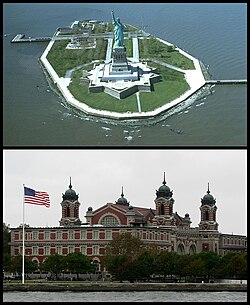
The Statue of Liberty is a colossal neoclassical copper statue designed by French sculptor Frédéric Auguste Bartholdi and engineered by Gustave Eiffel. A gift from the people of France to the United States commemorating liberty and Franco-American friendship, it stands on Liberty Island in New York Harbor. Dedicated in 1886, it became a welcoming beacon for millions of immigrants arriving by sea and remains one of the world's most recognizable symbols of freedom. More Less
1865
% complete
At a dinner near Versailles, French scholar Édouard René de Laboulaye proposed the idea of a monument commemorating American independence and the friendship between France and the United States, planting the seed for what would become the Statue of Liberty.
Image source: Statue of Liberty
1871
% complete
Sculptor Frédéric Auguste Bartholdi was tasked with designing the proposed monument. He traveled to America to promote the project, selecting Bedloe's Island in New York Harbor as the ideal site for the future statue.
Image source: Frédéric Auguste Bartholdi
1875
% complete
The Franco-American Union was established to raise funds for the statue, with France responsible for building the statue itself and the United States expected to provide the pedestal.
1883 - 1885
% complete
Fundraising for the pedestal lagged badly in the United States, prompting efforts like an auction of Bartholdi's models and a plea by Joseph Pulitzer in his newspaper The World, which raised over $100,000 from small donations.
1883
% complete
Poet Emma Lazarus wrote 'The New Colossus' for a fundraising auction, with its famous lines welcoming 'the tired, the poor' later becoming closely associated with the statue's symbolism.
Image source: The New Colossus
1875
% complete
Work began in Bartholdi's Paris workshop on the statue's head and torch-bearing arm, with copper sheets hammered over a wooden framework using repoussé techniques.
1876
% complete
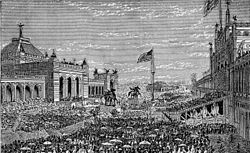
The completed right arm holding the torch was exhibited at the Centennial Exposition in Philadelphia to raise publicity and funds for the project.
Image source: Centennial Exposition
1878
% complete
The statue's head was displayed at the Paris World's Fair of 1878, drawing crowds and helping generate enthusiasm and financial support for the monument.
Image source: Exposition Universelle (1878)
1884
% complete
Engineer Gustave Eiffel took over structural design from Eugène Viollet-le-Duc, creating an iron framework that would allow the copper skin to move independently while supporting the statue against wind.
Image source: Gustave Eiffel
Jan 1884
% complete
The Statue of Liberty was fully assembled in Paris, standing outside Bartholdi's workshop, where it was viewed by thousands before being disassembled for shipping.
Jan 1885 - Jun 17, 1885
% complete
The statue was taken apart into 350 pieces packed in 214 crates and shipped aboard the French frigate Isère, arriving in New York Harbor after weathering rough seas during the voyage.
1886
% complete
Workers spent months reassembling the statue's copper sections onto the newly completed pedestal, connecting them to Eiffel's iron framework.
Apr 1886
% complete
Architect Richard Morris Hunt designed the granite pedestal, which was finally completed atop Fort Wood on Bedloe's Island after years of funding delays.
Oct 28, 1886
% complete
President Grover Cleveland presided over the dedication ceremony before thousands of spectators, with a massive parade through New York City and a naval salute marking the statue's official unveiling.
Nov 22, 1886 - 1902
% complete
The Lighthouse Board placed an electric light in the torch, making the statue a working lighthouse, though its light proved too weak to be effective as a navigational aid.
Jul 30, 1916
% complete
German saboteurs detonated munitions at the Black Tom pier in Jersey City, sending shrapnel into the statue and causing roughly $100,000 in damage, leading to restricted public access to the torch.
Image source: Black Tom explosion
1965
% complete
President Lyndon B. Johnson added Ellis Island, the historic immigration station, to the Statue of Liberty National Monument, linking the two symbols of American immigration.
Image source: Ellis Island
Sep 11, 2001
% complete
Following the September 11 terrorist attacks, the Statue of Liberty was closed to visitors due to security concerns, remaining shut for years before reopening in stages.
Image source: September 11 attacks
Aug 3, 2004
% complete
After nearly three years of closure, the statue reopened to the public with enhanced security measures, though the crown remained off-limits until 2009.
Jul 4, 2009
% complete
Interior Secretary Ken Salazar announced the reopening of the statue's crown, allowing limited numbers of visitors daily to climb to the top for panoramic views of New York Harbor.
May 16, 2019
% complete
A new 26,000-square-foot museum opened on Liberty Island, displaying the original 1886 torch, interactive exhibits, and artifacts telling the story of the statue's creation and legacy.
Image source: Statue of Liberty Museum
2020 - 2021
% complete
During the COVID-19 pandemic, Liberty Island and the statue operated under capacity limits and health protocols, gradually restoring fuller access as conditions improved.
1903
% complete
A bronze plaque bearing Emma Lazarus's sonnet 'The New Colossus' was mounted on the pedestal, cementing the poem's association with the statue as a symbol of welcome to immigrants.
1916
% complete
Sculptor Gutzon Borglum redesigned the torch, replacing the original copper flame with glass panes backed by electric lights, following damage concerns and leaks in the original arm.
Image source: Gutzon Borglum
Oct 15, 1924
% complete
President Calvin Coolidge declared the Statue of Liberty a national monument under the Antiquities Act, formally protecting it as a symbol of national significance.
Image source: Statue of Liberty National Monument
1933
% complete
Administration of the Statue of Liberty was transferred from the War Department to the National Park Service, beginning its modern era as a protected national monument.
Image source: National Park Service
1984
% complete
The United Nations Educational, Scientific and Cultural Organization inscribed the Statue of Liberty as a World Heritage Site, recognizing its outstanding universal value as a symbol of freedom and democracy.
Image source: List of World Heritage Sites in the United States
1984 - Jul 5, 1986
% complete
A comprehensive restoration replaced the corroded original torch with a new copper flame covered in 24-karat gold leaf, repaired the iron framework, and reworked the copper skin, closing the statue to visitors during the work.
Jul 4, 1986 - Jul 6, 1986
% complete
The restored Statue of Liberty was rededicated during Liberty Weekend, featuring President Ronald Reagan, fireworks, tall ships, and celebrations attended by millions marking the statue's centennial.
Image source: Liberty Weekend
2018 - 2019
% complete
The old museum inside the statue's pedestal was closed and its collections moved to the new museum, allowing improved visitor circulation and preservation of the historic structure.
Or browse the full history timeline directory, with more than 2,000 topics.
This Statue of Liberty timeline was generated with the help of AI, using information found on the internet.
We work hard to keep these timelines accurate, but mistakes do get through. If you spot one, email us at [email protected] and we'll fix it for future visitors.
Generate yours with AI or build it from scratch, for free.
Export your timeline, add your own events, edit or remove AI-generated events, and much more
No credit card required.
Cancel anytime.
Cancel anytime.
You can create an unlimited number of timelines with up to 10 events on each one, customize how they look, export them to PDF, PNG, PowerPoint, CSV, and Excel, and share them with a link. Paid plans raise the event limit and add features like spreadsheet imports and collaborators.
Yes. You can cancel your subscription from your account page at any time, and you will not be charged again. Your subscription stays active for the rest of the period you already paid for.
Yes. We will email you a reminder before the annual renewal, and we will also email you a receipt.
Yes. You can email us within 15 days of any payment, and we will issue you a full refund.
Check out our pricing docs or send us an email anytime: [email protected].